
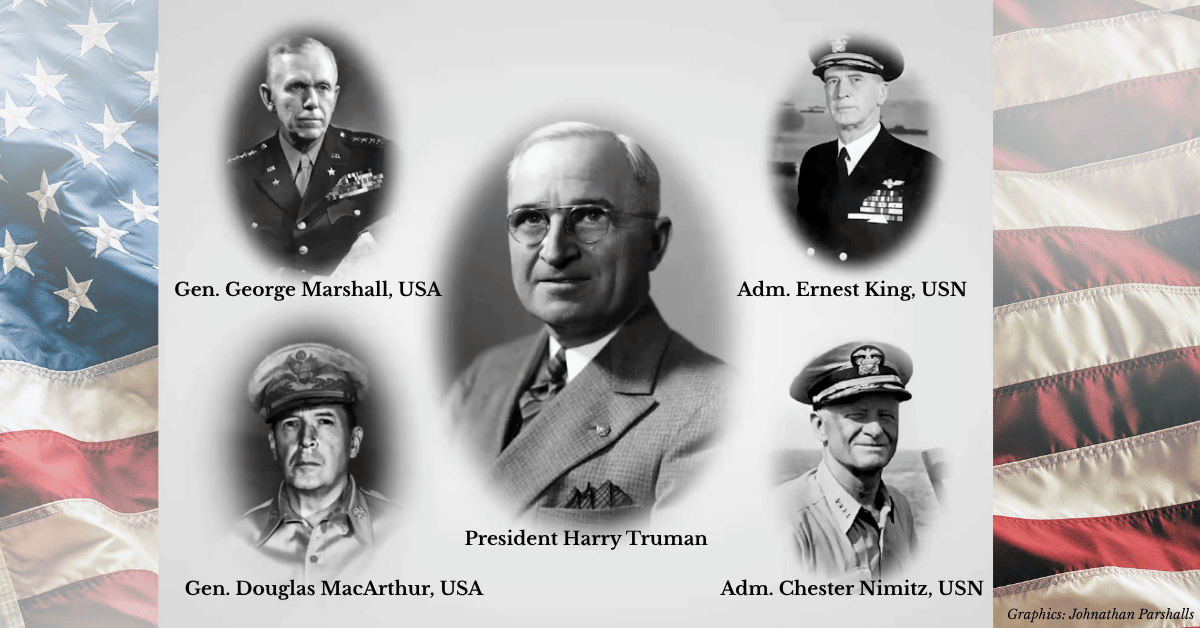
It is time to introduce the key figures “behind the curtain” of the United States. Apart from the human and political intrigue native to any human enterprise, the chain of command was clear. In wartime, the President of the United States was the “Commander in Chief.” He possessed the unilateral power to make decisions, was active in soliciting discussion, and most often took the advice of his military leaders. But it was clear that the “buck” stopped on the desk of the President.
The American operational leadership of the Asia-Pacific war effort was established and consistent from the inception of war to its conclusion in 1945.
- General George Marshall, Chief of Staff of the Army
- General Douglas MacArthur, Supreme Commander – Southwest Pacific Area
- Admiral Ernest King, Chief of Naval Operations
- Admiral Chester Nimitz, Commander in Chief, US Pacific Fleet and Commander in Chief, Pacific Ocean Areas.
By 1945, once the B-29 arrived in the Pacific theatre, leadership also included General ‘Hap’ Arnold, Commander of Army Air Forces.
With the death of President Roosevelt on April 12, 1945, the Commander-in-Chief was President Harry S. Truman, a combat veteran of the First World War where he served as captain of an Army artillery battery, seeing action in the Meuse–Argonne offensive. Before mustering out at the end of the war he had achieved the rank of Major.
Other key members of President Truman’s circle included:
- Adm. William Leahy, Chief of Staff to the President/Commander-in-Chief (as he had been for Roosevelt)
- Secretary of State – James F. Byrnes (for the last months of the war)
- Secretary of War – Henry L. Stimson
- Secretary of the Navy – James V. Forrestal
The Joint Chiefs of Staff (JCS) was composed of Leahy, Marshall, King, and Arnold. Leahy, as Roosevelt’s senior military advisor, chaired JCS meetings. He was the de facto “first among equals” and the president’s closest military aide. This role continued under the Truman administration.
American Leadership and Unconditional Surrender
Truman inherited Roosevelt’s “unconditional surrender” commitment, first announced at Casablanca in 1943. He was initially cautious about appearing to back away from the commitment of the recently deceased President, especially since public opinion equated “unconditional surrender” with total victory.
Among civilian leaders, Secretary of War Stimson was perhaps the most prominent cabinet officer urging modification. He believed insisting on “unconditional surrender” without clarifying the emperor’s fate could prolong the war unnecessarily and cost more lives. In memoranda during summer 1945, he pressed Truman to consider offering assurances that Japan could retain the imperial institution, even under Allied control.
Acting Secretary of State (until June 1945), Joseph Grew, former Ambassador to Japan and thus deeply familiar with kokutai of Japan, strongly argued that the emperor was essential to any surrender. He repeatedly warned Truman that trying to abolish the imperial institution could stiffen Japanese resistance. Grew’s view was that clarifying “unconditional surrender” to allow retention of the emperor would end the war sooner.
Secretary of State Byrnes was more skeptical. Byrnes worried that “softening” unconditional surrender would look like appeasement, both domestically and to the Soviets. He was influential at Potsdam in keeping the surrender terms harder, though he eventually agreed to language (in the Potsdam Declaration) that left Japan’s postwar government “subject to the will of the Japanese people.”
One might assume that the military leadership would have been “hard core” so to speak, seeking absolute victory – e.g. Admiral Bull Halsey, a frequent source of front page news and quotes. But the key leaders were more circumspect. Army Chief of Staff Marshall generally supported Roosevelt and Truman’s policy of unconditional surrender but was pragmatic. He listened to Stimson and others who thought clarifying the emperor’s role might hasten surrender. His priority was avoiding an invasion if possible, and he was open to modifications that would prevent massive casualties.
JSC “Chairman” Leady, a fleet admiral with diplomatic postings in France, Haiti, and Puerto Rico, opposed the harsh, “unconditional” language of Potsdam. Like Grew and Stimson, he believed Japan would fight to the last unless the emperor was preserved. He thought U.S. insistence on unconditional surrender would prolong the war and lead to needless bloodshed. He too sought to avoid an invasion if possible.
Chief of Naval Operations King was more hardline than Leahy, but not as vocal on surrender policy. His focus was on defeating Japan militarily as a first step to surrender. MacArthur strongly opposed unconditional surrender in its strictest sense. MacArthur believed the emperor should be retained to secure rapid surrender and postwar stability. Nimitz thought Japan could be persuaded to surrender if they were assured the emperor would remain. Of all the operational commanders, Nimitz was the lone voice fully opposed to an invasion of Japan because of the cost in allied lives. He believed continued bombing and blockade would achieve the desired end.
The Potsdam Declaration (July 26, 1945) deliberately left the emperor issue vague. After Japan’s acceptance, Truman allowed the Japanese to retain the throne under the MacArthur-led occupation authority — essentially the compromise Stimson, Grew, and Leahy had wanted all along.
Image credit: various photographs from Naval Aviation Museum, National World War II Museum, and US Navy Archives. The “Big Fve” image credit – Jonathan Parshalls’ online presentation.
Discover more from friarmusings
Subscribe to get the latest posts sent to your email.

