
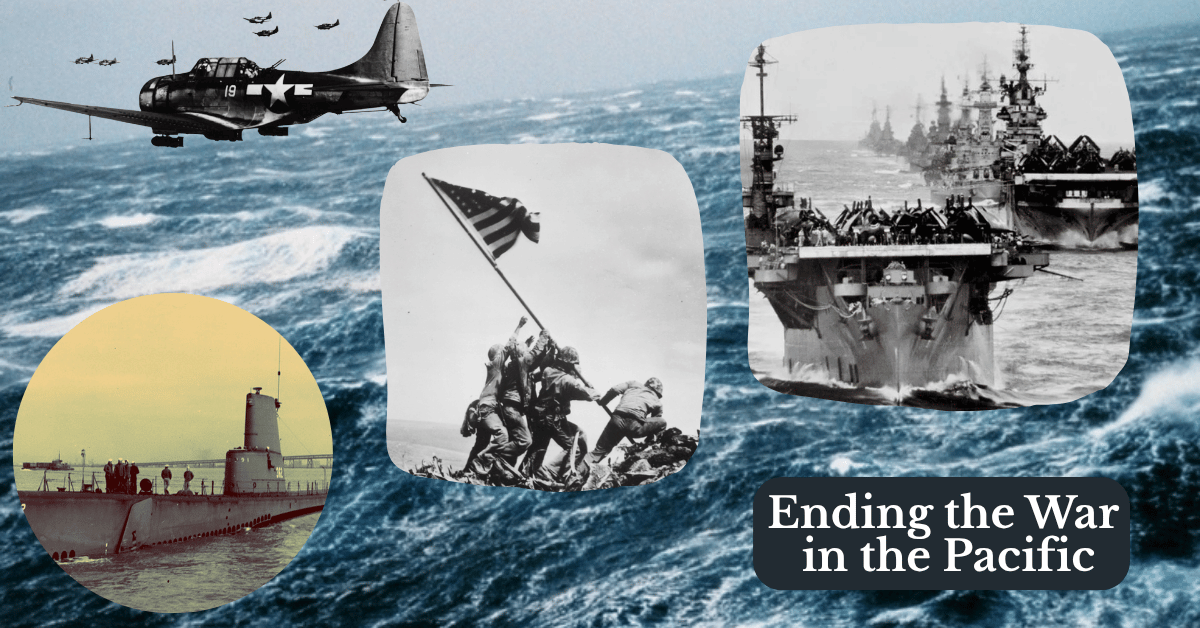
The preliminary planning for Operation Downfall – the invasion of the Japanese home islands of Kyushu and Honshu – began in the waning months of 1944. These were preliminary plans at best and were secondary to battle planning for Leyte, Luzon, Iwo Jima, Okinawa and the naval aircraft carrier raids on Formosa, as well as the massive logistics planning to support all the amphibious landings.
By April 1945 only the amphibious landings at Okinawa remained – the other islands had been secured, although scattered actions continued on Luzon until the end of the war. It was at this point that area commanders (Nimitz and McArthur) were ordered to develop detailed, actionable plans for the invasion of the southern island of Kyushu (Operation Olympic). As noted in the previous post there were multiple planning units that were providing estimates. The operations and logistics details were massive, but each unit knew the “hard question” would be their estimates of allied casualties for Operation Olympic.
But that question depended on their battle plan/order of battle and intelligence estimates of enemy troop strength and deployment. As will be made clear in subsequent posts, all the above was a moving target that was being shaped by a range of factors from the concrete and measurable to the personal and not quantifiable. The first phase of planning occurred in the Pacific theatre of operation from Nimitz’s and MacArthur’s operations group. This planning phase (and its iterations) lasted until May 25, 1945 at which point the Joint Chiefs of Staff (JCS) issued a formal directive to Nimitz, MacArthur, and Arnold, instructing them to begin detailed planning for Operation Olympic. We’ll come back to that date.
Rather than describe the basic plan, the iterations, updates, and changes that occurred in the first 5 months of the year, perhaps it is somewhat easier to describe the Operations Olympic plan at the end of July.
Downfall Details
Operation Downfall planned for the amphibious invasion of the Japanese home islands: the southern island of Kyushu (Operation Olympic) in Nov 1945 and the main island of Honshu (Operation Coronet) in March 1946. The intent of Operation Downfall was to invade, occupy, and bring about the unconditional surrender of Japan within 18 months of the surrender of Germany. Planning was difficult tactically, but would also be a problem of manpower and public relations.
The surrender of Germany did not suddenly “free up” forces to shift to the Asia-Pacific front. Post-war Germany and Austria required garrison troops, a task shared by the U.S., Britain, the Soviets, and France. Other European countries and territories (e.g. Danzig and East Prussia) had garrison troops but largely these did not require large numbers of U.S. forces. All-in-all the U.S. committed 1.9 million troops to garrison duty by July 1945. At the same time, 1.5 million troops were to be transferred to the Pacific. However, almost 1 million troops – the most experienced combat leaders and veterans – were being sent home and discharged from active duty.
American political and military leaders understood that war fatigue in the American homefront was becoming increasingly clear. The Japanese had always asserted that high casualties were the Allies’ strategic vulnerability. And they weren’t wrong. Apart from Pearl Harbor, overall U.S. casualties were relatively light in 1942. This changed in mid-1944 with the invasion of Normandy and the Marianas, the Battle of the Bulge, the campaign in the Philippines, Iwo Jima, and Okinawa. By late 1944, U.S. Army casualties had skyrocketed to 65,000 per month. There was increasing concern whether the U.S. could induct enough new manpower to keep up with losses at that rate. Hence, the U.S. Army leadership in particular was in no mood to drag out the war against Japan with the Navy’s and Army Air Force’s preferred approach of slow strangulation with sea blockade, sea mining and aerial bombardment.
Operation Olympic would require 14 Army divisions (~750,000 combat troops); 3 Marine divisions (~250,000 troops); 300,000 engineers, logistics, medical, and other support personnel; 500,000 Army Air Force personnel operating from the Mariana Islands for the air campaign; and 1.7 million sailors and aviators from the Navy operating 40+ aircraft carriers, 20+ battleships, 400 destroyers and escorts, plus hundreds of support vessels. This was spread out across three beachheads separated by significant distances and terrains.
And that was if everyone agreed to the plan. As the months passed the plan became more complicated and perilous as Allied Intelligence revealed the build up of Japanese ground forces on Kyushu.

Admiral Sam Cox, Director, Naval History and Heritage Command, nicely summarizes the thoughts of key U.S. military leaders:
Although General of the Army Douglas MacArthur…was the most vociferous proponent of an invasion of Japan, despite the expected cost. Chief of Staff of the Army George Marshall was less enthusiastic, but firmly believed that an invasion was necessary. Marshall did become increasingly concerned as the intelligence estimates of the number of Japanese troops on Kyushu continued to climb along with casualty estimates [this was in the June-July period]. The bloody battles for Iwo Jima and Okinawa were a real shock. Casualties on Saipan had been bad enough, and initial planning for Downfall was based on the “Saipan ratio” of about one U.S. casualty [killed, wounded, battle fatigue] for every seven Japanese defenders. By Okinawa, it was closer to one U.S. casualty for every one or two Japanese defenders. (Do the math on 900,000 Japanese troops fighting on their home soil on Kyushu, which explains why many U.S. leaders started getting cold feet on an invasion.)
On the Navy side, [CNO] Fleet Admiral Ernest J. King was consistently opposed to an invasion (although he acquiesced to the necessity for detailed planning for Olympic) and on that score was in rare alignment with the U.S. Army Air Force. King supported establishing a lodgment on the coast of China (Operation Longtom) for a base to strangle Japan via blockade… The Air Force believed they could bomb the Japanese into submission, although they were fast running out of cities to incinerate. Fleet Admiral William D. Leahy, roughly analogous to the Chairman of the Joint Chiefs of Staff, firmly believed that an invasion of Japan was neither necessary nor desirable. Fleet Admiral Chester Nimitz, Commander-in-Chief of the Pacific Ocean Area, was initially supportive of an invasion, but the carnage of Iwo Jima, Okinawa, and the kamikaze attacks changed his mind. Admiral Raymond Spruance, who would command the initial invasion of Kyushu and had first-hand experience at Saipan, Iwo Jima, and Okinawa, was not in favor of an invasion. Spruance recommended continued blockade and aerial bombardment to Nimitz, with the belief that the Japanese should be allowed to…“wither on the vine” as had been done with other Japanese strongholds in the war [referring to bypassing occupied islands].
In Admiral Cox’s comments you may have noticed a simple phrase: “as the intelligence estimates of the number of Japanese troops on Kyushu continued to climb.” The role of Allied intelligence in the spring and summer of 1945 was critical to the planning of Operations Olympic. But one problem was already noted in the post: Allied Intelligence Operations in the Pacific. Not every command planning staff had access to the same intelligence. Not every command staff had the same skill and acumen. Not every area commander believed or used his intelligence estimates.
The buck didn’t stop with them. President Harry Truman would make the critical decisions surrounding the end of the war in the Asia-Pacific region.
Image credit: various photographs from Naval Aviation Museum, National World War II Museum, and US Navy Archives. Jonathan Parshalls, National World War II Museum presentation
Discover more from friarmusings
Subscribe to get the latest posts sent to your email.
 friarmusings