
What is Visible

Today’s first reading is from St. Paul’s Letter to the Romans, one of the most challenging and complex of all the New Testament books. After opening his epistle, Paul provides a summary of covenant history in just a few verses.

For what can be known about God is evident to them, because God made it evident to them. Ever since the creation of the world, his invisible attributes of eternal power and divinity have been able to be understood and perceived in what he has made. As a result, they have no excuse; for although they knew God they did not accord him glory as God or give him thanks (Rom 1:19-21).

In Pope Francis’ apostolic exhortation, Laudato Si’, he wrote that our eyes are not meant to stare into a virtual world of human making, but that our eyes are meant to look into the eyes of another to gain human connections and be in relationships with one another. Our eyes are also meant to look up, around and outside of ourselves so that we might see “invisible attributes of eternal power and divinity” of God – and be amazed, be awed, and understand.

Many years ago while hiking and rock climbing in the Utah desert lands, we were camped out on a rock outcropping under a canopy of stars. There was no city shine, no moon, but there were shadows from the brilliance of the stars. One of our crew remarked that while she appreciated the expression “a thousand points of light” the night sky was really a soft canvas of a night glow. Silently we passed her a set of glasses. The next voice we heard was “Oh my.” The veil had been lifted and she saw what had been present since the creation of the world.

Thomas Jefferson once wrote that priests “dread the advance of science as witches do the approach of daylight”. And yet even the very scientific method was developed by the Franciscan priest Roger Bacon. Sure we had a rough spot with the whole Galileo thing, but the Church worked through it with the Vatican Observatory continuing to contribute to our understanding of the cosmos. In a striking challenge to the academic consensus that science and faith are incompatible, two French scientists argue that the latest scientific data and theories point to a singular beginning which can lead to only one logical conclusion: an all-powerful deity created the universe and all life within it. 

The question of the compatibility of science and faith is not going away, but for us mere mortals we are left to make this day and all days, a time when we are mindful of the world God created with his invisible attributes of eternal power and divinity.  Our eyes were meant for this world, not the virtual world on screens. Look up, around and outside of ourselves to see what God has created and then accord him glory as God [and] give him thanks.


Image credit: PickPix royalty free image | CC-0 modified with Canva
Just War

In the modern age, the average Catholic looks to the Catechism of the Catholic Church to find guidance on the concept of just war. The Church teaches that war can be morally justified under certain conditions, which are rooted in the principles of just cause, legitimate authority, right intention, and proportionality. (Found in paragraphs 2307 to 2317). The conditions fall into three broad categories:

  • jus ad bellum (before the war)
  • Jus in bello (during the war)
  • jus post bellum (after the war)

The first four conditions address jus ad bellum.

Continue reading

April 1945

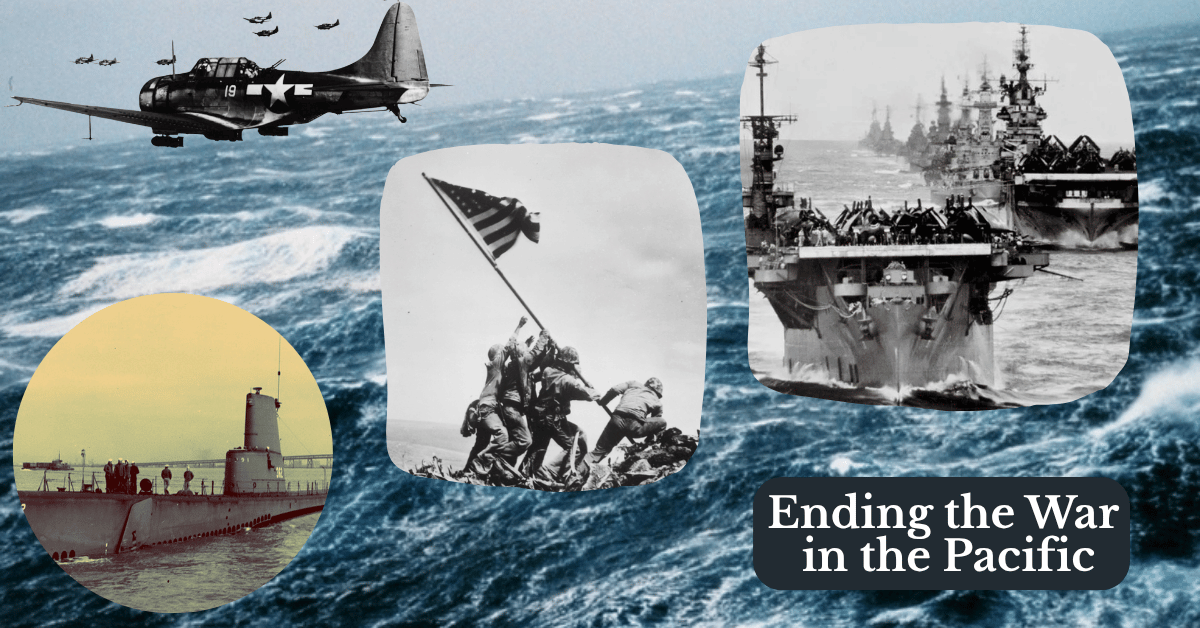
It was a busy month. Mounting military losses and the inability of Prime Minister Koiso to garner consensus within the War Council led to the collapse of the government and the appointment of Admiral Suzuki as Prime Minister. It takes time to form a government – and meanwhile there is a lot going on. Iwo Jima is reaching its bloody end just as Okinawa begins to unfold. The losses among land forces, naval personnel (viz. kamikaze) and especially among civilians will be horrific and impactful.

Some argue that April 1945 was a lost opportunity. Suzuki was the new prime minister and there are those historians who assert that he was an advocate for peace. That is probably wishful thinking. He was an absolute opponent of unconditional surrender but at the same time was a proponent of Ketsu-Go. He was not a hardliner like Army Chief of Staff Umezu and War Minister Anami, but one of his first acts was to sign a pledge presented by a delegation of generals from IJA/HQ that committed Suzuki to prosecute the war to its fullest as outlined in Ketsu-Go, the plan to defend the home islands to the bitter end – no surrender. Hardly a peace advocate.

Continue reading

Prayer and Hopeful Faith

The gospel for the 29th Sunday is the parable of the “Unjust Judge and the Persistent Widow.” It is Jesus’ parable about the necessity for them to pray always without becoming weary (v.1) stands as a climax for the longer section on faithfulness at the coming of the Son of Man (17:20-18:8). Read against the horizon of 17:22-37, Jesus’ teaching is particularly oriented toward the necessity of steadfast, hopeful faith in the midst of trials.

This parable is unique to Luke, as is the following parable on prayer (18:9-14, the gospel for the 30th Sunday in Year C). Luke has a greater emphasis on prayer than the other gospels. In the following five synoptic events, Luke adds a comment that Jesus is praying that is not found in the other gospels:

  • Jesus is praying at his baptism before heavens open (3:21)
  • Jesus spends the night praying to God before selecting the twelve (6:12)
  • Jesus is praying before he asks the disciples, “Who do the crowds/you say that I am?” (9:18)
  • Jesus is praying on the mountain before the transfiguration. (9:28, 29)
  • Jesus is praying before the disciples ask him to teach them to pray. (11:1)
Continue reading