This coming Sunday the gospel is the parable of the Pharisee and the Tax Collector. In the previous post we considered the meaning of “righteous” as a prelude to the parable’s beginning: He then addressed this parable to those who were convinced of their own righteousness and despised everyone else. The Greek pepothoitas normally means “to convince” or “to persuade;” however, it can also mean “to seduce,” “to corrupt.” It would have been interesting had the translators chosen “those who seduced themselves that they were in right relationship to God.”
The use of exoutheneo – “to despise” (v.9) raises an interesting question about who are the self-righteous people who are despising others in Luke’s time. Is this parable directed against Pharisees and others outside the community of believers who despise those inside the church? In Luke’s other uses of the word, it refers to those who despised or rejected Jesus (Luke 23:11; Acts 4:11). With this understanding, it might be easier for (self-righteous) Christians to assume that the problem is with “those people out there,” but not with “us”.
However, looking at the other uses of the word – all in Paul, it is usually directed towards those inside the church who despise other members of the community of faith. In all but two instances, Paul uses the word in this way (Romans 14:3, 10; 1Corinthains 16:11; 2Corinthains 10:10; Galatians 4:14; 1Thess 5:20). One exception is 1 Corinthians 1:28 where God chooses what is “despised” in the world; the other is 1 Cor 6:4 about a judge who “has no standing” in the church. With this understanding, those who were convinced of their own righteousness and despised everyone else are also among believers.
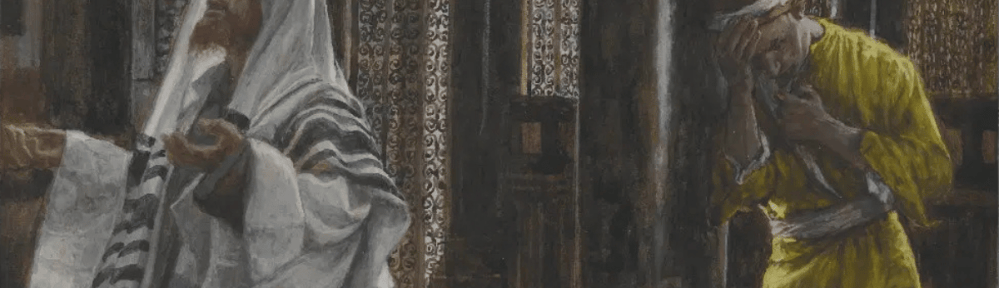
The Pharisee
The Pharisees were not villains. They were dedicated to observing the law. The Pharisee in our text actually exceeds the law’s demands. Fasting twice a week rather than once a week. Tithing on all he gets rather than just the foods and animals (Dt 14:22) for which it is required. [see Note on Luke 18:12 below] According to temple standards, Pharisees are the “good guys” – the “righteous” – and this Pharisee does even more than the ordinary Pharisee. Are the “temple standards” the correct ones? Clearly there is some merit as the traditions of fasting and tithing continue into the Christian spiritual practices.
“The Pharisee took up his position and spoke this prayer to himself.” The phrasing in Greek is awkward, lending itself to several possible understandings. One understanding is neutral: he simply assumed a posture of prayer and prayed quietly to himself. Two other understandings are negative: he prayed to himself rather than to God, or he prayed with reference to himself but with an eye to the tax-collector.
What about the Pharisee’s prayer? There are records of ancient prayers similar to the Pharisee’s and such prayers were not considered self-righteous boasting. The following prayer of thanksgiving from the Talmud was prayed by the rabbis on leaving the house of study.
I give thanks to Thee, O Lord my God, that Thou has set my portion with those who sit in the Beth ha-Midrash [the house of study] and Thou has not set my portion with those who sit in [street] corners for I rise early and they rise early, but I rise early for words of Torah and they rise early for frivolous talk; I labor and they labor, but I labor and receive a reward and they labor and do not receive a reward; I run and they run, but I run to the life of the future world and they run to the pit of destruction. [b. Ber. 28b
A similar ancient prayer (with something offense to our modern sensibilities) is found in the Talmud:
R. Judah said: One must utter three praises everyday: Praised (be the Lord) that He did not make me a heathen, for all the heathen are as nothing before Him (Is 40:17); praised be He, that He did not make me a woman, for woman is not under obligation to fulfill the law; praised by He that He did not make me … an uneducated man, for the uneducated man is not cautious to avoid sins. [t. Ber. 7.18] [p. 59]
So it would seem that the Pharisee’s prayer thanking God that he is not like the rest of humanity was not all that unusual. He is the model of the pious man, both by what he did do (fasting and tithing); and by what he didn’t do – acting like thieves, evil people, adulterers, and tax collectors. The word Pharisee (“those set apart’) is reflected in his posture of prayer – apart from the others.
Then he spoke this prayer to himself. The phrasing in Greek is awkward, lending itself to several possible understandings. One understanding is neutral: he simply assumed a posture of prayer and prayed quietly to himself. Two other understandings are negative: he prayed to himself rather than to God, or he prayed with reference to himself but with an eye to the tax-collector.
The Pharisee asks nothing of God. Why? Is he satisfied that his fasting and tithing are sufficient – reflecting a works-salvation mentality? Does he assume these actions reflect his piety and that he is not a sinner? What is clear is that his prayer gives no evidence of humility or contrition.
Image credit: The Pharisee and the Publican | Tissot, 1886 | Brooklyn Museum | PD-US
Discover more from friarmusings
Subscribe to get the latest posts sent to your email.
 friarmusings