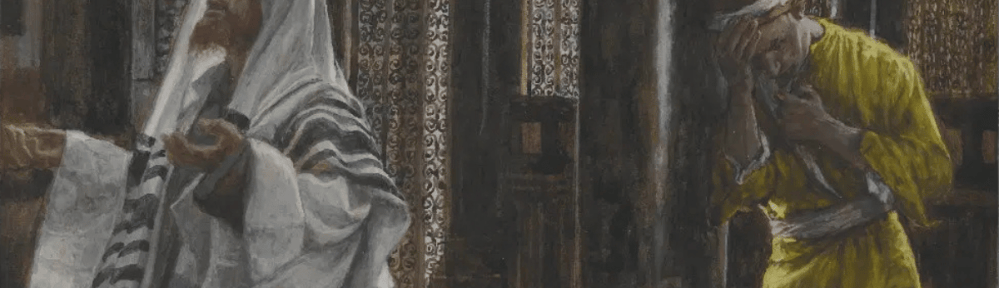
This coming Sunday the gospel is the parable of the Pharisee and the Tax Collector. As with Jesus’ parables, especially in Luke, they often echo earlier passages. For example:
“I have not come to call the righteous to repentance but sinners.” (Luke 5:32)
“…there will be more joy in heaven over one sinner who repents than over ninety-nine righteous people who have no need of repentance.” (Luke 15:7)
Those echoes ring clearly in the word of the tax collector’s prayer: ‘O God, be merciful to me a sinner.” (Luke 18:13)
Four aspects of the tax-collectors humility are briefly indicated by Luke: (1) he stood far off, (2) he kept his eyes lowered, (3) he beat his beast as a sign of repentance, an (4) he cries out for mercy. Unlike the Pharisee, the tax collector gives at least some evidence of humility and contrition: “…would not even raise his eyes to heaven” The tax collector’s reticence echoes Ezra’s prayer upon hearing of the numerous mixed marriages in Jerusalem: “O my God, I am too ashamed and embarrassed to lift my face to you, my God, for our iniquities have risen higher than our heads, and our guilt has mounted up to the heavens” (Ezra 9:6). Both of the situational comments in 18:13a—the downward gaze and the breast-beating—speak of a deep sense of unworthiness and embarrassment.
The tax collector simply asks: “be merciful.” The verb used is from hiláskomai used to translate the Hebrew kipper. The use of these words occurs in relation to the offerings prescribed by the OT Law and along with such terms as “to free from sin,” “to purge,” and “to sanctify” – all leading to the concept of “expiation” the offering and the act of offering a sacrifice for the forgiveness of sins.
He stands apart not because of his worry about defilement, rather he knows his unworthiness. Rather than suggest that he himself is daikaios (righteous), the tax collector self-identifies with exactly what the Pharisee considered him to be: a sinner (hamartōlós). Further, rather than speak to God via a reference to the Pharisee, the tax collector straight forwardly begs for mercy.
Culpepper (Luke, 342) notes:
If the Pharisee asks nothing of God, the tax collector boasts nothing before God. His prayer echoes the opening words of Psalm 51: “Have mercy on me, O God.” The crucial addition to the words of Psalm 51, however, is the tax collector’s self-designation: “a sinner.” Nothing more is said of the tax collector’s prayer. It is complete as it stands, and nothing more needs to be said of his character.
Image credit: The Pharisee and the Publican | Tissot, 1886 | Brooklyn Museum | PD-US
Discover more from friarmusings
Subscribe to get the latest posts sent to your email.
 friarmusings