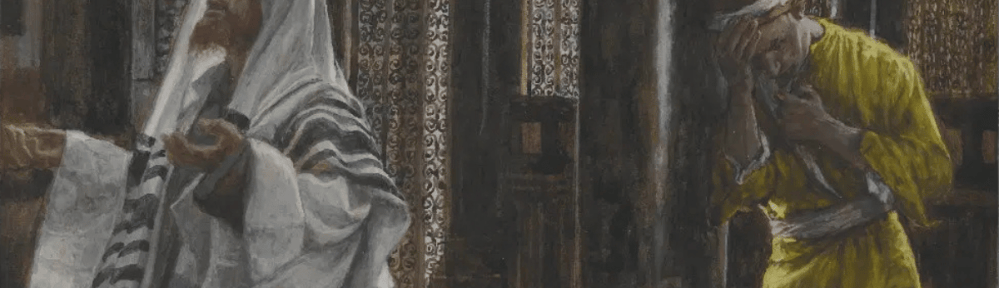
This coming Sunday the gospel is the parable of the Pharisee and the Tax Collector.
The Pharisee’s prayer is filled with himself. He speaks of his virtues, compares himself to others, and essentially reminds God how good he is. He asks for nothing, because he believes he needs nothing. His prayer is not really prayer—it is self-congratulation before heaven.
The tax collector, on the other hand, has no illusions. He stands at a distance, cannot lift his eyes, and prays only, “God, be merciful to me, a sinner.” He knows the truth about himself, and he places his whole hope in God’s mercy. And Jesus tells us it is this man, not the Pharisee, who goes home justified.
This tells us something about true prayer:
Prayer begins in humility. We come before God not to prove ourselves but to admit our need.
Prayer depends on mercy. We are not saved by our achievements but by God’s grace freely given.
Prayer ends in truth. The tax collector’s honesty before God opens him to healing; the Pharisee’s self-deception closes him off.
The “right relationship” with God is not built on comparing ourselves with others or on presenting spiritual résumés. It is built on knowing God as Father, ourselves as children, and salvation as gift. The heart of prayer is not saying, “Look at me, Lord, I have done well.” It is saying, “Look at me, Lord, I need You.”
Culpepper (Luke, 343) concludes his comments with:
The parable of the Pharisee and the tax collector, contrary to some interpretations, is a two-sided parable. To read it as simply a warning against pride, self-sufficiency, or a relationship with God based on one’s own works is to miss the other side of the parable, which connects the Pharisee’s posture before God with his contempt for the tax collector. To miss this connection would be tantamount to emulating the Pharisee’s blindness to the implications of his attitude toward the tax collector. The nature of grace is paradoxical: It can be received only by those who have learned empathy for others. In that regard, grace partakes of the nature of mercy and forgiveness. Only the merciful can receive mercy, and only those who forgive will be forgiven (6:36-38). The Pharisee had enough religion to be virtuous, but not enough to be humble. As a result, his religion drove him away from the tax collector rather than toward him.
In its own way, this parable is as though a scene from Jesus’ teaching of the greatest commandments: to love God – and to love your neighbor as yourself. If we find our relationship to God in Jesus raises barriers to others, then we have embarked on the journey with blind spots that require healing.
Image credit: The Pharisee and the Publican | Tissot, 1886 | Brooklyn Museum | PD-US
Discover more from friarmusings
Subscribe to get the latest posts sent to your email.
 friarmusings