
Graced Service

“Who among you would say to your servant who has just come in from plowing or tending sheep in the field, ‘Come here immediately and take your place at table’? 8 Would he not rather say to him, ‘Prepare something for me to eat. Put on your apron and wait on me while I eat and drink. You may eat and drink when I am finished’? 9 Is he grateful to that servant because he did what was commanded? 10 So should it be with you. When you have done all you have been commanded, say, ‘We are unprofitable servants; we have done what we were obliged to do.’” (Luke 17)

This parable presents an opposite picture of the master and slaves given in Luke 12:37. There the master has been out traveling and when he returns home, he has the slaves sit down to eat and he serves them. There one hears the theme of the great reversals so prevalent in that portion of Luke. Here, Alan Culpepper expresses the meaning of this parable very succinctly: “The disciples can do what God requires – through faith – but disciples never do more than is required” (324).

Continue reading
Courage and Urgency

To the Lord our God belongs justice; to us, people of Judah and inhabitants of Jerusalem, to be shamefaced, as on this day” (Baruch 1:15)

These words from the prophet Baruch are not just a historical lament of the first wave of exiles to Babylon. It is not a “woe-is-me” indulgence. It is a realization that the choices they made have led them to this moment: exile. The people of Israel, in exile, finally recognize the root of their suffering: their refusal to listen to God, their stubbornness, and their idolatry. It’s a moment of collective repentance, a turning back to the Lord. They should be a mirror held up to every generation, including our own. 

In Jesus’ time the cities of Chorazin, Bethsaida, and Capernaum were probably faithful people, no foreign gods among them. Where Baruch’s generation turned back to God, here and now, God turns to the people in the person of his Son who performed signs and miracles. But people are unmoved. They chose indifference to the grace that was evident to them. Jesus’ words are a lament of love rejected. 

In our modern spiritual lives, these readings challenge us in two profound ways: having the courage to confess and an urgency to respond. 

Continue reading

Defeat and Surrender

To understand in the inner workings of the wartime governance of Japan there are three keys to keep in mind:

  1. Cabinet and Supreme War Council recommendations to the Emperor must be unanimous and if unanimity can not be reached, the government collapses and a new cabinet and council must be promoted.
  2. In accord with the Meiji Constitution, certain cabinet members must be filled by active duty members of the military. In the context of #1 above, this means that the military holds a de facto veto on anything with which it does not agree. A single military member can either “filabuster” or simply resign – either achieve the same thing: collapse of the government.
  3. In accord with the Meiji Constitution, the Emperor is a Constitutional Monarch, but at the same time is “Supreme Commander” of the Military (daigensui).

Does #3 mean that the “buck stops” with the Emperor? Hardly. As described in earlier posts, the received tradition was that the Emperor was not an absolute monarch – and that is consistent with the Meiji Constitution. Then again, the Emperor was not a symbolic monarch like the King of England. In practice, the Emperor’s role lived somewhere between the two on a spectrum of direct influence, passive influence, and removed from decision making. Emperor Hirohito’s father was quite removed from decision making or shaping the future of Japan. Hirohito was… well, that has been the subject of debate by historians for the last 80 years and more.

The post-war tribunals placed the blame and responsibility for the war on the military, ultranationalists, and the zaibatsu (financial clique). But Emperor Hirohito escaped post-war tribunals because Gen. MacArthur (SCAP – Supreme Commander for Allied Powers) excluded him from the tribunals for reasons associated with SCAP’s vision for post-war Japan. This provided a post-war orthodoxy that Emperor Hirohito was a peace loving constitutional monarch who could not prevent the military from their desire for war. That view could not withstand the passage of time and the declassification of wartime documents.

Continue reading

The Faith of a Mustard Seed

“If you have faith the size of a mustard seed, you would say to (this) mulberry tree, ‘Be uprooted and planted in the sea,’ and it would obey you. (Luke 17) One might expect Jesus to well receive the request for more faith, but the response seems to imply that the disciples do not (yet) understand the real nature of faith. The saying is grammatically complex in Greek.  The first part of verse 6 is a construct that implies the disciples do have faith, but the second part of the verse contradicts that positive assessment with the implication that the disciples have not yet scratched the surface of the real nature of faith.

The disciples assume that they have faith and they will need more to accomplish what Jesus has taught in vv.1-5.  Jesus seems to be saying they don’t even have faith is the smallest quantity (hence the reference to the mustard seed). The point is not that they need more faith, but that they need to understand that faith allows God to work in a person’s life in ways that defy ordinary human experience.  This saying is not about performing extraordinary miracles, but that with even the smallest of faith, God can help them to live by his teachings on discipleship.

[Note: other commentaries suggest that Jesus is affirming their faith – in other words, they do not need more. If they believe and act on the faith that they already have, then they can rebuke and repent and forgive within the community. In essence, he seems to imply that they don’t need more faith, but to make use of the faith that they already have.  Why the difference?  It depends on how one assesses the conditional primary and secondary clauses present in the verse.]


Image credit: The Exhortation to the Apostles | James Tissot | ca. 1890 | Brooklyn Museum NYC | PD-US

Action and Planning for 1945

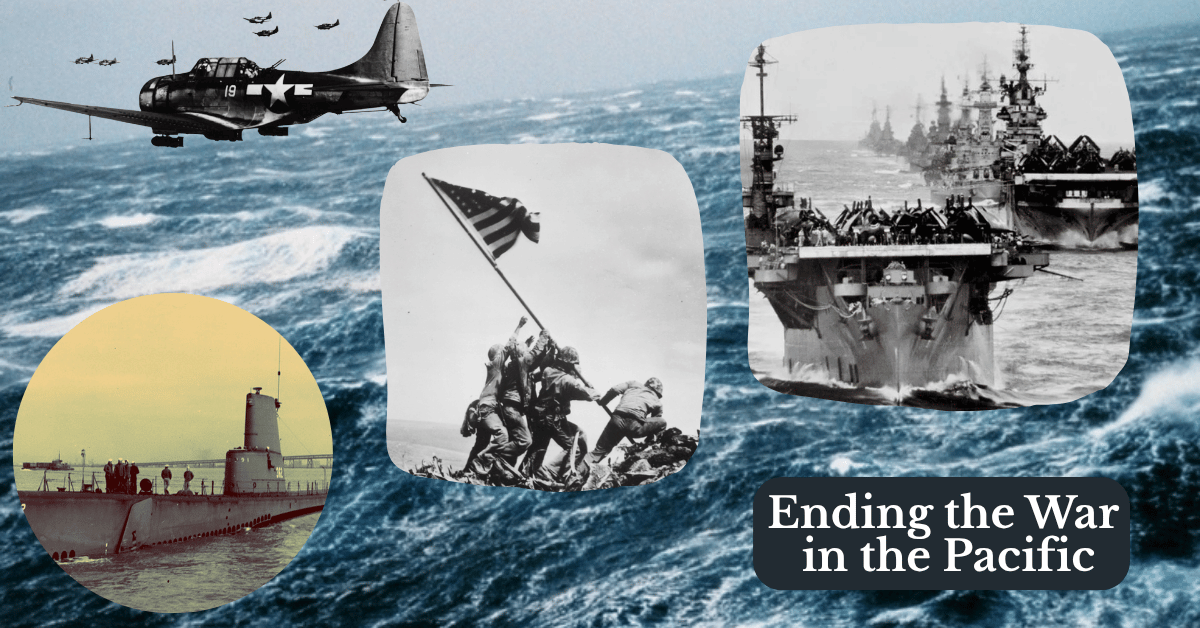
Sometimes the task at hand is like trying to rewire the house while keeping the lights on. Such was the 12 months preceding the planned November 1, 1945 Operation Olympic’s landings on the southern Japanese home island of Kyushu. That was the “rewiring” part. The “lights” that needed to be kept burning brightly were spread far and wide. Here is a brief summary of the major Pacific engagement from October 1944 until the end of the war.

  • Repatriation of the Philippines (Leyte, Luzon, Palawan, Visayas, Mindanao) (Oct 1944 until the end of the war)
  • Formosa Air Raid by the Fast Carrier Task Force (Oct 1944)
  • Strategic Bombing of Japan (Nov 1944 until the end of the war)
  • Burma: Battle of Meiktila and Mandalay (Jan – Mar 1945)
  • Iwo Jima Campaign (Feb 19 – Mar 26, 1945)
  • Dutch East Indies (Indonesia) operations to retake key islands (May 1 – Jun 21)
  • Burma: Battle of Rangoon (Apr 30 – May 3)
  • Okinawa (Apr – Jun 1945)
  • Unrestricted submarine operations (until the end of the war)
  • US 5th Fleet Fast Carrier Raids from the Sea of Japan to Singapore  (Feb-May 1945)
  • Mining of Japanese coastal waters (Feb-May 1945)

These operations engaged the entirety of Central Pacific Command (Nimitz) and Southwest Pacific Command (McArthur) – and yet at the same time the Allied forces were asked to begin preliminary planning for Operation Olympic which would be an amphibious invasion far more complex that Normandy.

Continue reading

Praying for Faith

Why do the apostles make the request: “Increase our faith”? Does their request indicate that one can have more or less faith? If one remembers that pístis (“faith”) is also translated as “trust” then our own experience shows us that we trust, but in different and varying degrees. But what was it that indicated their faith was somehow lacking?  Jesus commissioned them and sent them out with power over demons and diseases (9:1-6). They preached and healed; went about without any supplies of their own. They had trusted God for their necessities. They trusted God to heal the sick and cast out demons. They trusted God and proclaimed the coming Kingdom of God. Why do they now ask for more faith? Did they need more faith to stand up to temptations to sin? To cease from causing others to sin? To rebuke those who had sinned against them? To forgive one another? Perhaps moving mulberry trees (or mountains as in the parallels) into the sea is an easier act of faith than moving us to “rebuke” and “forgive” people who have sinned against us.

Culpepper (Luke, 322) writes on this verse:

The disciples’ plea in this context conveys the recognition that on the one hand faith is a dynamic process and one can grow in faith. On the other hand, the disciples ask that the Lord add to or strengthen their faith, thereby recognizing that faith is not just a matter of their own strength. In both of these aspects, Luke’s concept of faith is similar to Paul’s who writes of righteousness as being revealed “through faith for faith” (Rom 1:17) and declares that we have been saved by grace through faith and that this it not of our own doing (Eph 2:8). 

I think that our growth in Christ is nearly always a movement from faith to faith (rather than only from unbelief to faith). While the faith I have today is similar to the faith given at baptism, it is also different. As we grow in our intellectual and physical skills and abilities yet remain the same person, so too, who we are today is both spiritually the same and different from who we were as an infant. Either way we are loved by God.


Image credit: The Exhortation to the Apostles | James Tissot | ca. 1890 | Brooklyn Museum NYC | PD-US

Allied Intelligence Operations in the Pacific

In popular understanding, we think of intelligence operations as “code breaking.” But those were always later developments. The first step was listening in on enemy transmissions. Intercepts were collected by ground stations, ship-based stations, aircraft with radio monitoring gear, and even submarines. Once the encrypted communications were intercepted, even when messages couldn’t be decrypted, analysts studied call signs, frequencies, message traffic volume, transmission times, and transmission locations. Early in the war these “signal intelligence” (SIGNIT) operations were sophisticated enough to reveal patterns such as unit locations, movements, and order of battle. The early June 1942 Japanese attack on Midway was “known” through traffic analysis without the benefit of code breaking. This was done by the Hawaii based Station Hypo.

Continue reading

When to Rebuke, When to Forgive?

3 Be on your guard! If your brother sins, rebuke him; and if he repents, forgive him. 4 And if he wrongs you seven times in one day and returns to you seven times saying, ‘I am sorry,’ you should forgive him.” (Luke 17)

The disciples are warned to be on guard lest they become like the Pharisees. Several translations take the term adelphos as “disciple” but our translation does well to let it be literal as “brothers” [and sisters], retaining the communal kinship brought about by their common faith and service. Jesus is stressing that even individual sin has a communal element in that the sin of one may lead others astray. This sense of community is made clear in the Matthean parallel:

15 “If your brother sins (against you), go and tell him his fault between you and him alone. If he listens to you, you have won over your brother. 16 If he does not listen, take one or two others along with you, so that ‘every fact may be established on the testimony of two or three witnesses.’ 17 If he refuses to listen to them, tell the church.  If he refuses to listen even to the church, then treat him as you would a Gentile or a tax collector” (Mt 18:15–17). 

Continue reading