There are four different Masses that rightly celebrate the Nativity of the Lord. They are the Vigil Mass (all the masses before 10 pm on Christmas Eve), Mass during the Night (“Midnight Mass”), Mass at Dawn, and Mass during the Day. Many parishes these days have several Vigil Masses. At our parish in Virginia we will have 6 vigil Masses. The vigil mass has two options for the Gospel reading.
The option that is most often selected is one that seems well suited to Christmas: “This is how the birth of Jesus Christ came about. When his mother Mary was betrothed to Joseph, but before they lived together, she was found with child through the Holy Spirit. Joseph her husband…”(Matthew 1:18-25) The reading goes on to describe the angel’s message to Joseph to take Mary into his home. “For it is through the Holy Spirit that this child has been conceived in her. She will bear a son and you are to name him Jesus.”
Especially when one of the Vigil Masses is preceded by the Children’s Christmas Pageant this is a great choice and an easy one to be part of the evening’s homily.
The other option presents a few more challenges to listener and homilist alike: “The book of the genealogy of Jesus Christ, the son of David, the son of Abraham. Abraham became the father of Isaac, Isaac the father of Jacob, Jacob the father of Judah and his brothers. Judah became the father of Perez and Zerah, whose mother was Tamar…” and on for a total of 25 verses (Matthew 1:1-25). It really is a great gospel, but…it just does not seem a good choice for what will undoubtedly be a Mass filled with families and lots of children. Still…
When we gather for Christmas Eve, most of us come already filled with excitement. Children can hardly wait for tomorrow morning. Families look forward to being together. Lights are shining in every corner of the church. In his gospel, before Matthew tells us about angels, shepherds, and the Baby in the manger, he begins with a long list of names. Abraham, Isaac, Jacob… Ruth, David… and on and on. I have never had the gumption to choose this gospel. I wonder that as I proclaimed the gospel and watched eyes wander, children get restless, and their foreheads wrinkle as people think: “why on earth is he reading that gospel? Where is Joseph, Mary and the baby Jesus?” – would I accelerate the reading to rush to the end as soon as possible… and then… and then what? Then, I have to preach. So, maybe I will just share my thoughts with you.
Why does the gospel start with a genealogy? Because Matthew wants to tell us something important about the story of Jesus, something that is a great message for Christmas: God keeps His promises. Always.
The genealogy is a description of God’s promise moving through history, through the almost 2,000 years that passed from Abraham to Jesus. In that stretch of time, the people of God paid were faithful and not-so-faithful. But God remained faithful and never forgot the promise. God never abandoned His people even when they abandoned Him. God remained faithful across centuries. That is exactly what St. Paul offers in the Vigil Mass’ second reading: “From his descendants God, according to his promise, has brought to Israel a savior, Jesus.” (Acts 13:23)
So before Matthew gets to the point when that promise becomes flesh — a Baby laid in a manger. Matthew wants us to be mindful that God works through ordinary—and imperfect—people. Look closely at the genealogy and you’ll notice that the list is filled with surprising people: Abraham sometimes doubted. Jacob was a trickster who cheated his brother out of his inheritance. David was a great king, but also a great sinner. Ruth was a foreigner. Rahab wasn’t even part of Israel at first. What does this tell us? It says God is willing to work with our flaws because God’s plan is bigger than our weaknesses. God can work through saints and sinners, kings and shepherds, parents and children. God isn’t put off by the messiness of human life. That’s good news for everyone. It is good news for the families and folks that feel they are too complicated, a little imperfect, unsure and struggling. We all would fit right into the genealogy and the family of Jesus.
If the genealogy’s characters weren’t surprising enough, the biggest surprise is that God kept His promise by becoming one of us: “Behold, the virgin shall be with child and bear a son, and they shall name him Emmanuel, which means ‘God is with us.’” (Matthew 1:23) There was no flash of lightning or earthquakes. There was only a baby — small, vulnerable, needing to be held and fed. The promise was fulfilled gently, quietly, and in ways we never could have imagined.
The genealogy is a great gospel for Christmas because it is an invitation for us to trust, believe and remember that God is with us. No matter the year we’ve had, the worries we carry, the troubles we’ve seen, and the fears that grip us. No matter what. In the proclamation of the genealogy gospel, God whispers: “I am with you.”
He has been with his people for thousands of years and has kept the Promise, working through Jesus’ long and imperfect family line, and God is ready to work in all of our lives too. In the kindness we show, the forgiveness we offer, the prayers we whisper, and in the generosity with which we give. In these things, we take our place in Jesus’ family.
The Gospel reading of the genealogy of Jesus reminds us that as we gather around the manger, we gather not as strangers, but as members of the family God that has been forming since Abraham. The genealogy begins with Abraham and ends with a newborn child… but the story continues with each one of us.
It really is a great gospel.
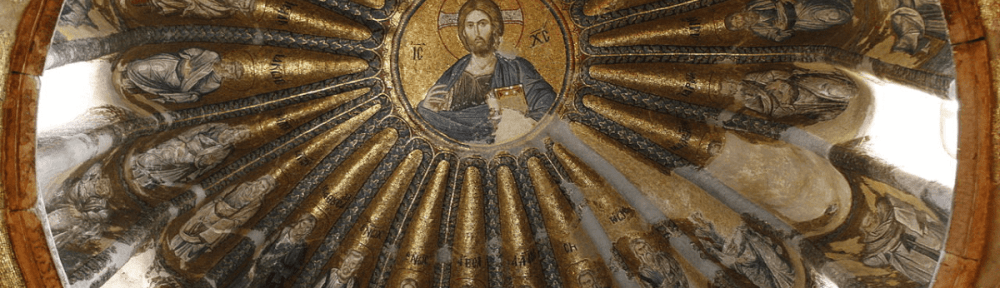
Image credit: Photograph | South dome of inner narthex at Chora Church, Istanbul, depicting the ancestors of Christ from Adam forward | Wiki Commons from José Luiz Bernardes Ribeiro | CC BY-SA 3.0
Discover more from friarmusings
Subscribe to get the latest posts sent to your email.
 friarmusings