This coming Sunday is the celebration of The Epiphany of the Lord. As much as we want to combine the nativity stories of Matthew and Luke, they really have no points of contact other than the birth of the child Jesus. Luke’s story is set among the lowly shepherds; Matthew’s story is set among royalty, chief priests and wealthy foreigners. The desire to make them one story is natural, but to do so misses the uniqueness and point of each gospel writer. Which would be a loss since Matthew’s story arcs across the ages and geography of the Middle East.
The gospel for the Epiphany in Chapter 2 follows after the story of Jesus’ birth (Mt 1) and comes before the inauguration of his public ministry in Matthew 3. The gospel passage is part of a larger narrative structure that includes the family’s escape to Egypt and subsequent return to Nazareth (Mt 2:13-23). Within this larger text there are four episodes each of which revolves around a place name: Bethlehem, Egypt, Ramah, and Nazareth. The scenes in the chapter explain how Jesus, Son of David, was born in Bethlehem, was taken to the safety of Egypt as Herod murdered the Holy Innocents (echoing the loss in Ramah), why the family did not return to Bethlehem, and how Nazareth came to be his home. Each episode includes an Old Testament quotation that connects the stories of the Old Testament with the unfolding of events in the New Testament era. These are examples of Matthew’s focus on scriptural fulfillment against the backdrop of the travelogue. In this, Matthew shows that the Messiah’s itinerary was guided by the will and promises of God.
Son of David: King and Messiah
This gospel story, peculiar to Matthew, underlines several themes in Matthew’s presentation of Jesus the Messiah. It makes explicit reference to the detailed fulfillment of Scripture, in his place of birth (vv. 5–6), as well as alluding to another Messianic passage from the Book of Numbers (24:17). The Matthean treatment presents Jesus as the true ‘king of the Jews’ (v. 2) in contrast with the unworthy king Herod. It begins to draw a parallel between Moses and Jesus (in the escape and return from Egypt) which will be further developed in the rest of the chapter and in this particular gospel. And it shows Jesus as the Messiah of all nations, opposed by the leader of the Jewish nation but recognized as the fulfillment of the hopes of the Gentiles.
Jesus was born in Bethlehem – just as the prophets said and thus Jesus truly is Son of David (cf the genealogy with which Matthew begins the gospel). The royal note runs throughout the story. Not only from the birthplace, but also the encounter with dignitaries in the person of King Herod the Great (considered an interloper king) and the magi (not actually kings at all) seeking the new-born king. The contrasts are laced within the narrative: to the true King of Israel, born in Bethlehem, come the foreign magi bearing gifts due royalty. This action echoes the Queen of Sheba coming to see David’s son Solomon (1 Kings 10:1-10) as well as scripture that points to the future Messiah (Ps 72 and Isa 60). It also points to the foreign prophet Balaam (Numbers 23) speaking of the “star’s rising in the east.”
Matthew 1 and its genealogy move in continuity with the OT story. It is here in Matthew 2 that the story is located as a present fulfillment in the world occupied by first century readers/listeners. It is a merging of biblical ages in which the promises of God to Israel are fulfilled. It is also a merging of other worlds. It is here that the gentile world begins to come to pay homage to the King of Kings – it is now that God “appears” to them. It truly is a revelation: an epiphaneia.
This text is the traditional gospel for the Feast of the Epiphany. In Greek epiphaneia derives from the verb “to appear” and means “appearance”, “manifestation”. In classical Greek it was used for the appearance or manifestation of gods. In Jewish scripture (LXX; Greek translation) the word occurs for manifestation of the God of Israel (2 Macc.15:27). In the New Testament the word is not used concerning the birth of Christ or visit of the Magi, but is used to refer: once to the revealing of Christ after the resurrection, and five times to refer to the Second Coming.
The traditional use of this text underscores the truth that Jesus is God’s revelation to the whole world and quietly sets the stage for the resurrected Jesus’ “Great Commission” (Mt 28:19) to the whole world.
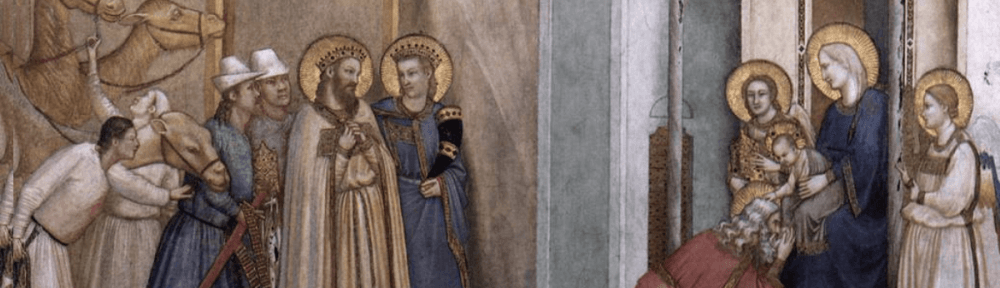
Image credit: The Adoration of the Magi | Giotto, 1310 | Basilica inferiore di San Francesco d’Assisi | Assisi, Italy | PD-US
Discover more from friarmusings
Subscribe to get the latest posts sent to your email.
 friarmusings