This coming Sunday is the celebration of The Epiphany of the Lord. In the previous post we considered St. Matthew’s setting for the gospel and how the account fits into the narrative arc of his entire gospel story.
Jesus is born, the magi arrive in Herod’s court stirring the pot as it were, consultations are made, the magi are told to go to Bethlehem, the star locates the Holy Family, and the magi do homage to the child. Meanwhile Herod plots and assumes the magi will return via Jerusalem and help the King fill in the details regarding this newborn king. But “having been warned in a dream not to return to Herod, [the magi] departed for their country by another way.” It is a simple story in the telling, but less in the details, especially when those details pique our curiosity.
All commentaries have some comment about the actual years that Jesus was born. We know that both Matthew and Luke report that Jesus was born while Herod the Great sat upon the throne of Judah. Herod died ca. 4 bc. and there are few other historical “anchors,” and so the exact date of Jesus’ birth is impossible to state with great certainty – and so we are forced to look for clues in the text itself. We are also interested to know if there was a gap of time between Jesus’ birth and the events described in Matthew’s narrative. Things to consider:
- In 2:9 and 11, Matthew describes Jesus as paidion, a small child, a word not normally describing an infant/baby. In Luke 2:12 and 16, the sacred author refers to Jesus as brephos which means “baby” or “infant.” [even though the translators choose “child” in the NAB]. That being said, in Luke 2:27, some 40 days after his birth, Luke describes him as paidion, “child” although we would still consider Jesus as an infant/baby. Language does not provide definitive clarity.
- The information about the star provides no clarity since we have no information beyond speculation. The chapter might well contain several indications suggesting that the visit of the Magi took place some time after the birth of Jesus so that he is now a ‘child’ not a ‘babe’ Even that is less than clear.
- Herod’s murder of all children under two (v.16) would hardly be necessary if the birth was known to be very recent. Against this backdrop, the magi arrive in Jerusalem.
All in all, we simply don’t know the answer to the questions of date and “gap.”
The Magi
To understand the power of this story, the listeners must first come to a new understanding of the magi. Many English translations render this Greek word, “wise men.” That is being far too kind about these visitors. Perhaps, because these visitors from the East have been held up as such good models of faith, we have been afraid to really present them for what they were. Originally, in 6th century BC Persia, magi were dream-interpreters. By Jesus’ time, the term referred to astronomers, fortune-tellers, or even con-men. In fact, our word “magic” or “magician” comes from this word “magi”. They were not so much respectable “wise men” or “kings” but charlatans in a practice condemned by Jewish standards. This same word occurs in Acts 13. Barnabas and Saul meet Elymas, a Jewish magi (or magus in the singular). This is how Paul describes him in verse 10:
“You son of the devil, you enemy of all that is right, full of every sort of deceit and fraud. Will you not stop twisting the straight paths of (the) Lord?
Magi in Jesus’ day were not models of religious piety but Matthew makes them the heroes in his first story following the Savior’s birth. The magi come from a group that doesn’t worship the God of Israel. They are the wrong race, the wrong denomination, the wrong religion. They don’t practice orthodox worship. Yes, they give the child Jesus gifts of gold, frankincense and myrrh, but those are elements used in their trade/magic. The magi would have been much better models of unbelief and false trust; than models of faith, trust and worship. Some would say their appearance is “too good to be true.”
Objections to the historicity of this story have been made mainly on two grounds. First, it is regarded as an artificial construction around chosen Old Testament texts. Secondly, the account is said to bear all the marks of pious legend. But in fact, with the exception of the moving star in v. 9, there is nothing historically improbable in the account, and the fact of a comparable visit by eastern Magi to Nero in ad 66 (Dio Cassius 63.7; Suetonius, Nero 13) vouches for the probability of this story rather than otherwise. It may perhaps be added that a church which soon found itself in serious conflict with astrology is not likely to have invented a story which appears to favor it.
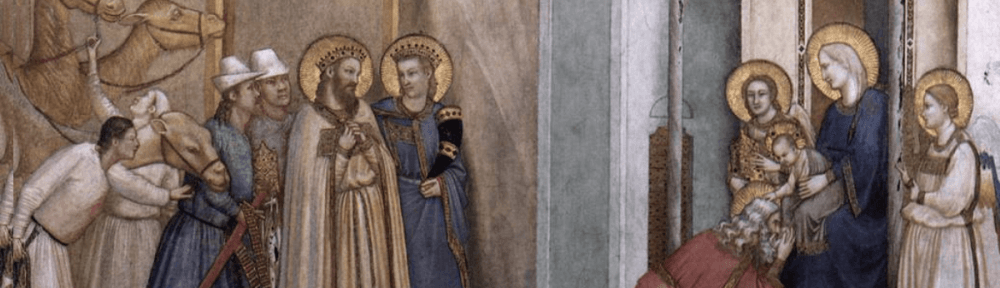
Image credit: The Adoration of the Magi | Giotto, 1310 | Basilica inferiore di San Francesco d’Assisi | Assisi, Italy | PD-US
Discover more from friarmusings
Subscribe to get the latest posts sent to your email.
 friarmusings