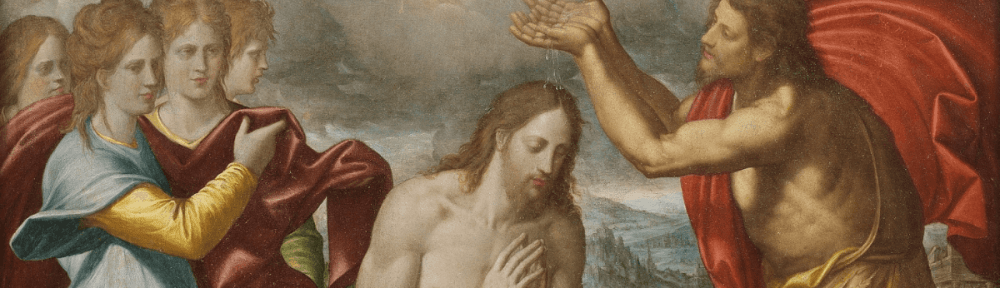
This coming Sunday we celebrate the Baptism of the Lord. 14 John tried to prevent him, saying, “I need to be baptized by you, and yet you are coming to me?” 15 Jesus said to him in reply, “Allow it now, for thus it is fitting for us to fulfill all righteousness.”
Righteousness (dikaiosýnē) is a complex concept rooted in the Hebrew ṣedeq-ṣĕdāqâ and mišpāṭ. In short, as used by Matthew, dikaiosýnē refers to right conduct before God. This is the consistent usage in Matthew. Jesus is baptized so as to do what is right with God (3:15). The hungering and thirsting of 5:6 is for a right state before God. Yet this righteousness is God’s gift (6:33). It is to be sought with his kingdom. It brings persecution (5:10). It includes the practice of piety (6:1). The way in which the Baptist came is that of right conduct (21:32).
Boring (Matthew, New Interpreters Bible, 160) comments on the phrase:
Both righteousness and fulfillment are key Matthean theological themes. Righteousness here means, as often elsewhere, doing the revealed will of God. Here, fulfill seems to mean simply “do, perform,” and the meaning is that it is necessary for both John and Jesus to do God’s will, which includes the baptism of Jesus. The plural “us” links John and Jesus together as partners in carrying out God’s saving plan (11:2-19).
The First Temptation of Christ. Brian Stoffregen has an interesting insight about righteousness as “do, perform” what God requires of us.
John, by trying to prevent the baptism, tempts Jesus not to do all that God requires of him. He tempts Jesus to assume his proper position now: to be the more powerful one; to baptize with the judgmental Holy Spirit and fire; to meet John’s need. I don’t think that these are too dissimilar to the devil’s temptations that occur immediately after the baptism (4:1-11) — temptations for Jesus to use his power now, for his own glory; and avoid his emptying and eventually the pain and suffering of the cross.
What does God require of Jesus? Is it just the baptism? I think that baptism is only part of the picture of Jesus identifying with sinful humanity: the Sinless One is baptized for the forgiveness of sin; the Holy One eats/fellowships with unholy sinners; the Immortal One dies on a cross as a criminal. It is part of the emptying of himself — the God who becomes truly human.
In fact, the “emptying,” occurs even earlier in Matthew. We have been told that the child has been conceived from the Holy Spirit. We have been told that “Jesus” will save his people from their sins. We have been told that he will be called “Immanuel” — God is with us. What happens to this very special child after his birth? He has to flee for his life. The one, who will save his people, has to be saved from Herod. The one who is “God-with-us” has to flee from the Promised Land. He (and his parents) are acting as people who have been emptied of power.
This thought is highly reflective of Philippians 2:6-11 in which Jesus empties himself “becoming obedient to death, even death on a cross.” This passage from Philippians strongly echoes Is 53:12 which speaks of the “Suffering Servant” of God – one who does what is right before God and thus fulfills all righteousness.
Image credit: The Baptism of Christ, Juan Fernández de Navarrete, “El Mudo” | Museo del Prado, Madrid | Wikimedia Commons | PD-US
Discover more from friarmusings
Subscribe to get the latest posts sent to your email.
 friarmusings