The celebration of the Baptism of the Lord marks the end of the Christmas season and the entry of the Church into “ordinary time,” so called not because it is the regular, nothing-special liturgical season, but it is the season when we number the weeks. The word ordinary in this liturgical context comes from the Latin ordinalis, meaning “ordered,” “numbered,” or “arranged in sequence.” Ordinary Time is simply the part of the liturgical year counted by ordinal numbers: 1st week, 2nd week, 3rd week, and so on.
Each year as we enter Ordinary Time, no matter which year, the gospel for the 2nd Sunday is taken from the first chapter of the Gospel according to John. The purpose for this is essentially the same – following the celebration of the Baptism of the Lord, which reveals the relationship of the Father to the Son and to the Holy Spirit – this week’s gospel reveals the relationship of Jesus to the world. And perhaps no one does so more robustly than the Fourth Evangelist.
The fourth Gospel is a book of “signs;” namely things, events, and people who point to something else. Such “intermediaries” are the means by which people prepare and come to faith. The “lamb of God” is a sign in this sense. Even Jesus is a type of intermediary as the logos — the “Word” or “Revealer” of God. The theme and purpose of the “signage” becomes clear in John 20:31 – “But these are written that you may (come to) believe that Jesus is the Messiah, the Son of God, and that through this belief you may have life in his name.” This entirety of the gospel itself is a “sign” to point us to the Messiah, who is a “sign” who points us to God. As O’Day (John, NIB, 524) states about this gospel: “… the story of Jesus is not ultimately a story about Jesus; it is, in fact, the story of God.”
Introduction and Context
We begin the new liturgical year’s ordinary time with the beginning of John’s gospel. What precedes our Sunday gospel is the very rich and complex Prologue to the Fourth Gospel. Where Mark begins with the gospel message, Luke and Matthew begin with the birth narratives, John takes us back to the time before Time to reveal the eternal purpose of God.
John 1:1-18 is the prologue and outlined here by Fr. Raymond Brown to show the eternal purpose that all of creation began with God through the Word, and through the Word Incarnate, Jesus Christ, all the created world will return to God.

No sooner than this sweeping revelation of eternal purpose is revealed, the opening chapter in the Fourth Gospel begins to lay out 7 days of new creation via an artistic first week in the good news recalling the first week of the creation story in the Book of Genesis. Both Genesis and John’s Gospel begin with the identical phrase, “In the beginning.” This “re-creation” story is embedded with a whole list of witnesses to Jesus who, one by one, identify Jesus for John’s audience. From the very beginning they are told who and what Jesus is. As detailed in the Collegeville Bible Commentary [892-3] the testimonies flow as follows:
First day (vv. 19–28).
Witness: John the Baptist to priests and Levites.
Testimony: John is not Christ, nor the expected Elijah of Mal 3:23 (4:5 in some versions), nor the prophet of Deut 18:15, 18, but “the voice of one crying out in the desert,” himself unworthy to untie the sandal strap of the one coming after him.
Second day (“next day” of vv. 29–34).
Witness: John the Baptist at sight of Jesus.
Testimony: Jesus is “the Lamb of God who takes away the sin of the world”; he who ranks before John; he on whom the Spirit descended and who baptizes with the Spirit; God’s chosen One.
Third day (“next day” of vv. 35–39).
Witness: John the Baptist to two of his disciples, who go to Jesus about 4 p.m. and stay.
Testimony: “Behold, the Lamb of God.” (This would be a reference to the paschal lamb and/or to the suffering servant of Isa 53:7, silent before its shearers.)
Fourth day (vv. 40–42).
Witness: Andrew to Simon.
Testimony: “We have found the Messiah.”
Fifth day (“next day” of vv. 43–51).
Witness: Philip to Nathaniel.
Testimony: “the one about whom Moses wrote in the law, and also the prophets.”
Witness: Nathaniel.
Testimony: “You are the Son of God; you are the King of Israel.”
Seventh day (“On the third day” of 2:1–11).
Witness: Jesus’ Cana miracle.
Testimony: “ … and so revealed his glory, and his disciples began to believe in him” (2:11).
Such is the context for our Sunday Gospel – we are on the second day of a new creation narrative. It is to this that John testifies: “Now I have seen and testified that he is the Son of God.”
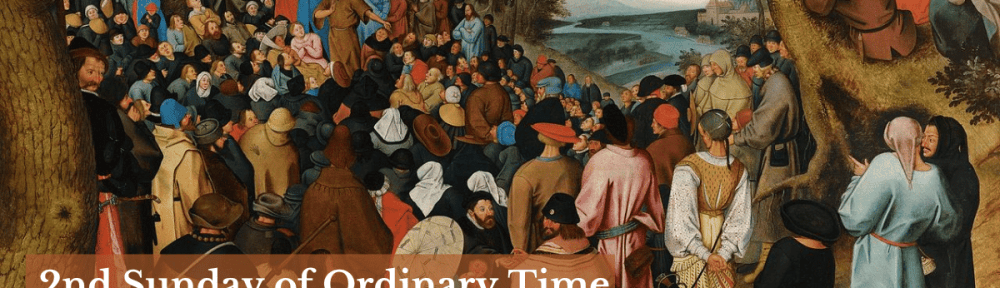
Image credit: Saint John the Baptist Preaching to the Masses in the Wilderness | Pieter Brueghel the Younger | Galerie de Jonckheere, Paris | Wikimedia Commons, PD-US
Discover more from friarmusings
Subscribe to get the latest posts sent to your email.
 friarmusings