29 The next day he saw Jesus coming toward him and said, “Behold, the Lamb of God, who takes away the sin of the world. 30 He is the one of whom I said, ‘A man is coming after me who ranks ahead of me because he existed before me.’ 31 I did not know him, but the reason why I came baptizing with water was that he might be made known to Israel.” 32 John testified further, saying, “I saw the Spirit come down like a dove from the sky and remain upon him. 33 I did not know him, but the one who sent me to baptize with water told me, ‘On whomever you see the Spirit come down and remain, he is the one who will baptize with the holy Spirit.’ 34 Now I have seen and testified that he is the Son of God.” (John 1:29-34)
After John’s interrogation by priests, Levites and Pharisees, the evangelist proclaims Jesus as “the Lamb of God, who takes away the sin of the world!’ This is but the start of a short, compact testimony by the Baptist witnessing to the One he had just baptized.
- “Behold the Lamb of God… (1:29)
- who takes away the sin of the world.” (1:29)
- The one who existed before John (1:30-31)
- The one on whom the Spirit came from the sky and remain upon him (1:32-33)
- “he is the Son of God.” (1:34)
The Fourth Gospel does not record, as the Synoptic Gospels do, the baptism of Jesus by John. However, the coming of Jesus mentioned in this verse was not his coming for baptism, because, as the reading implies, John had already witnessed the descent of the Spirit upon Jesus when he had baptized him. John already knew who Jesus was, and therefore said to those around, “Behold, the Lamb of God, who takes away the sin of the world”
Christian readers of the Fourth Gospel naturally infer that this is an allusion to the sacrificial death of Christ by which he atoned for the sins of the world as described earlier in this commentary. An interesting question is if there was a difference between what God was announcing to the world through the words of the Baptist – that indeed, a sacrificial death on the Cross was the means of atonement – and what the Baptist himself understood. Although it is not always prudent to “fuse” the different gospel narratives into a single account, one can not help but look “over our shoulder” to Matthew’s account where there are strong indications about what the Baptist understood. He expected the Messiah to carry out judgment against sinners, not to offer himself as a sacrifice for their sins (cf. Matt. 3:12: His winnowing fan is in his hand. He will clear his threshing floor and gather his wheat into his barn, but the chaff he will burn with unquenchable fire.”) The Baptist may have been identifying Jesus as the apocalyptic warrior lamb referred to in Jewish writings (e.g. 1 Enoch 90:9–12; Testament of Joseph 19:8–9) as did the author of the book of Revelation (Rev. 5:5–10; 17:14), though the latter fused the idea of the powerful lamb/lion of Judah with the sacrificial lamb. That being said, we should also recognize that the Fourth Gospel was written some 20 years after Matthew’s gospel.
The Fourth Evangelist, for his part, places the Baptist’s declaration into the wider context of his passion narrative. This “lamb of God” will, as the book of Hebrews makes clear, replace the entire OT sacrificial system that was merely provisional until the coming of Christ. Moreover, as God’s lamb, Jesus takes upon himself the sin, not merely of Israel, but of the entire world (cf. John 1:10). The idea that the Messiah would suffer for the sins of the world (rather than merely for Israel) was foreign to first-century Jewish ears; John’s gospel, however, makes clear that Jesus came to save the entire world (John 3:17; 1 John 2:2), and that he is the Savior of the world, not merely Israel (4:42; 1 John 4:14)
The fourth gospel’s teaching on Jesus’ substitutionary atonement builds on the evangelist’s earlier reflection on Jesus’ incarnation. For it is in the flesh that Christ suffered vicariously; his humanity was an indispensable prerequisite for his work on behalf of others. In fact, the atonement theme, far from being absent, is part of the fabric of John’s Gospel: Jesus is the Bread of Life, who will give his flesh for the life of the world (6:51; cf. 6:32–33, 53–58); he is the Good Shepherd, who lays down his life for his sheep (10:15; cf. 10:17–18); and his sacrifice fulfills Passover symbolism (e.g., 19:14, 31).
The Reveal. In his commentary on this gospel, Neal Flanagan [Collegeville Bible Commentary, 983] offers an explanation of why there is such a marked difference in the manner the Johannine Gospel reveals Jesus’ deeper identity immediately in the first chapter while the other Gospels let the “reveal” play out as the story unfolds. Or like, Mark’s gospel, keeps it a “secret.”
“This series of testimonies can be a source of confusion and difficulty for anyone who has read Mark’s Gospel, in which the disciples come to their faith-knowledge of Jesus only hesitantly, timidly, and imperfectly — and that over a lengthy period of time. John seems to contradict Mark’s picture. By the end of chapter 1 the Johannine disciples seem to know everything there is to know about Jesus, even his divinity. I think we must say that John is not attempting here to give a historical presentation of the first disciples’ advance in faith. He has a different purpose in mind. He wishes to impress these christological statements on the minds of his audience at the very start of his dramatic presentation; therefore his actors appear in a succession of brief scenes to pass along the required information. The testimonies indicate that the Gospel’s main interest is Christology. John may also wish to indicate through this procedure the way in which his own community advanced to its knowledge of Jesus: by moving from the circle of John the Baptist to the greater personage of Jesus, who was gradually recognized as the Lamb of God, God’s chosen One, the Messiah, Son of God, and King of Israel. Jesus was the fulfillment of all the Old Testament hopes.”
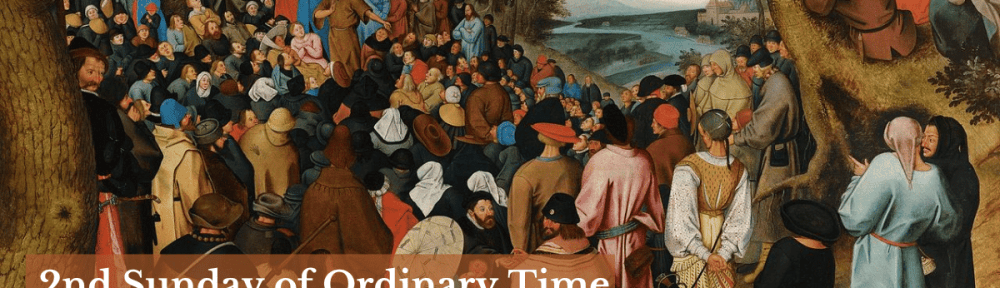
Image credit: Saint John the Baptist Preaching to the Masses in the Wilderness | Pieter Brueghel the Younger | Galerie de Jonckheere, Paris | Wikimedia Commons, PD-US
Discover more from friarmusings
Subscribe to get the latest posts sent to your email.
 friarmusings