As noted above, this gospel lays out the story of a new creation that flows through the “next day” of our gospel reading and into the remainder of the first chapter. In that vein, Flannagan notes that a similar story is unfolding as witnesses to Jesus are gathered. It is the “new creation” of the people of God. No longer defined by ethnic association, but by belief in Jesus as the Son of God. Flannagan continues:
“There is another purpose that John, a man of rich creative genius, may have intended. His list of characters in this first act/period of seven days seems to typify the basic personal elements of the Christian community. In order there appear: (1) John the Baptist, precursor to the new creation, whose sole function is to witness; (2) the Savior; (3) disciples who hear, follow, look for, and stay; (4) Peter, the rock; (5) missionaries like Andrew arid Philip who spread the good news; (6) Nathaniel, the true Israelite in whom there is no guile, who, as some Jewish traditions expressed it, studied law under a fig tree and was rewarded. With this, the founding elements of the community are assembled.”
The Testimony. The Baptist makes clear that until seeing the descent of the Spirit upon Jesus, he did not know Him. This is not to say he had no idea about who Jesus was – after all they were cousins. Given that Jesus was brought up in Galilee and John in the Jerusalem area, perhaps they never met, or perhaps it had been since they were children and so Jesus was not recognizable. But by the time of this testimony, it is clear that the Baptist knows of Jesus and has a sense of his mission – even indicating “he existed before me…” We know the baptist is older than Jesus (cf. the Visitation story in Luke). Does the Baptist have an idea of the existence of Jesus before time itself? With all that is being revealed to the Baptist (by the Spirit?) it is no wonder that he remarks: “I did not know him” akin to “who is this guy, my cousin, I guess I really didn’t know him! But now I see…”
but the reason why I came baptizing with water was that he might be made known to Israel.” 32 John testified further, saying, “I saw the Spirit come down like a dove from the sky and remain upon him. 33 I did not know him, but the one who sent me to baptize with water told me, ‘On whomever you see the Spirit come down and remain, he is the one who will baptize with the holy Spirit.’ 34 Now I have seen and testified that he is the Son of God.”
Unlike the Lukan account, this gospel does not say whether the sign of the dove was included in the original revelation, or whether he simply recognized the dove for what it was when he saw it alight on Jesus. But what is clear is that he was given a divinely appointed sign, and that he knew Jesus by that sign. The Baptist is the one disciple who received true illumination about Jesus; every other disciple is dependent on another human witness.
John goes on to describe him as “the One who will baptize with the Holy Spirit.” The other three gospels make this point; Jesus came that people might be brought into contact with the divine Spirit who leads people into the infinite divine spiritual resources. This had not been possible previously, for there is a quality of life that Christ and none other makes available. Baptism with water in John’s time was a form of cleansing and an outward sign of repentance. Baptism with the Spirit portends a new thing. It is the bestowal of new life in God. In the Catholic understanding of Sacramental Baptism, both are accomplished. A person is cleansed of all sin and given the Spirit. It is an outward sign of an inward reality.
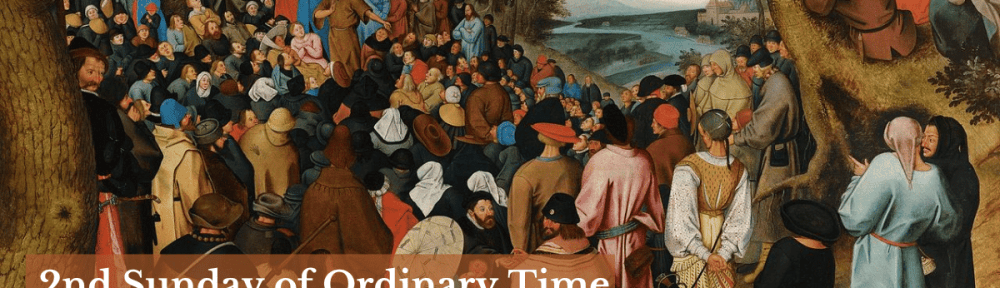
Image credit: Saint John the Baptist Preaching to the Masses in the Wilderness | Pieter Brueghel the Younger | Galerie de Jonckheere, Paris | Wikimedia Commons, PD-US
Discover more from friarmusings
Subscribe to get the latest posts sent to your email.
 friarmusings