There is what scholars sometimes describe as a “lovely strangeness” in how the evangelists talk about John the Baptist. Each writer is announcing the same figure, but each tunes John’s ministry to a distinct theological key. Modern scholars tend to emphasize those distinct emphases; the Church Fathers, with their characteristic theological imagination, tend to harmonize them.
Mark leads with moral urgency. John appears in the wilderness: “proclaiming a baptism of repentance for the forgiveness of sins” (Mk 1:4). Repentance is the doorway into the story. John’s baptism cleans, prepares, and awakens Israel to the coming kingdom. Mark is writing for a community who needs to know that the gospel demands an immediate response. The Gospel of John gives a different angle. John the Baptist says: “I did not know him, but the reason why I came baptizing with water was that he might be made known to Israel.” (Jn 1:31) And the Baptist’s testimony climaxes in the Spirit descending and remaining: “I saw the Spirit come down like a dove from the sky and remain upon him.” (Jn 1:32). The Fourth Gospel is not denying repentance; it simply pivots to revelation. John is the hinge by which Israel sees the One upon whom the Spirit rests. The heart of John’s theology is revelation: Jesus is shown as the Lamb of God, the Spirit-bearer, the Son.
Modern scholars today tend to approach each gospel as its own literary and theological world. So they notice that Mark focuses on the ethical preparation of the people. John’s ministry cleans the heart so that one can welcome the stronger One who is coming, focusing on Christological revelation. The Baptist’s job is not primarily to purify Israel but to point out and identify Jesus as the one on whom the Spirit “remains” which will be a major Johannine theme. Modern critics don’t see these as contradictions but as distinct windows into the same historical event.
The Early Church writers in the 2nd through 4th centuries did not focus on the topics as modern scholars. The Father treated Scripture as a unified symphony, not a set of competing soloists. So they typically harmonize the accounts. They see the accounts as windows with complimentary views of the same historical event. Augustine, Chrysostom, and Hilary of Poitiers all say something like this: John’s baptism is first a baptism of repentance, preparing the people; it is also God’s chosen stage on which Jesus’ identity is revealed. John Chrysostom says that John called Israel to repentance so that they would be ready to see Christ when he appeared. Repentance clears the eyes; revelation fills them. Hilary notes that the Baptist is “the boundary between the covenants”—the last prophet of the old and the first herald of the new. His washing works as a sign, not as a sacrament; its value lies in its direction.
Either way, the outcome is the same: the Baptist’s ministry is a hinge between the old age and the new. The ministry calls Israel to turn back to God and pointing, unmistakably, to the One in whom the fullness of the Spirit dwells.
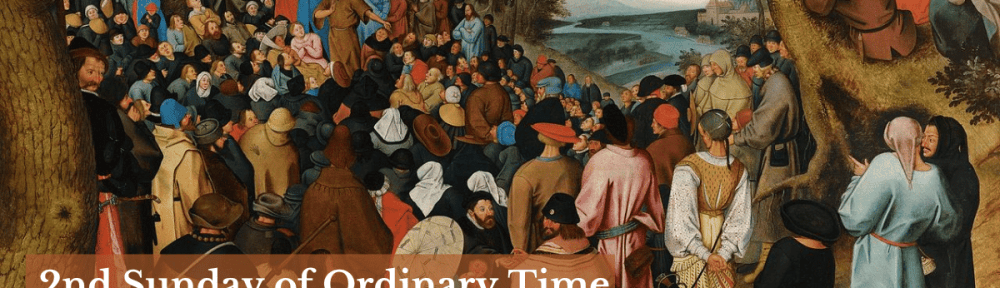
Image credit: Saint John the Baptist Preaching to the Masses in the Wilderness | Pieter Brueghel the Younger | Galerie de Jonckheere, Paris | Wikimedia Commons, PD-US
Discover more from friarmusings
Subscribe to get the latest posts sent to your email.
 friarmusings