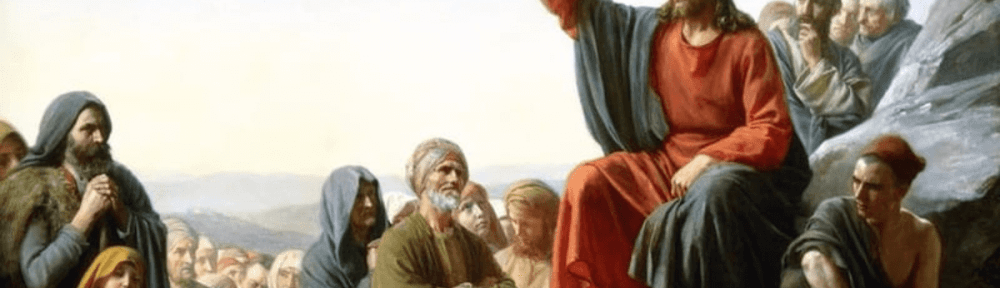
“You are the light of the world. A city set on a mountain cannot be hidden. Nor do they light a lamp and then put it under a bushel basket; it is set on a lampstand, where it gives light to all in the house. Just so, your light must shine before others, that they may see your good deeds and glorify your heavenly Father.” (Mt 5:14-16)
In Scripture, light symbolizes God’s presence (Ex 13:21; Ps 27:1), God’s wisdom and law (Ps 119:105), revelation of truth, joy and salvation, and the mission of Israel (Isa 42:6; 49:6). In the Gospel of John, Jesus is explicitly called “the light of the world” (John 8:12). Matthew applies that same imagery to Jesus’ disciples. That alone is a striking theological claim.
Matthew highlights that the light of the disciples is derived, not inherent. They share in the Light of Christ. Since Jesus proclaims Himself the true light (cf. John), the Church becomes the reflection of Christ’s light, a visible continuation of His mission, and a community whose holiness reveals the presence of Christ. This interpretation connects closely to the idea of the Church as the body of Christ (cf. 1 Cor 12).
Matthew 5:16 explicitly identifies the “light” with good deeds that point to God: “that they may see your good deeds and glorify your heavenly Father.” Light, therefore, is concrete actions of mercy, justice, forgiveness, and compassion forming a public witness to God. These actions become a force that pushes back the darkness of sin, sorrow, confusion, and injustice. Unlike the hidden practices in Mt 6 (almsgiving, fasting, prayer), these deeds are meant to be public because they reveal God’s goodness, not the disciple’s ego.
Isaiah speaks of Israel as a “light to the nations” (Isa 42:6; 49:6). Jesus now gives that vocation to the disciples. Thus, Matthew presents the Church not as replacing Israel but fulfilling Israel’s mission of making God known among the nations. The mission is to reveal God’s justice and mercy and so for the Church and its members to be a visible sign of the kingdom.
A city built on a hill is both unavoidable and unambiguous. In the same way, the Christian community is meant to be publicly recognizable. The Church can not be an agent of the Kingdom if its holiness remains private, hidden. The nature of discipleship is inherently evangelistic, calling people to “come” to the “city set on a mountain.” The city is the Church, an ecclesial image of the visible and public community, not simply individuals
A “lamp on a lampstand” connects to a simple image that was in the experience of all people: a single small lamp could illuminate the entire room. Jesus’ image teaches that the gift of faith is meant to be shared to light up a community and the world. It means that disciples should live lives of integrity, transparency, and in view of the world. Suppression of one’s Christian identity contradicts the very nature of discipleship. And in a world that may push back or ridicule, fear must not extinguish missionary zeal. Fearless witness a a theme frequently emphasized in Matthew’s writings (cf. Mt 10:26–33). It means that the disciple must refuse to hide the Gospel.
Matthew’s use of light also serves as an image of interior transformation that becomes exterior witness. In Jewish wisdom literature, light symbolizes wisdom and the inner life of the righteous: “The light of the just rejoices” (Prov 13:9). This idea is also well expressed in the familiar passage: “Your word is a lamp for my feet, a light for my path” (Ps 119:105) Thus, being “light” involves an interior conversion that is achieved by embracing the Beatitudes. This leads to an exterior radiance in which the disciples live visibly transformed lives. The Sermon on the Mount emphasizes this integrity between inner dispositions and outward actions as constituent of discipleship.
St. Augustine understood the light as the life of grace within the disciple, expressed in noble deeds directing praise to God. St. John Chrysostom held that light refers to the example of the apostles, who enlighten a world darkened by ignorance and sin, emphasizing that Christian witness must be both public and humble. St. Jerome pointed out that light is the proclamation of the gospel, dispelling the shadows of error. St. Gregory of Nyssa emphasized the interior life in which light is the soul purified and united with God, whose radiance naturally spreads outward.
The Church, as the Body of Christ, is tasked with carrying that Light to all the world in its fundamental roles of evangelization, carrying out works of justice and mercy, living holiness of life in our everyday, being a public witness of truth, and being a source of comfort for the afflicted, thus revealing God’s compassion. The Catechism echoes all this emphasizing the Christian vocation to transform society. (CCC 782, 2044–2046)
With the use of the light imagery, Jesus declares that His disciples, shaped by the Beatitudes are:
- the visible manifestation of God’s presence
- the continuation of Israel’s vocation to enlighten the nations
- the instruments by which Christ shines into a dark world
- called to public witness through good works that reveal God’s glory
Being light is not optional—it is the very identity and mission of the disciple.
Image credit: Sermon on the Mount (1877) by Carl Heinrich Bloch | Museum of National History | Frederiksborg Castle, Public Domain
Discover more from friarmusings
Subscribe to get the latest posts sent to your email.
 friarmusings