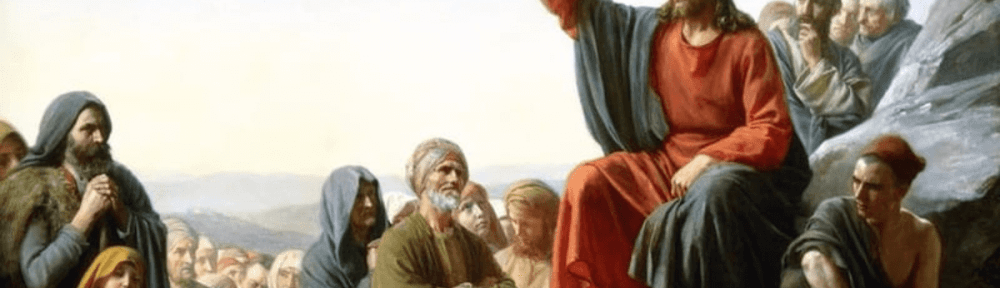
“Do not think that I have come to abolish the law or the prophets. I have come not to abolish but to fulfill.” (Mt 5:17)
The opening passage of this Gospel is controversial. Is it a general statement of Jesus’ attitude to the Old Testament? Especially in its legal provisions, is it designed to introduce the detailed examples of Jesus’ teaching in relation to the Old Testament law in vv. 21–48 and other points throughout the Gospel? Do Jesus’ words affirm the permanent validity of the details of the Old Testament law as regulations, or do they express more generally the God-given authority of the Old Testament without specifying just how it is applicable in the new situation introduced by the coming of Jesus?
Too often the question becomes framed only with respect to the “Law” where the verse reads: “Do not think that I have come to abolish the law or the prophets. I have come not to abolish but to fulfill” (5:17). The “law or the prophets” establishes a literary bracket with 7:12 (Do to others whatever you would have them do to you.This is the law and the prophets.”), setting off the verses/sections in between as the instructional core of the Sermon. The phrase itself technically refers to the Pentateuch, the Former Prophets (Joshua-Kings) and Latter Prophets (Isaiah-Malachi), but forms the functional equivalent of the whole of Scripture.
Remember that this is not an apologetic to those who had accused 1st-century Christians of rejecting the Law (or rather the rabbinic interpretation of the Law), but rather is for “internal use” by Christians who belong to a community that has made some fundamental changes to Torah observance (which is different that rejecting the Law). Jesus does not abolish the law, yet he does not affirm the status quo of the manner of observance. How are we to understand this “in-between” posture? Eugene Boring (186-87) offers some clear insights as he writes:
“(1) The whole Scripture (‘law and prophets’) testifies to God’s will and work in history. Matthew does not retreat from this affirmation. He does not play off the (abiding) ‘moral law’ against the (temporary) ‘ceremonial law.’
“(2) God’s work, testified to in the Scriptures, is not yet complete. The Law and Prophets point beyond themselves to the definitive act of God in the eschatological, messianic future.’
“(3) The advent of the messianic king’s proclaiming and representing the eschatological kingdom of God is the fulfillment of the Scriptures – the Law and Prophets. The Messiah has come. He embodies and teaches the definitive will of God. The Law and Prophets are to be obeyed not for what they are in themselves, but because they mediate the will of God. But in Matthew, Jesus declares that what he teaches is God’s will and the criterion of eschatological judgment (7:24, 26; cf. 7:21), so there can be no conflict between Jesus and the Torah, which he fulfills. This is a tremendous, albeit implicit, christological claim.
“(4) The messianic fulfillment does not nullify or make obsolete the Law and the Prophets, but confirms them. The incorporation of the Law in the more comprehensive history of salvation centered is the Christ-event which is an affirmation of the Law, not its rejection.
“(5) But his affirmation, by being fulfilled by Christ, does not always mean a mere repetition or continuation of the original Law. Fulfillment may mean transcendence as well (cf. 12:1-14). The Matthean Jesus elsewhere enunciates the critical principle that mercy, justice, love, and covenant loyalty are the weightier matters of the Law by which the rest of must be judged (see 9:13; 12:7, both of which quote that his own life and teaching are the definite revelation of the will of God; cf. 11:25-27; 28:12-20) does indeed mean that neither the written Torah nor its interpretation in the oral tradition…is the final authority.”
At this point one needs to be careful lest one is drawn into a purely “Law” question and begins to focus on the legal portion of the Mosaic covenant to the exclusion of the remainder of that covenant, as well as the other covenants that make up the whole of the relationship of the people with God. Remember that this passage follows upon an earlier passage wherein Jesus is teaching the disciples about discipleship in the kingdom of heaven (5:1-2) – something that is here and yet not fully here.
Image credit: Sermon on the Mount (1877) by Carl Heinrich Bloch | Museum of National History | Frederiksborg Castle, Public Domain
Discover more from friarmusings
Subscribe to get the latest posts sent to your email.
 friarmusings