18 Amen, I say to you, until heaven and earth pass away, not the smallest letter or the smallest part of a letter will pass from the law, until all things have taken place.” It is notable that “the prophets” are not mentioned again in Matthew 5; the focus seems to now be on the law alone. The statement is striking and perhaps somewhat puzzling. It is clearly a statement of the permanence of the law. The preservation of every least mark of the pen is a vivid way to convey that no part of it can be dispensed with. But the saying is complicated by two “until” clauses. It is not clear how these two clauses relate to one another, or whether they are making the same or different points. “Until heaven and earth pass away” is the equivalent of our modern “until hell freezes over” – a colloquial way of saying “never.” The phrase about “heaven and earth” appears as a positive in Jeremiah (cf. Jer 31:35-36; 33:20-21, 25-26) and Job 14:12. The expression is also used positively in Ps 72:5, 7, 17. The repetition of the verb “pass away” (parerchomai) links the law to the earth/heavens as equally permanent. Note that in Mt 24:35 Jesus’ own words are stated to be more permanent than heaven and earth.
The puzzling part comes with the use of the second “until.” Some see the repetition as just that, a repetition for emphasis. But the second “until” is contextualized by something happening, whereas the first is in the context of something that will not happen. The majority of scholars see the phrase “until all things have taken place” as typical Matthean use of eschatological fulfillment (as he does later in 24:34). If this is correct then fulfilling the law and the prophets is in terms of a future situation to which the law pointed. Then the text could be saying that the smallest detail of the law would be valid until the fulfillment arrived – and only valid until then.
This is the point at which some insist that Jesus is that fulfillment and since Jesus is there in their midst, then the law passes away. But in the light of Jesus claiming not to abolish the law (v.17), his insistence that even the least of the commandments remains important (v.18) and that the community is to “obey and teach these commandments” (v.19) – that understanding seems improbable.
The double “until” is perhaps awkward but is paraphrased by RT France (2007, p.186) as: “The law, down to its smallest details, is as permanent as heaven and earth, and will never lose its significance; on the contrary, all that it points forward to will in fact become a reality.” The new reality is present in Jesus, but not fully present as the kingdom of heaven. Still the law (smallest detail and all) have to be seen in a new light, but they still cannot be discarded. Matthew will make clear in 5:21-47 how the law will function in a new situation where they are not halakah but are pointers to a greater righteousness (relationship) in the family kinship (covenant).
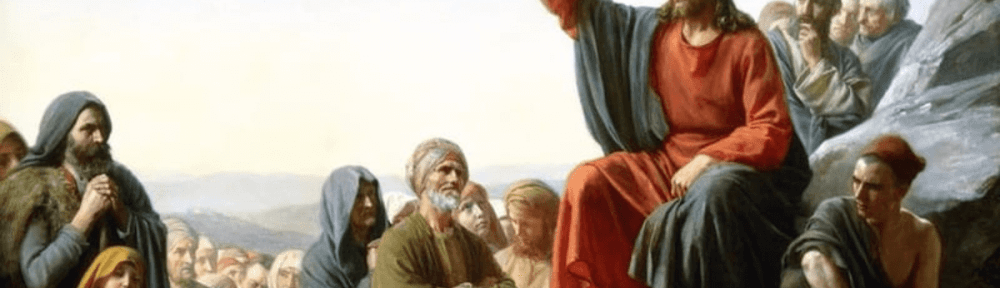
Image credit: Sermon on the Mount (1877) by Carl Heinrich Bloch | Museum of National History | Frederiksborg Castle, Public Domain
Discover more from friarmusings
Subscribe to get the latest posts sent to your email.
 friarmusings