Both France and Boring point to the movement towards righteousness as expressed in a deepening of relationship with God – not by external observance alone – but by a conscious movement of conversion to the deeper observance to the root (radix) of things: seeking out the Divine will it in fullness in order to live that out in the world. In other words, to more fully be the people of God – that is, to be the covenant people that God has always intended them to be.
And perhaps most radical of all, let us not lose sight, this portion of the Sermon on the Mount also marks Jesus’ assertion of authority. But it is not simply claiming a new contribution to the exegetical debate among rabbis, Jesus is making a definitive declaration of the will of God. Such a claim demands (and receives, 7:28–29) the response, “Who is this?”
A Final Thought
And all the above is but an introduction to the “Sermon on the Mount.” Perhaps it is good to recall the beginning of this commentary.
The sermon is not, though, a comprehensive manual or rule book, not a step-by-step “how to” book. Rather it offers a series of illustrations, or “for examples,” or “case studies” of life in God’s empire, visions of the identity and way of life that result from encountering God’s present and future reign. (p.128)
For those who belong to the minority and marginal community of disciples of Jesus, the sermon continues the gospel’s formational and envisioning work. It shapes and strengthens the community’s identity and lifestyle as a small community in a dominant culture that does not share that culture’s fundamental convictions. The community is reminded that the interactions with God, with one another, and with the surrounding society are important aspects of their existence which embraces all of life, present and future. Mission to, love for, and tension with the surrounding society mark their participation in this society. Integrity or wholeness defines their relationships with one another. Prayer, accountability, and the active doing of God’s will are features of their relationship with God and experience of God’s empire. (Warren Carter, Matthew and the Margins; p.129)
As covenant people, we have the promise of God – much of which is unconditional – that our right relationship with Him provides a wholeness for life by which we can freely enter into a full relationship with God and with his people. The arc of Scripture shows God building for Himself a people. From family (Adam), clan (Noah), tribe (Abraham), federation of tribes (Moses), a nation (David), the covenants point in line and in pattern to the whole of the world as the people of God in and through the Covenant in Jesus. If one loses sight of this, then one forever asks “what do I have to do” instead of “what am I becoming.”
The Sermon on the Mount is the guideline to becoming holy and righteous before God.
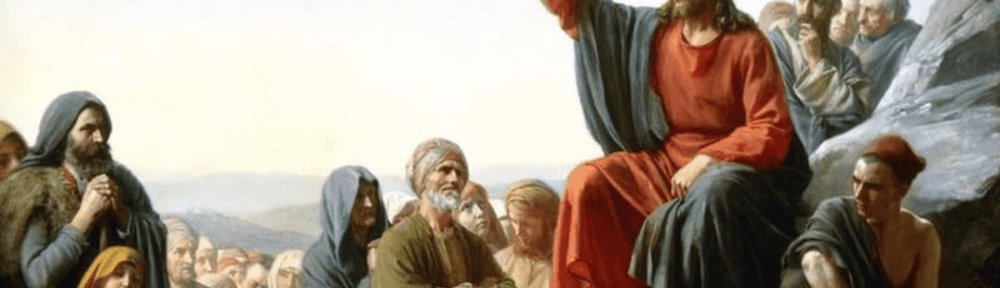
Image credit: Sermon on the Mount (1877) by Carl Heinrich Bloch | Museum of National History | Frederiksborg Castle, Public Domain
Discover more from friarmusings
Subscribe to get the latest posts sent to your email.
 friarmusings