
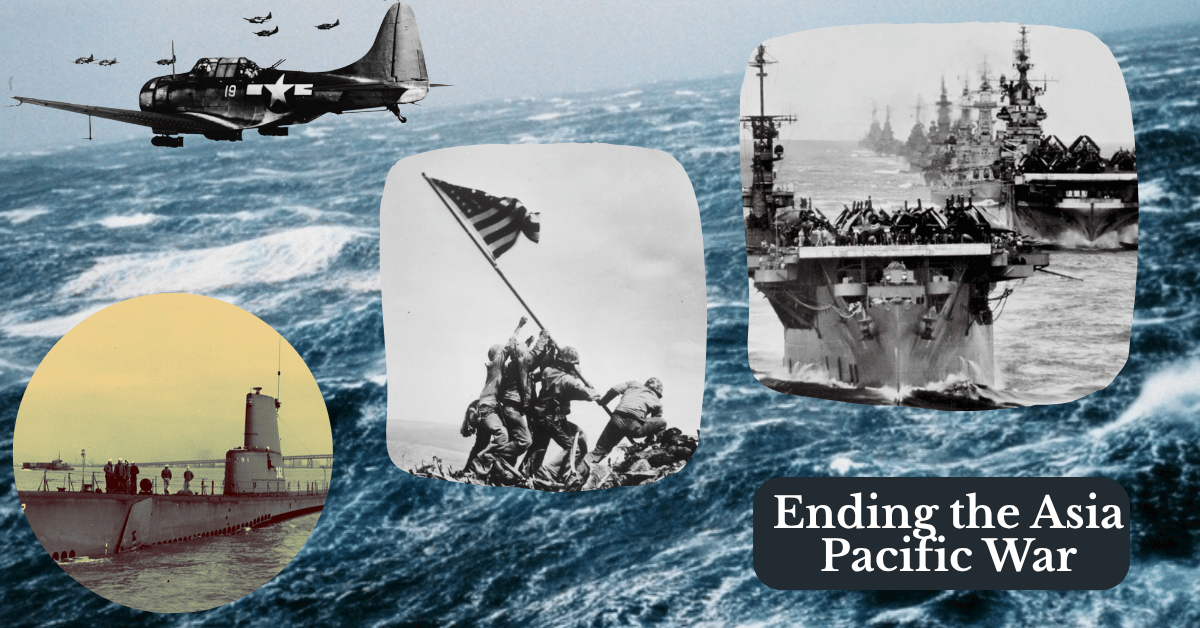
This second phase of the series on the Asia-Pacific War began with a goal of discovering if there was merit to the claims made by some historians that in the summer and autumn of 1941 the United States missed diplomatic opportunities that could have avoided war with Japan and at the same time took a series of economic actions that brought about U.S. involvement in the Second World War. The exploration has taken us from the pre-history to Japan of the early 20th century discovering currents, trends, events, personalities and changes that brought that nation to 1937. Along the way we considered the complex and evolving nature of Japan’s relationships with China, Korea, Russia, and the United States. All of this (and far more) were the ingredients in the mix that formed Japan’s strategic, economic, political, and civil policies.
A Future of the Asia Pacific Region
These policies brought Japan and the U.S. to a crossroad each having different objectives and visions of their roles and future in the Asia-Pacific region. The U.S. was committed to its own Westphalian vision of the world as its fundamental principles: democratic government (without kings or emperors), open markets with fair and free trade (at least in theory), respect for national boundaries and sovereignty (with an aversion to classic colonialism but with a Monroe Doctrine), and non-interference with the internal governance of another country (but trade and the Monroe Doctrine were priorities). Without a doubt that is so general a description it suffers in accuracy, but it has points and exceptions. Some of the exceptions are striking: Admiral Perry’s presence in Tokyo Bay ostensibly to open up trade in the western Pacific, the annexation of Hawaii, the territories of Guam and the Philippines, and its business interests in China. What was a fundamental driver of its Asia-Pacific ambitions? Business. The U.S. was a nation of massive natural resources, industrial power, financial wealth, and at least in a business sense, a drive to be a market leader. It was a country with minimal import needs and massive export capacity.
Japan was an island nation of limited key material natural resources, limited land for agriculture, a net importer of strategic raw materials and in the 20th century was over populated and a net importer of basic foodstuffs, even rice. While in its own history Japan had never been successfully invaded it was always concerned to the point of obsession with its vulnerability to invasion and embargo. The fall of the once great China to its state in the 19th and 20th centuries was a clarion call to protect Japan from the grip of the western colonial powers. This gave way to the transformation of the feudal samurai system to a modern army and navy based on European models, ultimately leading to rise in militarism that was only enhanced by Japan’s defeat of China and Russia within a 10 year period. Now it was ready to take its place and be recognized as a world power with a special sphere of influence in the western Pacific – a role and recognition it never received, only enhancing its sense of vulnerability to the western powers.
Colonialism and Racism
Japan abhorred western colonialism yet it had colonial ambitions for Korea (annexed in 1910) and Manchuria (conquered by 1932 and renamed the independent nation of Manchukuo) for both strategic buffer and for emigration of its people and access to food and raw materials. It participated in world trade but with a wary eye seeing what the “Open Market” policy (a U.S. initiative) had done to China. The Meiji Restoration and Constitution’s governance appeared as liberal democracy akin to Britain – and in many ways it was growing into it – but the military had an outsized place in the nation and without civilian control. The military was responsible only to the Emperor.
When modern people consider the 1942 internment of west coast U.S. citizens of Japanese origins, it is commonly held that it was basic racism and unwarranted fear that motivated the action. It was primarily fear and national politics, but that was just the immediate context for the underlying racism in California – which was present elsewhere. The U.S. federal government had to inject itself into California politics when the state passed laws restricting land ownership and segregating schools that applied only to Japanese. But in 1924, the federal government passed the 1924 Immigration Act which specifically excluded Japanese from U.S. and all territories, e.g. Hawaii. In 1924, 40% of Hawaiian residents were of Japanese origin. The U.S. was just more overt about racism as Japan had its own form.
Japan viewed all westerners as decadent, weak, uncultured and morally inferior. At the same time, this anti-Western racial critique coexisted with hierarchical and discriminatory attitudes toward other Asians, especially Chinese and Koreans, who were frequently described as backward and in need of discipline. The result was a contradictory worldview: Japan opposed Western racism in principle, yet practiced its own racial and cultural hierarchy in Asia, a tension that shaped both its propaganda and its imperial conduct in the 1930s.
A Cautious Eye
These were the two nations that arrived at the crossroads of the 20th century each casting a cautious eye towards the other, each sensing that the other would be the inevitable rival. Early in the century each country, as is prudent, developed “what if” war strategies. Both countries were adherents of Mahan’s theory of naval power (The Influence of Sea Power upon History) and saw in each other threat to their own ambitions. Each nation’s naval war colleges developed and adjusted its Pacific strategies. Virtually every senior naval leader in the Pacific had studied these and contributed to it as new circumstances, technology, and situations arose. As one historian noted: “it was part of their DNA.”
Japan’s army faced west and northwest to expand its colonial ambitions on the Asian mainland. Japan’s navy faced south to the oil rich regions of the Pacific island nations as it also faced east to the U.S. its current major supply of oil and ship building materials. The U.S. navy had missions in the Atlantic and Pacific but only enough assets for a “one-ocean navy”. After World War I, the U.S. interest was controlling navies and the status quo. This led to the 1922 Washington Conference that established limits on capital ships. It also ultimately led to deep divisions with the Imperial Navy. One faction knew it could never match U.S. industrial power and wanted to avoid a naval arms race and was satisfied that the limits were within the Mahanian theory in that the U.S. would have to transit the Pacific Ocean. The other faction was more driven by an ideology of the Navy as the ocean guardian of the Imperial destiny of a greater Asia led by the Emperor. The Washington treaty was a barrier and worse, an insult to national honor.
Key Figures at the Crossroads
By 1937 it seems fair to say that Japan was a nation with an amazing degree of disunity within – and a single key to the unity of the nation as a whole: the Emperor and the idea of kokutai – and these were not clear to West nor it seems to Emperor Hirohito himself as to the role he could play.
Historians do not agree on the role Hirohito played in the path to the Asia Pacific War. He was the Commander-in-Chief of the armed forces, yet his Kwantung Army in Manchuria feels free to do what it wants, not expecting and not receiving punishment for their actions. Emperor Hirohito’s response to incidents such as the Marco Polo Bridge affair was to “fire” the Prime Minister but not to take any action within Army ranks. This does not seem to indicate Hirohito feels he should be an absolute monarch or even the “buck stops here” commander-in-chief. The range of views includes Herbert Bix’s assessment that Hirohito was an active, knowledgeable, directive monarch and had a key role in strategic military decisions. There is historian Stephen Large’s idea of “self-induced neutrality” in which Hirohito knew his power and authority but withheld its use to allow others to lead. The historian Peter Wetzler’s version is that the Emperor periodically put his thumb on the scale but he did not see himself responsible for the result. This version sees Hirohito aware of Japanese atrocities but taking no action to intervene but in the end it was Hirohio’s “thumb on the scale” that ended the war.
And yet the man and his role in Japanese governance was unclear at best to 1940 Washington leaders. But hardly less clear were key government positions. Between July 1937 and December 1941 there were nine different people serving in the role of Foreign Minister. There were six different Prime Ministers in that same period although Prince Konoe served for a total of 12 months and during critical periods.
In that same period Roosevelt was President and Cordell was Secretary of State – but they were not always on the “same page.” Hull was very territorial of his role and believed the role of the President was to set macro-level policy and everything else was the purview of the Secretary of State. But Roosevelt dabbled in foreign policy from time to time. Hull’s irritation with Roosevelt’s “dabbling” in Japan policy between 1937 and 1941 stemmed from the president’s habit of personal, informal, and sometimes contradictory diplomatic initiatives, which Hull feared undercut coherence, leverage, and credibility.
Roosevelt was noted and preferred back-channel and personal diplomacy. Most notably, FDR repeatedly encouraged or entertained the idea of a personal summit with Japanese leaders (especially Prince Konoe in 1941), sometimes through intermediaries or informal messages, without firm preconditions. Roosevelt also floated tentative peace feelers, exploratory trial balloons, and hypothetical compromises often orally, ambiguously, or indirectly rather than through formal diplomatic notes. In addition, FDR occasionally made public statements or private assurances that suggested flexibility (or restraint) that had not been fully coordinated with the State Department.
Hull’s experience was that Japan used negotiations tactically to buy time while consolidating aggression in China and preparing for further expansion. Roosevelt’s informal probes, in Hull’s view, risked sending mixed signals about U.S. resolve and principles, weakened bargaining leverage by suggesting concessions before Japan changed behavior, undermined State Department control over a carefully constructed, principle-based negotiating position, and encouraging Tokyo to believe that persistence or pressure might extract a deal from the president personally
Hull favored clear, written, multilateral, principle-driven diplomacy (non-aggression, territorial integrity, Open Door), whereas Roosevelt favored personal flexibility and strategic ambiguity. To Hull, the president’s “dabbling” threatened to turn diplomacy into improvisation at precisely the moment when clarity and firmness, he believed, were essential.
Even though our “cast of characters” was consistent, Hull was concerned the “message” was not. This added a degree of uncertainty to any dialogue that was compounded by the frequent changes in Japan. As one might imagine this was the tip of the iceberg. More details were provided in the post American Diplomacy in 1937 which describes a lack of unified thinking with the State Department.
The Crosses
There are cross purposes, crossroads, crossed messages and more. In July 1940, the United States initiated significant export restrictions against Japan by passing the Export Control Act which allowed the President to license or prohibit the export of essential defense materials. Roosevelt restricted licenses for high-grade aviation gasoline, lubricating oil, and certain iron and steel scrap. These measures aimed to curb Japanese aggression, specifically in response to pressure on French Indochina, without triggering an immediate, total war-inducing oil embargo. In general, they were also intended to impact Japan’s aggression in China. These actions followed earlier 1938–1939 “moral embargoes” on aircraft and raw materials. All this complicated any foreign policy dialog between nations that were only going to become more difficult.
In November of 1940 retired Admiral Nomura was assigned as Ambassador to the United States. When Emperor Hirohito was in his teens, Nomura was one of his private tutors. He also served as Naval Attache in Washington DC when Franklin Roosevelt was Assistant Secretary of the Navy. They were friends and so it was hoped that the connections to the leaders of the two nations would help communications. But neither the Foreign Ministry nor State Department wanted such channels open and required formal communications through the usual chain.
Ambassador Noruma was also not in the mainstream of senior naval officers as he was known to be a supporter of the 1922 naval treaties. He understood that the U.S. was the nexus between industrial power and ultimate sea power. He was also one of the few senior people who understood that the American public would see any Japanese-U.S. conflict as a battle of fascism vs. democracy, and also if Japan moved against British interests in the Pacific, Britain would be fully supported.
He recognized that the only bulwark to prevent Japanese-US conflict would be if senior naval leadership acknowledged that Japan could not prevail in a protracted war with the United States nor would there be the “decisive battle” that caused the U.S. to negotiate a peace. Once bloodied, the U.S. could bring its industrial power to bear and in the interim the American public would give enduring support to war efforts. All of these positions were mixed at best among senior naval leaders. Among mid and junior naval officers these were discarded as weak thinking. This group was very positive about the Tripartite Pact with Germany and sought distinction in a naval move into the Southwest Pacific.
Nomura made his views known to Navy Minister Oikawa and Fleet Admiral Yamamoto who agreed. Yet former Prime Minister Yonai (a naval officer) warned Nomura that he was being sent as the scapegoat. He warned that Foreign Minister Matsuoka would take credit for any success and blame Nomura for setbacks and failures. At best Matsuoka would sweep into Washington DC with a separate agenda and negotiate as he had done in Berlin and Moscow.
As one dedicated in service to his nation, he accepted the position. And in a harbinger of things to come he was sent without specific policy instructions.
When he arrived in Washington DC his naval attache was Capt. Yokoyama with whom he had served in the Military Mission in Britain years before. Yokoyama shared Nomura’s ideas and perspectives. But the American concerns in that time period were not Japan. The administration was focused on Europe having established a “Europe First” policy. The goals were munitions and supplies to Britain and convoy escort and protection. U.S. Chief of Operations Stark (the title was actually different) bluntly told Nomura that war with Japan was “when, not if.”
This is the diplomatic milieu facing Japan and the United States at the beginning of 1941.
Stay tuned…
Image credit: various photographs from Naval Aviation Museum, National World War II Museum, and US Navy Archives.
 friarmusings