
Between 1939 and 1941, President Franklin D. Roosevelt confronted a central strategic dilemma: how to oppose Nazi Germany and keep Britain in the war while U.S. public opinion overwhelmingly opposed entering another European conflict. Roosevelt’s response was a policy of incremental engagement on economic, military, and political level, all designed to shift the balance of power without formally declaring war. This strategy succeeded in sustaining Britain and positioning the United States as the decisive future belligerent in Europe, but it also produced ambiguity and mixed signals both within his own administration and abroad, particularly affecting Secretary of State Cordell Hull and Japanese perceptions of U.S. priorities.
The Core Concerns
Roosevelt’s overriding concern after 1939 was that a German-dominated Europe would fundamentally threaten long-term American security. He believed that Britain’s survival was essential to prevent Nazi hegemony over the Atlantic world for reasons of democracy and international trade as well. He was convinced that a German victory would eventually force the United States into a far more dangerous war under worse conditions or would leave the U.S. isolated with fascist nations on the other side of two oceans.
Importantly, the U.S. needed time to build industrial and military capacity both of which were the nation’s most valuable strategic asset. In 1936 the Washington Naval Treaty, which had sharply limited the future growth of the U.S. Navy in the name of arms control, expired. Roosevelt let it lapse. He then ordered the Navy to launch its first major shipbuilding program in more than twelve years (one of the ships to come. In 1938 the Army Air Corps got the biggest authorization for buying planes in its history. From the fourth-biggest military force in the world in 1918, the United States Army shrank to number eighteen, just ahead of tiny Holland. By 1939 the Army Air Corps consisted of some seventeen hundred planes, all fighters and trainers, and fewer than 20,000 officers and enlisted men. Arthur Herman’s Freedom’s Forge is a fascinating account of the plan FDR put in place so by December 1941, the industrial capacity of the U.S. was well underway to achieving a war footing from an industrial base.
At the same time, Roosevelt faced a public with deep and recent memories of the costs of World War I resulting in a wide-spread suspicion of foreign entanglements. As a result there was a strong isolationist sentiment in Congress and among the public. This led Congress to pass the 1935 Neutrality Acts which stated the U.S. could trade with belligerents in foreign wars.
Escalation short of war
From 1939 to 1941, Roosevelt pursued a steady escalation of U.S. involvement short of becoming involved in the European war. Key elements of that escalation included:
- Cash-and-carry (1939) allowed Britain and France to purchase arms.
- Destroyers-for-bases (1940) provided Britain with vital naval assets.
- Lend-Lease (1941) transformed the U.S. into the “arsenal of democracy.”
- Naval patrols and Atlantic convoy escorts increasingly blurred the line between neutrality and belligerency.
- The Atlantic Charter (August 1941) publicly aligned U.S. war aims with Britain.
Roosevelt understood that these actions made eventual conflict with Germany likely, but he judged that preserving Britain and buying time outweighed the risks. Importantly, he often moved faster than public opinion but slower than his own private convictions, using executive authority and rhetorical framing to narrow the gap.
Strategic Ambiguity
Roosevelt’s diplomacy depended on strategic ambiguity. He avoided explicit war commitments while steadily expanding U.S. involvement. This ambiguity was essential domestically but costly diplomatically. Publicly, Roosevelt repeatedly promised not to send American troops into foreign wars but framed the actions he took, often by executive authority, as defensive or humanitarian. At the same time, privately, he anticipated war with Germany as increasingly likely and prepared the military and economy accordingly. This dual-track approach was politically effective but institutionally destabilizing, especially for the State Department.
Secretary of State Cordell Hull favored clear, principle-based diplomacy rooted in international law, multilateralism, and formal commitments. He believed that clarity strengthened deterrence and credibility. Roosevelt, by contrast, preferred personal diplomacy, trial balloons, and backchannels. FDR accepted ambiguity as a tool. In discussion with Hull and others he sometimes explored hypothetical compromises without formal follow-through. This created confusion about presidential priorities and led to some elements taking a “wait and see” approach while others believed they had just been given the “go ahead.”
Hull worried that Roosevelt’s improvisational style undercut the coherence of U.S. foreign policy, sent mixed signals to adversaries, and encouraged tactical maneuvering rather than genuine compliance. Nowhere was this tension more visible than in Japan policy, where Roosevelt’s willingness to entertain personal diplomacy (such as a potential Konoe summit) clashed with Hull’s insistence on firm principles. While Hull was razor focused on Japan and the Far East, Roosevelt’s primary strategic focus remained Europe, even as tensions with Japan escalated. He viewed Japan largely through the prism of the wider global struggle. FDR was concerned that a Japan aligned with Germany threatened the Atlantic strategy. Above all, he wanted to avoid a two-ocean war and yet he was not willing to abandon Britain or China in the Asia-Pacific theatre. The President believed that diplomatic pressure on Japan had little success given their internal factions and fractures. He believed economic pressure on Japan could deter further expansion without immediate war. However, Roosevelt’s strategic ambiguities sent mixed signals to Japan.
From Japan’s point of view the U.S. Navy remained concentrated in the Pacific and was meant to be a deterrent to Japan. Yet Roosevelt’s rhetoric and actions increasingly emphasized Germany as the principal enemy. Japan concluded that U.S. restraint in Europe (no declaration of war) and inferred American caution or division. In addition, it was noted that Roosevelt was impatient with prolonged negotiations which suggested to some in Tokyo that the U.S. sought delay rather than confrontation. Some historians believe Japan mimicked that style; others held it suited their own style of delay and ambiguity. In any case, Japan’s response strengthened Hull’s already held belief that Japan was exploiting negotiations to buy time, much as Germany had exploited diplomacy in the 1930s. Roosevelt’s continued openness to dialogue even as U.S. policy hardened deepened Hull’s fear that ambiguity was now enabling aggression rather than restraining it.
1941- Crises Converge
By mid-1941, Roosevelt’s balancing act became increasingly unstable as Germany invaded the Soviet Union, Japan moved into southern French Indochina., the U.S. froze Japanese assets and imposed an oil embargo, and Atlantic naval incidents with Germany intensified. Roosevelt now faced two converging paths to war, but still lacked public authorization for either. The result was a tragic irony: a strategy designed to prevent premature war may have contributed to miscalculation, especially in Tokyo, even as it prepared the United States to fight and ultimately win the war Roosevelt believed was unavoidable.
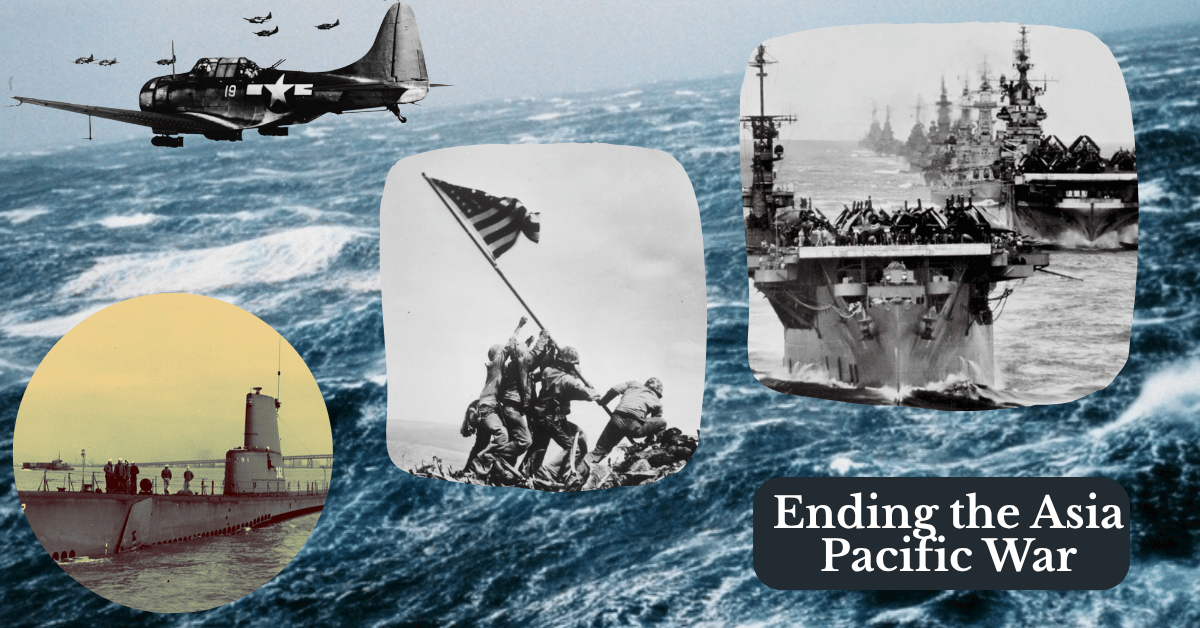
Image credit: various photographs from Naval Aviation Museum, National World War II Museum, and US Navy Archives.
 friarmusings