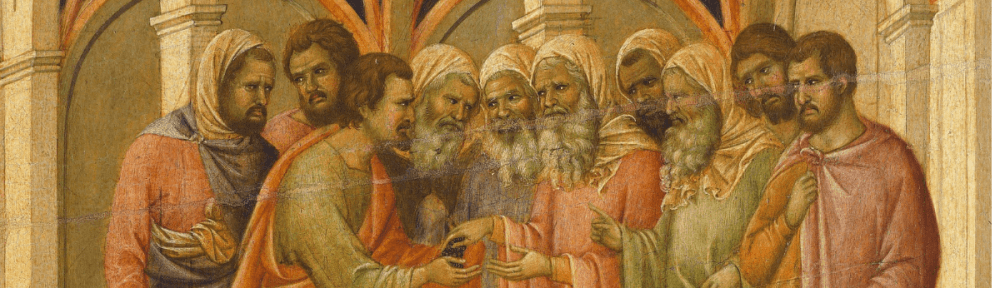
The gospel reading for the Wednesday of Holy week is always about Judas and his betrayal of Jesus. The day has the unofficial title of “Spy Wednesday.” The story is well known. Judas accepts 30 pieces of silver from the religious leadership of Jerusalem to inform them of Jesus’ location so that the authorities could arrest Jesus. But why did Judas betray Jesus?
Perhaps the most straightforward reason is greed. In today’s gospel it seems as though it is Judas who approaches the authorities: “What are you willing to give me if I hand him over to you?” In the Gospel of John 12:6, Judas is described as a thief who used to take from the common purse. Greed as an explanation is supported by Scripture and as a lesson shows how small compromises can lead to grave sin. But then again, 30 pieces of silver is not a terribly large amount. Greed is not too compelling as an explanation. After all, why would someone who had traveled with the penniless rabbi for three years suddenly be consumed with greed? Maybe he saw the end coming and simply wanted to make the best of an increasingly hopeless situation.
Another widely held theory is that Judas expected a political Messiah who would overthrow Roman rule. When it became clear that Jesus was not going to pursue political change, Judas decided He wasn’t worth following. This gives rise to two different explanations. The first is a corollary to “greed”: cut my losses and might as well get some reward before I abandon Jesus. The second is an attempt to force Jesus’ hand.
One Scripture scholar, the late William Barclay, professor of divinity at Glasgow University suggested that the most compelling explanation is that in handing Jesus over to the Romans, Judas was trying to force Jesus to act in a decisive way. Barclay suggests that Judas expected the arrest would prompt Jesus to reveal himself as the long-awaited Messiah by overthrowing the Roman occupiers.
St. Luke simply writes: “Then Satan entered into Judas, the one surnamed Iscariot, who was counted among the Twelve, and he went to the chief priests and temple guards to discuss a plan for handing him over to them.” The idea is similar in John 13:27. This does not remove Judas’ responsibility but indicates that his betrayal is part of a larger spiritual conflict. Catholic teaching is clear that Judas remains morally responsible for his choice. While there is something cosmically compelling about this explanation, it still leaves unanswered the question of why Judas allowed Satan to enter into his decision making. In any case, this reminds us that sin can open the door to deeper darkness
Many theologians see Judas’ betrayal less as a single motive and more as a gradual interior breakdown that perhaps began with small sins associated with dishonestly handling the money. One thing leads to another, there is a growing distance from Jesus leading to an increased loss of trust and then betrayal. If this has merit, it serves as a warning to a believer who remains externally close but internally drifts away.
The farther one is from the Light of Christ, one increasingly lives in the shadows. In the shadows you think you see it all, but it is only in the light that the truth can be known. Outside the light one forms their own plans and agendas. None of us think of ourselves as Judas, willing to betray Jesus. I doubt he did either. But the longer one is outside the Light of Christ…who knows?
The Apostle Peter has his shares of blunders and will deny knowing Jesus. But he is fundamentally in the Light where all good things are possible. He always returns to Jesus’ plan.
It is good to take time to discern where one stands in life and by whose plan one operates.
Image credit: Pact of Judas | Duccio di Buoninsegna, ca. 1310 |Museo dell’Opera metropolitana del Duomo, Florence | Public Domain
Discover more from friarmusings
Subscribe to get the latest posts sent to your email.
 friarmusings