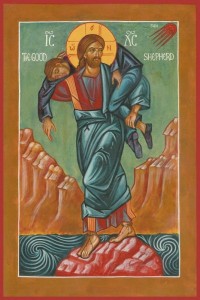
 Amen, amen, I say to you, whoever does not enter a sheepfold through the gate but climbs over elsewhere is a thief and a robber. 2 But whoever enters through the gate is the shepherd of the sheep. 3 The gatekeeper opens it for him, and the sheep hear his voice, as he calls his own sheep by name and leads them out. 4 When he has driven out all his own, he walks ahead of them, and the sheep follow him, because they recognize his voice. 5 But they will not follow a stranger; they will run away from him, because they do not recognize the voice of strangers.” 6 Although Jesus used this figure of speech, they did not realize what he was trying to tell them. 7 So Jesus said again, “Amen, amen, I say to you, I am the gate for the sheep. 8 All who came (before me) are thieves and robbers, but the sheep did not listen to them. 9 I am the gate. Whoever enters through me will be saved, and will come in and go out and find pasture. 10 A thief comes only to steal and slaughter and destroy; I came so that they might have life and have it more abundantly.
Commentary Moloney [301] outlines this narrative by the following schema:
- 9:39-41: Introduction. Jesus is questioned by the Pharisees (among whom there is a division) and he condemns them for their blind ignorance
- 10:1-6: Jesus tells a parable about entering the sheepfold and the Pharisees cannot understand. This section is marked with the unique, “Amen, Amen…”
- 10:7-13: Jesus contrasts himself, the door and the Good Shepherd, with others who are thieves, robbers and hirelings. This section is also introduced with “Amen, Amen…”
- 10:14-18: Jesus the Good Shepherd, out of union with the Father, lays down his life for the sheep
- 10:19-21: Conclusion: A division among “the Jews.”
Continue reading →

 Matthew 28:16-20 16 The eleven disciples went to Galilee, to the mountain to which Jesus had ordered them. 17 When they saw him, they worshiped, but they doubted. 18 Then Jesus approached and said to them, “All power in heaven and on earth has been given to me. 19 Go, therefore, and make disciples of all nations, baptizing them in the name of the Father, and of the Son, and of the holy Spirit, 20 teaching them to observe all that I have commanded you. And behold, I am with you always, until the end of the age.” Continue reading

 At The Table With Jesus The disciples are struck by what Jesus has said and ask him to stay with them even has he appears to be traveling on. Alan Culpepper (479) offers an interesting insight into the simple passage (v.28):
 The Ninth Beatitude. In response, Jesus told Thomas, Because you have seen me, you have believed; blessed are those who have not seen and yet have believed. Thomas came to believe because he saw the risen Lord, but Jesus did not praise Thomas’ pathway to faith; rather, he pronounced a blessing upon those who have not seen the risen Jesus yet have believed in him nevertheless. These are those who hear or read the witness to Jesus borne by the disciples and confirmed by the Spirit (15:26–27). This is the second pronunciation of blessing by Jesus in the form of a beatitude in the Fourth Gospel (cf. 13:17: “If you understand this, blessed are you if you do it.”)
