“Jesus answered, ‘My kingdom does not belong to this world. If my kingdom did belong to this world, my attendants would be fighting to keep me from being handed over to the Jews. But as it is, my kingdom is not here.’” (John 18:36)
I suspect that for most of my life, I have understood Jesus’ words as saying, my kingdom is not in this world, but is in the next; not a matter of earthly concerns, but of heavenly ones. In other words, all this will pass away, and, in the end, there will only be heaven. But then Scripture promises a new heaven and new earth… Turns out the Greek word used, kosmos, includes our traditional understanding of heaven and earth …. hmmm. What to make of “does not belong to this world?”
There is another way to hear and understand Jesus’ encounter with Pontius Pilate. Think about the way we use the word, “world.” If someone wants to talk with me about the finer points of authentic French cooking, I might reply, “Sorry, that’s not my world” can mean anything from not part of my experience, not part of my interests, not something I have time to deal with – and, no doubt, a range of similar meanings. Turns out kosmos, in one of its definitions, means “the order and arrangement of things.” French cooking is definitely not in the order of “my world.”
So, what might Jesus mean? Maybe, Jesus’ words are as simple as this: “Pilate, your world of pax romana is a world where order, your kosmos, are maintained by intimidation, power, and ultimately violence or the threat of retaliatory violence. That is your world, not the world my Father in heaven intended here on earth. If that were my world, then my followers would meet violence with violence.”
In other words, pax Christi will not be achieved by violence. Dr. Martin Luther King, Jr. understood Jesus’ meaning. He wrote:
The ultimate weakness of violence is that it is a descending spiral, begetting the very thing it seeks to destroy. Instead of diminishing evil, it multiplies it. Through violence you may murder the liar, but you cannot murder the lie, nor establish the truth. Through violence you may murder the hater, but you do not murder hate. In fact, violence merely increases hate. So it goes. Returning violence for violence multiplies violence, adding deeper darkness to a night already devoid of stars. Darkness cannot drive out darkness: only light can do that. Hate cannot drive out hate: only love can do that. (“Where Do We Go From Here?” as published in Where Do We Go from Here: Chaos or Community?)
That is Jesus’ world – light and love. That is a choice we have as people, as a community, as a nation.
It was the choice given to Francis of Assisi who grew up in a world of Crusades, knights and grand adventure. When Assisi went to war against the city of Perugia over control of the valley land between the cities. The armies met on the battlefield of Colestrada. Such was Francis’ world, a world where order and peace were maintained by intimidation, power and ultimately violence. Assisi was roundly defeated, Francis taken prisoner, and spent the next year as a prisoner of war in the dungeons of Perugia. Upon release, Francis’ world began to unravel but he held onto his dream of glory and honor on the field of battle. And soon another occasion arose, another call to the Crusades.
One evening, Francis saw, in a vision, a beautiful palace, and there he saw various suits of armor and a lovely bride. In that same dream Francis was called by name and sensed the promise of all these things. Because war as a means to glory was Francis’ world, he again suited up in armor to join the crusade. On the way to join the gathering army, there was a second dream. Again, the palace appeared, but a voice in the dream asked, “Who can do more for you, the servant or the Lord?” “The Lord,” said Francis. “Then why do you seek the servant instead of the Lord?” Francis then asked: “Lord, what do you want me to do?” God was about to introduce Francis to a whole new world and new understanding of Christ as the King of the kosmos. A world that reflects God’s love, inviting and embracing, forgiving and reconciling, never intimidating, punishing, and resorting to violence.
Years later, the people of the town of Gubbio were beset by a wolf they saw as terrorizing the town, killing its sheep, and becoming the source of ever-growing accounts of a beast who would kill for the sake of killing. In their world, you mounted a hunting party and took the battle to the beast. And they did. Several people lost their lives. At this point, they sent for Francis to come and drive the wolf away.
Intimidation, punishment, banishment, and violence were no longer part of Francis’ world – he had chosen Christ as King and entered a new world. Dialogue, understanding, reconciliation were the tools and not weapons. Francis found the wolf and simply uncovered the reality that the wolf and her family were starving – she-wolf would do what is necessary for her children. The kosmos of the wolf was not much different from that of the townspeople. Francis received the pledge of the wolf to change her way. He received the pledge of the town to care for the family. Francis brought them both into a new world.
Refugee caravans leave Central America. They leave a world of drug and gang violence where intimidation, extortion and murder as the reality of their kosmos They travel across Mexico where intimidation, bribery, and the slow death of a spirit are the reality of their kosmos. They reach the border to find intimidation, the deployment of the mightiest Armed forces in the world, and the gateway to peace and hope closed. They have to wonder about the world, the kosmos in which they live.
Christ the King does not reign over a kosmos that operated as did Pilate, or young Francis of Assisi. His kingdom is not there. But the Kingdom is in the midst of the world – and each day we choose what world we will live in. “Who can do more for you, the servant or the Lord?” “The Lord,” said Francis. “Then why do you seek the servant instead of the Lord?” Francis then asked: “Lord, what do you want me to do?”
Dr. Martin Luther King, Jr understood: “Returning violence for violence multiplies violence, adding deeper darkness to a night already devoid of stars. Darkness cannot drive out darkness: only light can do that. Hate cannot drive out hate: only love can do that.”
Christ the King Sunday is a day when we are reminded of the words of Pope Pius XI, who instituted the Solemnity celebration. He said that Christ should reign in our minds, our will, our hearts, and our bodies – in the choices we make. It is a day we ask, “Lord, what you want me to do” as we kneel before Christ the King. The answer will always be to do our part to build the kosmos with truth, light, and love.
This is Christ the King Sunday. Amen.
Image credit: “The Mocking of Christ” | Ciambue, 1290 | Louvre, Paris | PD-US

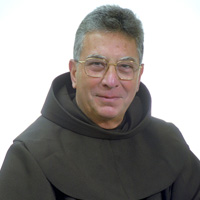 As part of our morning prayer as a community of Friars, we read the names aloud for the friars who passed away on the given day. This weekend marks the 12th anniversary of the passing of one of the true characters and legends of our Franciscan province. Brother Juniper Capece was a friar for 60 years, was our provincial tailor, and was the keeper of many of the stories of the friars – you know, the ones that never get written down, but bring everyone to tears because we are laughing so hard.
  friarmusings