I think it is fair to say that I am a card-carrying, fully committed Bible nerd. If you are a regular reader of friarmusings.com then you have probably realized I write biblical commentaries for fun. I even know Bible dad-jokes! When God created Adam from the clay of the earth, what time of day was it? ….just a little before Eve. [groan…] Anyway… I have been at this for a while and it is only recently that I spent time with the Book of Chronicles. I remember when I first encountered it my reaction was, “This is a repeat of the Book of Kings” … turn the page. My bad. Chronicles is a great book to read during the season of Lent. Continue reading
Tag Archives: 4th Lent
A Final Thought
A Reflection from Gail O’Day
In interpreting John 3:1–21, then, it is not enough to say on the basis of the discourse in vv. 11–21, for example, that this text is about faith, decision, and judgment, because that way of interpreting diminishes the full impact of the text. One needs the preceding dialogue, with Nicodemus’s misunderstanding and Jesus’ repeated offer of new images, to understand what the words of vv. 11–21 are really saying. The interpreter must attend to how John tells this story of Jesus and Nicodemus, how he moves the reader through the give and take between the two characters and thus affords the reader the chance to understand what Nicodemus can only misunderstand. Because the reader has participated in the dialogue between Jesus and Nicodemus, the words in vv. 11–21 are heard with more immediacy. Moreover, the reader has read the Prologue and attended to the witness of John, so that he or she has a wider theological context in which to place those words. Continue reading
Living the Truth
This coming Sunday is the 4th Sunday in Lent. 19 And this is the verdict, that the light came into the world, but people preferred darkness to light, because their works were evil. 20 For everyone who does wicked things hates the light and does not come toward the light, so that his works might not be exposed. 21 But whoever lives the truth comes to the light, so that his works may be clearly seen as done in God. These three verses portray this intricate balance between judgment and decision in the metaphorical language of light and darkness. This language recalls the language and imagery of the Prologue (1:5, 9-10). To love darkness more than light is the same as not believing, and it results in judgment (v. 19). Continue reading
Given.
This coming Sunday is the 4th Sunday in Lent. For God so loved the world that he gave his only Son, so that everyone who believes in him might not perish but might have eternal life. Verse 16 provides the link between the two parts of the discourse. It sums up vv. 14-15 by reiterating the salvific dimensions of Jesus’ death, but moves the argument forward with its reference to God’s love. God gave Jesus to the world because God loves the world. Continue reading
Lifted up to Eternal Life
This coming Sunday is the 4th Sunday in Lent. In the previous post we discussed the account from the Book of Numbers in which “Moses lifted up the serpent in the desert.” Whoever looked at the bronze snake was healed. And, just as that snake was “lifted up” in the wilderness, so, Jesus says, “so must the Son of Man be lifted up.” The key to interpreting this analogy between Moses’ lifting up of the serpent in the wilderness and the ascension of the Son of Man is the verb (hypsoō), meaning both “lift up” and “exalt.” (The Hebrew verb nāsā’ has a similar double meaning; see the pun based on this verb in Gen 40:9-23.) Continue reading
Moses and the Fiery Saraphs
This coming Sunday is the 4th Sunday in Lent. With the dialogue with Nicodemus over, the verses become a monologue by Jesus in which he makes a reference to a well known story from the Book of Numbers – well known to the first century audience, but perhaps not to you. The setting for the reference is that the tribes have transited the wilderness and are near the Promised Land. Moses sends out 12 spies to reconnoiter the land. Ten return giving reports of dire warning and the message to turn back. Two recognize the peril but also note the fertility of the land – and point out that God is ever on their side. The people turn back, condemned to wander in the wilderness and the grumbling begins (actually continues!): Continue reading
The Middle
This coming Sunday is the 4th Sunday in Lent in Lectionary Cycle B. Our gospel selection is akin to walking into the middle of a conversation – and indeed it is. Although Nicodemus has faded from the scene, at least by mention and name, this gospel is part of that dialogue between Jesus and Nicodemus, one of the leaders of the Jews. John 3:1-21 is often taken as a single pericope by scholars, that is, studied and considered together. Continue reading
Sin and blindness
Next Sunday is the 4th Sunday in Lent, Year A. You can read a complete commentary on the Sunday Gospel here.
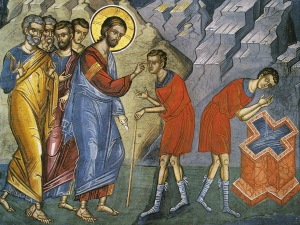
1 As he passed by he saw a man blind from birth. 2 His disciples asked him, “Rabbi, who sinned, this man or his parents, that he was born blind?” 3 Jesus answered, “Neither he nor his parents sinned; it is so that the works of God might be made visible through him. 4 We have to do the works of the one who sent me while it is day. Night is coming when no one can work. 5 While I am in the world, I am the light of the world.” 6 When he had said this, he spat on the ground and made clay with the saliva, and smeared the clay on his eyes, 7 and said to him, “Go wash in the Pool of Siloam” (which means Sent). So he went and washed, and came back able to see. Continue reading