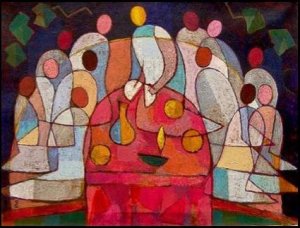
This series does not undertake to explain the Catholic doctrine of the Real Presence of Christ in the Eucharist; that is perhaps for another time, although the Catechism is an excellent place to begin your own research (para. 1373 is a good starting point). Our starting point will be in the reservation of the Eucharist. Continue reading
Tag Archives: Eucharist
Our Lexicon
One of the benefits of Latin being the official language of the Catholic Church is that it is a “dead” language. In other words, a language no longer in use in the world outside of Church and academia; a language no longer subject to the evolution of usage in the world. For example, “peruse” technically means to examine in a thorough or careful way, but in everyday use it is used and understood to mean to “glance over a document.” The word has evolved to mean something very different. Words in Latin have meant the same thing for centuries. Over the centuries the Church’s use of certain words form a lexicon of language – something quite true in the lexicon of the Eucharist. Continue reading
Reservation, Adoration, Exposition, and Benediction: The Eucharist Outside of Mass
The Catechism of the Catholic Church (CCC) is a great resource for Catholics to explore the Faith and Traditions of the Church. When one reads the article on the Sacrament of the Eucharist it is clear that the sacrament is largely discussed in the context of the celebration of the Mass. But what about outside of the celebration of Mass? Continue reading
More than memory
In today’s first reading we hear the instructions for Passover’s celebration. I am always particularly taken by the simple, yet complex, verse: “This is how you are to eat it: with your loins girt, sandals on your feet and your staff in hand, you shall eat like those who are in flight. It is the Passover of the LORD.” Continue reading
Christifies
Bishop Barron’s post (always good) was especially good, so I have re-posted it here.
Friends, in today’s Gospel, Jesus declares that he is the bread of life and promises eternal life to all who believe in him.
Many of the Church Fathers characterized the Eucharist as food that immortalizes those who consume it. They understood that if Christ is really present in the Eucharistic elements, the one who eats and drinks the Lord’s Body and Blood becomes configured to Christ in a far more than metaphorical way. The Eucharist, they concluded, Christifies and hence eternalizes.
If the Eucharist were no more than a symbol, this kind of language would be so much nonsense. But if the doctrine of the Real Presence is true, then this literal eternalization of the recipient of Communion must be maintained.
But what does this transformation practically entail? It implies that the whole of one’s life—body, psyche, emotions, spirit—becomes ordered to the eternal dimension. The Christified person knows that his life is not finally about him but about God; the Eucharistized person understands that her treasure is to be found above and not below. Wealth, pleasure, power, honor, success, titles, degrees, even friendships and family connections are all relativized as the high adventure of life with God opens up.
Bishop robert Barron
If you would like to receive a daily gospel reflection from Bishop Barron you sign up here.

Dorothy Day and Eucharist
In the American Catholic scene there is perhaps one name that stands above all when thinking about social justice: Dorothy Day. In the course of time we have all heard many stories about this remarkable woman. Today I heard one with which I was not familiar. Continue reading
Remembering
I could not begin to guess the number of times I have said or heard the words: “Do this in remembrance of me” – part of the Eucharist prayer celebrated at the Holy Mass in places and times around the world. I imagine that across the globe, at every moment of time there is a voice speaking those words. At every moment of time there are believers gathered to worship and collectively remember the story we live by – the life and redeeming death of Jesus Christ. Continue reading
Understanding and Joy
Back in the day, the 1980s to be exact, there was a year in which my job required me to spend a lot of time as a road warrior in support of our clients. There are approximately 250 working days in a year. I spent about 200 of them in a hotel. At first it was kinda’ fun. There was someone who cleaned your room every day, you got to eat out at the restaurant of your choice, you could drop your laundry off at the front desk and it would show up in your room at the end of the day. What’s not to like, right? By the second week, the thrill was gone and now all that was left was HBO. Remember this was 40 years ago, a hotel that had HBO had a serious leg up on the competition. But here’s the thing. HBO did not have a lot of choices that interested me. And now we are at week three. Continue reading
Francis and the Eucharist
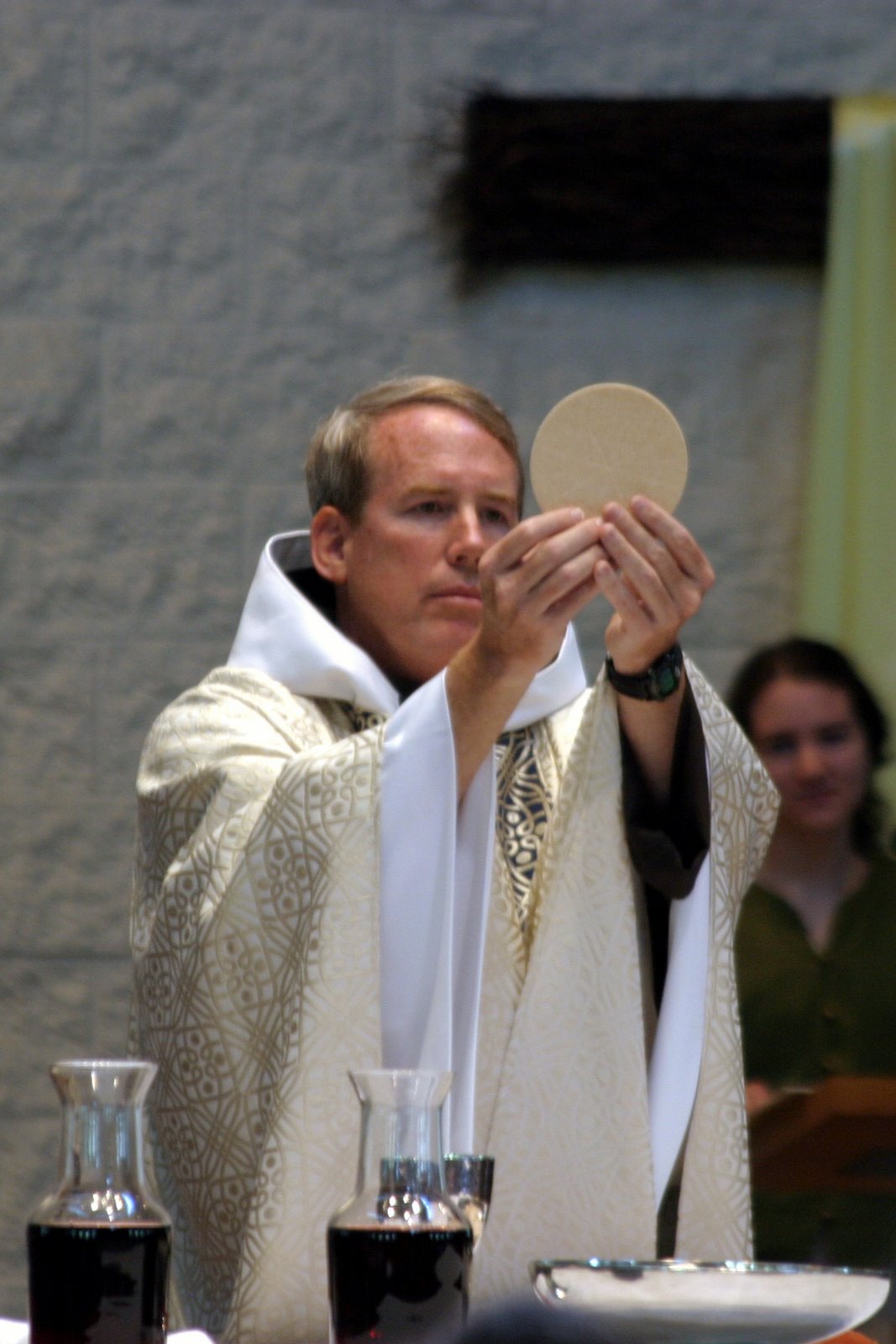
In our previous installment, speaking of Francis’ unique view of nature, we ended with the idea that Francis “held that the whole world is a sacrament, a sacred thing, a gift; and the sacramental character of the world reminds us of the central sacrament, the Incarnation, continued among us in the seven sacraments of the Church, especially in the Eucharist.” But did Francis have any thoughts specifically on the Eucharist itself?
I would wager that most people would guess that in Francis’ own writings he spoke at length about poverty, his love of nature and animals, and other topics for which Francis is so well known in the modern world. Yet, in his own writings, there is perhaps no other topic that he addresses more than the Eucharist. In his Eucharistic writings, Francis expresses a deep view of the continuing Incarnation of Christ in the world, and in that vision is an entire way of life. These writings represent part of the movement of Francis’ mystical life from prayer and devotion in solitude before the cross, to a pattern of communal prayer and devotion in the Mass as well as a devotion to the Eucharist apart from Mass. Continue reading
Everything
Way back in the day, before this life as a Franciscan, I was helping out with a teen ministry program at my parish. I will always remember one comment a young woman made: “It’s not like I have a contract with God or anything.”
Contract: an agreement with specific terms between two or more persons or entities in which there is a promise to do something in return for some consideration, often an exchange of goods and services. A contract includes a) an offer; b) an acceptance of that offer; c) a promise to perform; d) a valuable consideration; f) terms and conditions for performance, including fulfilling promises; g) and the execution of all the above. I am sure the lawyers and first year law students can provide a more precise definition. But my point is that contracts are hardly personal. I have signed contracts for car loans without ever meeting the bank representatives. And I signed an apartment rental contracts and never met the actual property owners. Who cares? It’s business, right? Did everyone get what they agreed to? Contract with God? Continue reading