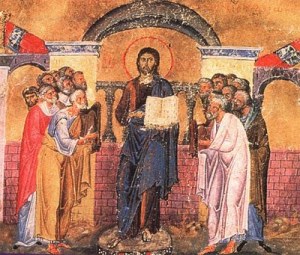
Today. 20 Rolling up the scroll, he handed it back to the attendant and sat down, and the eyes of all in the synagogue looked intently at him. 21 He said to them, “Today this scripture passage is fulfilled in your hearing.” With the reading complete, Jesus takes the posture (sitting) of the teacher – as he was expected to do. All eyes are upon him, his reputation preceding, his choice of scripture provocative – the eyes of all in the synagogue looked intently at him. Then simply and powerfully Jesus tells them that this great promise of God given in Isaiah, this promise of the long-awaited Messiah has been fulfilled. Continue reading
Tag Archives: Nazareth
Nazareth: the people
Context. One thing that is evident when you look at this Gospel reading (Luke 4:21-30) is that the narrative really begins at v.14. As mentioned last week, it is as though the story was cut in half (last week vv.14-21) and we never got to know the reaction of the people in the synagogue. Fortunately, the story continues as Luke 4:21-30 is the Gospel reading for this Sunday (4th Ordinary, C). Many Lucan scholars hold that the two halves together are key and make clear the four major points in Luke’s account:
- the announcement of Jesus ministry as the fulfillment of God’s salvation-time,
- a statement about the content of Jesus’ ministry based on the quotation from Isaiah,
- the foreshadowing of Jesus’ final suffering and rejection,
- the foreshadowing of the movement of the gospel from Jew to Gentile. (found in Stoffregen)
Nazareth: today
The Poor, Captive, Blind and Oppressed. It is important to note that this mission is specifically directed at the needs of people: poor, captive, blind, oppressed. Significantly, Jesus’ work will be good news to the poor. Mary’s prayer (1:52-52; the Magnificat) praises the Lord for lifting up the lowly and sending the rich away empty. Later, Jesus announces God’s blessing on the poor (6:20) and then refers to the fulfillment of the charge to bring good news to the poor in his response to John (7:22). The poor also figure more prominently in Jesus’ teachings in Luke than in any other Gospel (14:13, 21; 16:20, 22; 18:22; 21:3). Continue reading
Nazareth: spirit
As noted, this passage begins with a reference to Jesus being “in the power of the Spirit.” While there are no doubt some implicit Trinitarian ideas here, the OT should serve as the means of understanding the direction of Luke’s narrative. The OT metaphors of wind (Heb: ruach – breath, wind, spirit), smoke, and cloud, as well as fire, were ways of talking about the active presence of God in the world. Even though the single Hebrew term is translated in various ways even when used of God, this idea became a way to talk about God in terms of his immediate activity in the world. The idea behind the Hebrew term ruach expressed the immanence of God in the world and encompassed his willingness and power to act in human history. This idea carried over into most of the NT since the equivalent term in Greek (pneuma) carries the same varied meaning. As well, this “power of the Spirit” also points to a commissioning of prophets and enabling of leaders to carry out their mission. Continue reading
Nazareth: first words
How appropriate that the first record of public ministry is the very living Word made flesh sharing the Word of God. Luke records these first spoken words of Jesus’ ministry:
18 “The Spirit of the Lord is upon me, because he has anointed me to bring glad tidings to the poor. He has sent me to proclaim liberty to captives and recovery of sight to the blind, to let the oppressed go free, 19 and to proclaim a year acceptable to the Lord.” Continue reading
Nazareth: synagogue
He came to Nazareth, where he had grown up, and went according to his custom into the synagogue on the sabbath day. He stood up to read 17 and was handed a scroll of the prophet Isaiah. He unrolled the scroll and found the passage where it was written…” (Luke 4:16-17)
The Gospel of Mark has a similar account but records it later in Jesus’ public ministry near the end of the ministry in Galilee (Mark 6:1-6a). Luke reports the account at the beginning of Jesus’ ministry. In doing so, Luke highlights the initial admiration (Luke 4:22) and subsequent rejection of Jesus (Luke 4:28-29) and presents it as a foreshadowing of the whole future ministry of Jesus. Moreover, the rejection of Jesus in his own hometown hints at the greater rejection of him by Israel (Acts 13:46). Luke’s account seems to have at least two emphases: (a) the announcement of Jesus’ ministry as the fulfillment of God’s promises from the OT in general, but in Isaiah in particular; and (b) a statement about the context of Jesus’ ministry (cf. Luke 4:18-19). In each case, the prophet Isaiah serves as the fulfillment text.
Brief as it is, Luke’s introduction to the ministry in Galilee gives the reader an indication of the nature of Jesus’ work (teaching), one of its common settings (the synagogues), the source of its power (the Spirit), its result (praise), and its extent (to all). Continue reading
Nazareth: context
1:1 Since many have undertaken to compile a narrative of the events that have been fulfilled among us, 2 just as those who were eyewitnesses from the beginning and ministers of the word have handed them down to us, 3 I too have decided, after investigating everything accurately anew, to write it down in an orderly sequence for you, most excellent Theophilus, 4 so that you may realize the certainty of the teachings you have received.
4:14 Jesus returned to Galilee in the power of the Spirit, and news of him spread throughout the whole region. 15 He taught in their synagogues and was praised by all. 16 He came to Nazareth, where he had grown up, and went according to his custom into the synagogue on the sabbath day. He stood up to read 17 and was handed a scroll of the prophet Isaiah. He unrolled the scroll and found the passage where it was written: 18 “The Spirit of the Lord is upon me, because he has anointed me to bring glad tidings to the poor. He has sent me to proclaim liberty to captives and recovery of sight to the blind, to let the oppressed go free, 19 and to proclaim a year acceptable to the Lord.” 20 Rolling up the scroll, he handed it back to the attendant and sat down, and the eyes of all in the synagogue looked intently at him. 21 He said to them, “Today this scripture passage is fulfilled in your hearing.” (Luke 1:1-4, 4:14-21)
Continue reading
