
The Spirit of the Lord

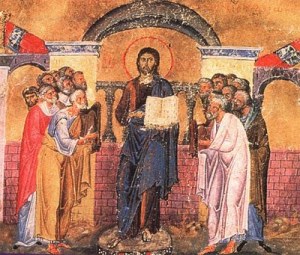
This coming Sunday is the 3rd Sunday of Ordinary Time at the opening of the public ministry as told in the Gospel of Luke. It strikes me as supremely appropriate that the first record of public ministry is the very living Word made flesh sharing the Word of God. Luke records these first spoken words of Jesus’ ministry:

18 “The Spirit of the Lord is upon me, because he has anointed me to bring glad tidings to the poor. He has sent me to proclaim liberty to captives and recovery of sight to the blind, to let the oppressed go free, 19 and to proclaim a year acceptable to the Lord.”
Continue reading

The Expectations Build

This coming Sunday is the 3rd Sunday of Ordinary Time and we continue our study of the beginning of the public ministry of Jesus at the synagogue in his home town of Nazareth.

He came to Nazareth, where he had grown up, and went according to his custom into the synagogue on the sabbath day. He stood up to read 17 and was handed a scroll of the prophet Isaiah. He unrolled the scroll and found the passage where it was written: The Gospel of Mark has a similar account but records it later in Jesus’ public ministry near the end of the ministry in Galilee (Mark 6:1-6a). Luke reports the account at the beginning of Jesus’ ministry. In doing so, Luke highlights the initial admiration (Luke 4:22) and subsequent rejection of Jesus (Luke 4:28-29) and presents it as a foreshadowing of the whole future ministry of Jesus. Continue reading

Nazareth: the people

JesusIconNazarethContext. One thing that is evident when you look at this Gospel reading (Luke 4:21-30) is that the narrative really begins at v.14. As mentioned last week, it is as though the story was cut in half (last week vv.14-21) and we never got to know the reaction of the people in the synagogue. Fortunately, the story continues as Luke 4:21-30 is the Gospel reading for this Sunday (4th Ordinary, C). Many Lucan scholars hold that the two halves together are key and make clear the four major points in Luke’s account:

  • the announcement of Jesus ministry as the fulfillment of God’s salvation-time,
  • a statement about the content of Jesus’ ministry based on the quotation from Isaiah,
  • the foreshadowing of Jesus’ final suffering and rejection,
  • the foreshadowing of the movement of the gospel from Jew to Gentile. (found in Stoffregen)

Continue reading

Nazareth: the people

JesusIconNazarethContext. One thing that is evident when you look at this Gospel reading (Luke 4:21-30) is that the narrative really begins at v.14. As mentioned last week, it is as though the story was cut in half (last week vv.14-21) and we never got to know the reaction of the people in the synagogue. Fortunately, the story continues as Luke 4:21-30 is the Gospel reading for this Sunday (4th Ordinary, C). Many Lucan scholars hold that the two halves together are key and make clear the four major points in Luke’s account:

  • the announcement of Jesus ministry as the fulfillment of God’s salvation-time,
  • a statement about the content of Jesus’ ministry based on the quotation from Isaiah,
  • the foreshadowing of Jesus’ final suffering and rejection,
  • the foreshadowing of the movement of the gospel from Jew to Gentile. (found in Stoffregen)

Continue reading