In the modern age, the average Catholic looks to the Catechism of the Catholic Church to find guidance on the concept of just war. The Church teaches that war can be morally justified under certain conditions, which are rooted in the principles of just cause, legitimate authority, right intention, and proportionality. (Found in paragraphs 2307 to 2317). The conditions fall into three broad categories:
It was a busy month. Mounting military losses and the inability of Prime Minister Koiso to garner consensus within the War Council led to the collapse of the government and the appointment of Admiral Suzuki as Prime Minister. It takes time to form a government – and meanwhile there is a lot going on. Iwo Jima is reaching its bloody end just as Okinawa begins to unfold. The losses among land forces, naval personnel (viz. kamikaze) and especially among civilians will be horrific and impactful.
Some argue that April 1945 was a lost opportunity. Suzuki was the new prime minister and there are those historians who assert that he was an advocate for peace. That is probably wishful thinking. He was an absolute opponent of unconditional surrender but at the same time was a proponent of Ketsu-Go. He was not a hardliner like Army Chief of Staff Umezu and War Minister Anami, but one of his first acts was to sign a pledge presented by a delegation of generals from IJA/HQ that committed Suzuki to prosecute the war to its fullest as outlined in Ketsu-Go, the plan to defend the home islands to the bitter end – no surrender. Hardly a peace advocate.
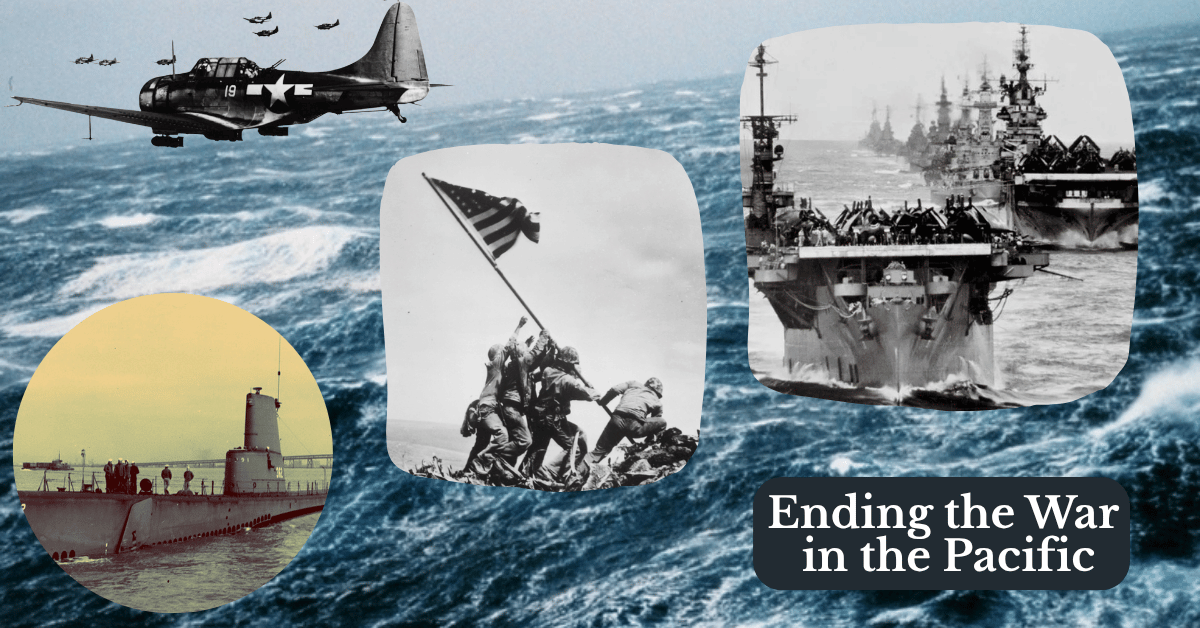
The title may have caught your eye and caused you to wonder about the dates. Shouldn’t the War in the Pacific be dated from December 7, 1941, the attack on Pearl Harbor, until September 2, 1945 and the surrender of Japan aboard the USS Missouri? Certainly those are the dates which involved the United States and her allies. But war in the Asia-Pacific region had already started with the Sino-Chinese war, long simmering, but breaking out into open warfare in 1937. Japan had occupied Manchuria since 1931, but then invaded much of China from 1937 onward, including Beijing, Shanghai, Nanjing, and the coastal regions). French Indochina (Vietnam) was invaded next: the North in 1940 followed by the South in 1941. Well before Pearl Harbor troops were already in position to launch attacks against Cambodia, Laos, Thailand, Burma, Indonesia (Dutch East Indies), Malaysia and Singapore, Brunei and Borneo, Hong Kong, parts of New Guinea, the Marshall Islands, Truk, Palau, the Marshalls, and other Micronesian islands. It should also be remembered that Japan ruled the Korean people during the 20th century.
The United States was drawn into a war already underway for more than 4 years.
The preliminary planning for Operation Downfall – the invasion of the Japanese home islands of Kyushu and Honshu – began in the waning months of 1944. These were preliminary plans at best and were secondary to battle planning for Leyte, Luzon, Iwo Jima, Okinawa and the naval aircraft carrier raids on Formosa, as well as the massive logistics planning to support all the amphibious landings.
By April 1945 only the amphibious landings at Okinawa remained – the other islands had been secured, although scattered actions continued on Luzon until the end of the war. It was at this point that area commanders (Nimitz and McArthur) were ordered to develop detailed, actionable plans for the invasion of the southern island of Kyushu (Operation Olympic). As noted in the previous post there were multiple planning units that were providing estimates. The operations and logistics details were massive, but each unit knew the “hard question” would be their estimates of allied casualties for Operation Olympic.
But that question depended on their battle plan/order of battle and intelligence estimates of enemy troop strength and deployment. As will be made clear in subsequent posts, all the above was a moving target that was being shaped by a range of factors from the concrete and measurable to the personal and not quantifiable. The first phase of planning occurred in the Pacific theatre of operation from Nimitz’s and MacArthur’s operations group. This planning phase (and its iterations) lasted until May 25, 1945 at which point the Joint Chiefs of Staff (JCS) issued a formal directive to Nimitz, MacArthur, and Arnold, instructing them to begin detailed planning for Operation Olympic. We’ll come back to that date.
It is time to introduce the key figures “behind the curtain” of the United States. Apart from the human and political intrigue native to any human enterprise, the chain of command was clear. In wartime, the President of the United States was the “Commander in Chief.” He possessed the unilateral power to make decisions, was active in soliciting discussion, and most often took the advice of his military leaders. But it was clear that the “buck” stopped on the desk of the President.
The American operational leadership of the Asia-Pacific war effort was established and consistent from the inception of war to its conclusion in 1945.
We jump ahead on the timeline for a moment to complete the Allied thought that began at the Jan 1943 Casablanca Conference: terms of surrender for Germany and Japan. 2.5 years after Casablanca, after Nazi Germany had unconditionally surrendered, the Allies prosecuting the war in the Pacific met. On July 26, 1945, US President Harry S. Truman, UK Prime Minister Winston Churchill, and President of China Chiang Kai-shek issued a document, which outlined the terms of surrender for the Empire of Japan. The Potsdam Declaration (Proclamation Defining Terms for Japanese Surrender) was a statement that called for the surrender of all Japanese armed forces. The ultimatum (and it was worded as an ultimatum) warned: “We will not deviate from them. There are no alternatives. We shall brook no delay.” The ultimatum was clear: if Japan did not unconditionally surrender, it would face “prompt and utter destruction.” By this time in the war Japan was already devastated by bombing and only possessed defensive capability. The war was all but lost by any conventional standard. The Potsdam statement was released only 11 days before the atomic bombing of Hiroshima.
Who were the allied leaders whose decisions would be the most impactful on the Asia- Pacific War? And equally important what were key inter-allied conversations and decisions that would shape the manner and outcome of the war? Unlike Japan that had no effective dialog or connection to its Axis partners, the Allied met quite regularly in high level conferences with its partners. Quite early in the war, the allies agreed that both the war in Europe and the Asia-Pacific would end in unconditional surrender.
At the January 1943 Casablanca Conference the Allies (U.S., Britain, USSR*) demanded, as pertains to Japan, that Japan surrender without preconditions, meaning:
total disarmament,
Allied occupation of the home islands,
war crimes trials, and
Reshaping of Japan’s government along democratic lines.
At no point did the policy mention the future of the Emperor, a central figure in Japan’s political and spiritual life.
This policy did not emerge from a vacuum but was rooted in and shaped by the experience of World War I, current knowledge of WWII axis war crimes, and concerns over postwar stability.
The two previous posts were meant to give the reader a sense of the Emperor’s role in war-time governance in Japan. To be sure, I have not done the topic justice as just like “Washington insider” machinations (then and now) Japan had its own “system” to navigate to achieve decisions. Some of this was already covered. A review of two posts would be helpful: Ketsu-Goand Governance and Ketsu Go. The former describes Japanese plans for the “decisive battle” that would bring the Allies to a negotiation table and away from their demands for unconditional surrender. The latter describes the sequence of events that took Ketsu-Go from a strategic idea (January 45) to a formally approved plan of action (March 45) – and gave some sense of the internal factions within the government along with their agendas. In this post we look “behind the curtain.”
The previous posts have tried to show that Hirohito, as Emperor, moved from “self-induced neutrality” in decisions to a more animated Emperor in decisions about the war. He was briefed and was aware of war progress and failures. He asked critical questions. He knew of cases where the military subverted his expressed views. And he deftly navigated the reach and influence of his power while remaining the Emperor in a constitutional monarchy where the power lay with the military.
What is uncertain was the quality of information the Emperor was receiving. While there were cases in which military leaders hedged reports, these same leaders were at the mercy of field commander reports which often were greatly exaggerated. This was especially true among Imperial Army (IJA) ranks; less so from the Imperial Navy (IJN). It was hard to obfuscate the loss of aircraft carriers, battleships, cruisers and more. A subtext of much of the reports, as the historian Edward Drea notes, was a dismissive view that “Americans [were] products of liberalism and individualism and incapable of fighting a protracted war.” This is what drove the Japanese to find the “Decisive Battle” to bring the Allies to a negotiation to end the war. Midway, Guadalcanal and especially Saipan were to be those battles. And yet the allies pressed forward with the war. The Emperor supported the drive to bring about the decisive battle – but as a necessary precursor to his end-game: a negotiated peace. Or perhaps a negotiated continuity of the Imperial Household.
In the summer of 1942, as outlined in the post “Before the War”, Japan pursued parallel paths: diplomacy and war preparations. The military (members of the cabinet, IJA Headquarters, and influential flag officers) flush with success in Manchuria, China and French Indo-China (Vietnam) wanted to unleash the Army against the entire Asia-Pacific region in order to establish the Empire of Japan under the guise of the Greater East Asia Co-Prosperity Sphere. The Navy was circumspect with part of its leadership desirous of some means to achieve “glory for the Emperor” as the Army had already done. But another part of its leadership understood that meant taking on the US and British Pacific Fleets. The United States was particularly worrisome given three factors: (1) the fleet at Pearl Harbor, (2) that US shipyards were already building a new generation of aircraft carriers, battleships, cruisers and fleet tankers that would be commissioned in 1942, and (3) that was without the full engagement of the industrial base of the nation. That meant the war plan “decisive battle” would not be engaged in Philippine Island waters, but needed to be a “knockout blow” at Pearl Harbor to take out battleships and aircraft carriers.
In the autumn of 1941 there were a series of Imperial Conferences (Gozen Kaigi) where Emperor Hirohito, his cabinet, and senior military leaders debated the U.S. demands for a diplomatic settlement and Japan’s course of action. The first of these conferences was held September 6, 1941 – “Imperial Conference on the Empire’s Future Policy.” The cabinet and military presented Hirohito with two paths: (a) continue negotiations with the U.S. and Britain and (b) preparation for war if negotiations failed. Hirohito approved a resolution: negotiations would continue, but war preparations must be ready by late October if talks broke down. The Emperor made it clear that diplomacy was the priority (for reasons outlined in the previous post) and so he accepted the parallel path, but also set a firm deadline for agreement or war.
The Second Imperial Conference was held November 5, 1941 after weeks of inconclusive Army-Navy-Cabinet debates it was agreed that the military would strike Pearl Harbor while also moving into Malaya, the Dutch East Indies, and the Philippines. At a final Imperial Conference on December 1, 1941. The cabinet reported to Hirohito that diplomatic negotiations had failed. The Army and Navy both argued that war was now unavoidable. Hirohito approved the resolution that war with the United States, Britain, and the Netherlands would begin in early December. Diaries record Hirohito as somber, but he gave no objection. His silence ratified the decision. Hirohito performed the ritual reading of the imperial rescript that authorized hostilities. The debate was closed. The Combined Fleet had already set sail for Pearl Harbor on November 26th. Army troops were already being deployed throughout the Asia Pacific region.
To understand in the inner workings of the wartime governance of Japan there are three keys to keep in mind:
Cabinet and Supreme War Council recommendations to the Emperor must be unanimous and if unanimity can not be reached, the government collapses and a new cabinet and council must be promoted.
In accord with the Meiji Constitution, certain cabinet members must be filled by active duty members of the military. In the context of #1 above, this means that the military holds a de facto veto on anything with which it does not agree. A single military member can either “filabuster” or simply resign – either achieve the same thing: collapse of the government.
In accord with the Meiji Constitution, the Emperor is a Constitutional Monarch, but at the same time is “Supreme Commander” of the Military (daigensui).
Does #3 mean that the “buck stops” with the Emperor? Hardly. As described in earlier posts, the received tradition was that the Emperor was not an absolute monarch – and that is consistent with the Meiji Constitution. Then again, the Emperor was not a symbolic monarch like the King of England. In practice, the Emperor’s role lived somewhere between the two on a spectrum of direct influence, passive influence, and removed from decision making. Emperor Hirohito’s father was quite removed from decision making or shaping the future of Japan. Hirohito was… well, that has been the subject of debate by historians for the last 80 years and more.
The post-war tribunals placed the blame and responsibility for the war on the military, ultranationalists, and the zaibatsu (financial clique). But Emperor Hirohito escaped post-war tribunals because Gen. MacArthur (SCAP – Supreme Commander for Allied Powers) excluded him from the tribunals for reasons associated with SCAP’s vision for post-war Japan. This provided a post-war orthodoxy that Emperor Hirohito was a peace loving constitutional monarch who could not prevent the military from their desire for war. That view could not withstand the passage of time and the declassification of wartime documents.

 friarmusings