
St. Anthony of Padua – part 1

tn_anthony-padua1For more than 100 years, Sacred Heart Catholic Church (in downtown Tampa, FL) had been under the pastoral guidance of the Jesuits. When we Franciscans arrived at Sacred Heart in 2005, we were quite surprised to find that one of the clerestory windows (the ones up high in the nave vault) was Saint Anthony of Padua, a Franciscan contemporary of St. Francis of Assisi.  In fact, we Franciscans still have a brief letter, in Francis’ own hand, written to Anthony. Most people know St. Anthony of Padua as the patron saint of lost and stolen articles, but have you ever wondered why he is that particular patron saint?

The Patron Saint of Lost Things. The reason for invoking St. Anthony’s help in finding lost or stolen things is traced back to an incident in his own life. As the story goes, Anthony had a book of psalms that was very important to him. You have to remember this was before the age of the printing press and so all books were of great value, and besides the value of the book, the psalter had the notes and comments he had made to use in teaching students in his Franciscan Order.

A novice who had already grown tired of living religious life decided to depart the community. Besides going AWOL, he also took Anthony’s psalter! Upon realizing his psalter was missing, Anthony prayed it would be found or returned to him, and after his prayer the thieving novice was moved to return the psalter to Anthony and to return to the Order, which accepted him back. Legend has embroidered this story a bit. It has the novice stopped in his flight by a horrible devil, brandishing an ax and threatening to trample him underfoot if he did not immediately return the book. Obviously a devil would hardly command anyone to do something good, but the core of the story would seem to be true. The stolen book is said to be preserved in the Franciscan friary in Bologna.

In any event, shortly after his death people began praying through Anthony to find or recover lost and stolen articles. And the “Responsory of St. Anthony” composed by his contemporary and brother friar, Julian of Spires, proclaims, “The sea obeys and fetters break/And lifeless limbs thou dost restore/While treasures lost are found again/When young or old thine aid implore.”
Francis and the Crusades – Part 3

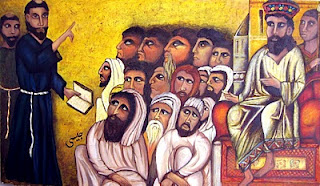
francis-sultanIt is important to recognize why Francis came to Damietta during the Fifth Crusade is just one part of his life.  How the experience of the crusade and his meeting with the Sultan of Egypt, Al-Malik al-Kamil, may have changed Francis is a different part of the saint’s life.  While the early sources about the life of Francis are uniform in Francis’ zeal for evangelization and his desire for martyrdom, many modern scholars dismiss these as hagiographic (“saint making”) embellishments.  The modern desire, especially among Franciscan scholars, seems to ensure that Francis “the peacemaker” arrives on the shore of Egypt in 1201.  When one looks outside modern Franciscan scholarship, especially to the current medieval specialist, one gains a different perspective.  André Vauchez, a French medievalist noted for his recent and thorough book on Francis, thinks that “some commentators are doubtful today [re: martyrdom], fearing to attribute to their hero a suicidal attitude or irresponsible behavior.”  Vauchez goes on to write, that “Contrary to what is sometimes affirmed, the search for martyrdom was not in contradiction with his desire to follow Christ, who died on the cross to open to humanity the way to salvation.  To face tribulations and dangers, including the loss of life, in order to spread the Christian faith was, from the beginning, a constitutive element of Franciscan sensibility.” Continue reading

Dr. Sheldon Cooper, Mystery of a Kiss, and the Eucharist

Sheldon CopperIn seminary, one of my theology professors (not Dr. Sheldon Cooper – although that would have been interesting….) offered that the Johannine “And the Word became flesh” becomes the starting point of most Christological heresy if one attempts to explain “how.”  Eventually the limitations of language and human fumbling will eventually lead to the heterodox expression of faith. Continue reading

Francis and the Crusades – Part 2

crusaders2The previous two articles give the background for Francis of Assisi’s mission during the time of the Fifth Crusade.  The previous article introduced two key ideas that seemed to be part of a strong spiritual movement in Francis’ time: peregrination pro Christo (“wandering for the sake of Christ”) which we would now call “pilgrimage,” and the long-established idea of Christian martyrdom.  We have already seen the friars “wandering for Christ” in their trips throughout central Italy. Continue reading

Opening the doors…

PopeFrancisThis past week, at a daily Mass, Pope Francis shared some wonderful thoughts that I thought would be good to share here on the Solemnity of the Body and Blood of Christ.  He said, “I remember once, coming out of the city of Salta, on the patronal feast, there was a humble lady who asked for a priest’s blessing.  The priest said, ‘All right, but you were at the Mass’ and explained the whole theology of blessing in the church.  ‘Ah, thank you father, yes father,’ said the woman.  When the priest had gone, the woman turned to another priest:  ‘Give me your blessing!’  All these words [of the first priest] did not register with her, because she had another necessity:  the need to be touched by the Lord.  That is the faith that we always look for, this is the faith that brings the Holy Spirit.  We must facilitate it, make it grow, help it grow.”

The question he raised is do we as Church, as pastors, as priests, and as the faithful help other people’s faith to grow?

The Pope also mentioned the story of the blind man of Jericho, who was rebuked by the disciples because he cried to the Lord, “Jesus, Son of David, have mercy on me!”  The Pope said, “The Gospel says that they didn’t want him to shout, they wanted him not to shout but he wanted to shout more, why?  Because he had faith in Jesus!  The Holy Spirit had put faith in his heart.  And they said, ‘No, you cannot do this!  You don’t shout to the Lord.  Protocol does not allow it.’”

This weekend past, someone mentioned that after my homily she wanted to stand up and give out an “Amen” and applause.  Over the particular quality or delivery of the homily?  No, I think because she was moved by the Spirit… but our “protocol” does not allow such things in the church – just not done in the Catholic Church, don’t you know?

Maybe it is that we try to control the Holy Spirit – or as the Pope remarked, “try and take possession of the Lord.”  It can become very dangerous if we try to overly bind the Sacraments in rules that blind us to the movements of the Spirit in a person.  The Pope remarked:  “Think about a single mother who goes to church, in the parish and to the secretary she says:  ‘I want my child baptized.’  And then this Christian, this Christian says:  ‘No, you cannot because you’re not married!’  But look, this girl who had the courage to carry her pregnancy and not to return her son to the sender, what is it [that she faces]?  A closed door!  This is not zeal!  It is far from the Lord!  It does not open doors!’”

As Christians we have a choice:  we can be “the controllers of faith, or the facilitators of the faith of the people…[or] We think today of Jesus, who always wants us all to be closer to Him, we think of the Holy People of God, a simple people, who want to get closer to Jesus, and we think of so many Christians of goodwill who are wrong and that instead of opening a door they close the door of goodwill … So we ask the Lord that all those who come to the Church find the doors open, find the doors open, open to meet this love of Jesus.  We ask this grace.”