
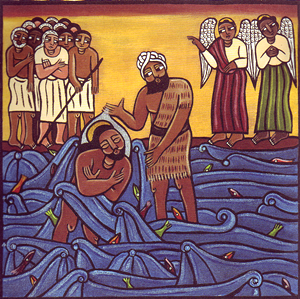
 John 1:29-34 29 The next day he saw Jesus coming toward him and said, “Behold, the Lamb of God, who takes away the sin of the world. 30 He is the one of whom I said, ‘A man is coming after me who ranks ahead of me because he existed before me.’ 31 I did not know him, but the reason why I came baptizing with water was that he might be made known to Israel.” 32 John testified further, saying, “I saw the Spirit come down like a dove from the sky and remain upon him. 33 I did not know him, but the one who sent me to baptize with water told me, ‘On whomever you see the Spirit come down and remain, he is the one who will baptize with the holy Spirit.’ 34 Now I have seen and testified that he is the Son of God.”
Context. In the prologue the Fourth Evangelist presented John as “a man sent from God” who “came for testimony, to testify to the light, so that all might believe through him. He was not the light, but came to testify to the light.” (John 1:6-8; see also 1:15; and later 5:33) This opening characterization sets the stage for the narration of John’s ministry in 1:19–34. John’s identity is further probed when he is called to account by a delegation sent by the Jewish leaders in Jerusalem. Three times John denies being a particular end-time figure: the Christ (1:20; cf. 1:8, 15); Elijah (1:21a); the Prophet (1:21b; cf. 6:14; 7:40; cf. Deut. 18:15, 18).
After affirming three times who he is not, John in the present passage, at long last, is telling his interrogators who he is. Even though he is none of the scriptural figures expected to make their appearance in Israel in the last days, John does respond in terms of a figure spoken of in Scripture. He is “the voice of one crying out in the wilderness, ‘Make straight the way of the Lord’ ” (1:23) featured in Isaiah 40:3 (see the OT context of Isa 40:3 in a section below). In this characterization of John, the Fourth Evangelist joins together fully with the Synoptic portrayal of the Baptist (cf. Matt. 3:3; Mark 1:3; Luke 3:4). According to the Fourth Evangelist, John’s witness centered on Jesus’ role in the divine plan of salvation as the “Lamb of God who takes away the sin of the world” (1:29, 36). At its very heart, the purpose of John’s baptism and ministry is described as being bound up with revealing Jesus’ true identity to Israel (1:31).
Each year in the Lectionary Cycle (A: Matthew; B:Mark; C:Luke) the gospel for the 2nd Sunday in Ordinary Time is taken from the first chapter of the Gospel according to John. The purpose for this is essentially the same – following the baptism of the Lord, which reveals the relationship of the Father to the Son and to the Holy Spirit – this week’s gospel reveals the relationship of Jesus to the world. And perhaps no one does so more robustly than the Fourth Evangelist.
The fourth Gospel is a book of “signs;” namely things, events, and people who point to something else. Such “intermediaries” are generally necessary in this gospel in order to come to faith. Even Jesus is a type of intermediary as the logos — the “Word” or “Revealer” of God. The theme and purpose of the “signage” becomes clear in John 20:31 – “But these are written that you may (come to) believe that Jesus is the Messiah, the Son of God, and that through this belief you may have life in his name.” This gospel itself is a “sign” to point us to the Messiah, who is a “sign” who points us to God. As O’Day (John, NIB, 524) states about this gospel: “… the story of Jesus is not ultimately a story about Jesus; it is, in fact, the story of God.”
It is to this that John testifies: “Now I have seen and testified that he is the Son of God.”
Discover more from friarmusings
Subscribe to get the latest posts sent to your email.
 friarmusings