One of the interesting things about “blogging” is what happens off-line. WordPress has a feature for “comments” and it is a controllable feature. You can allow all comments and then remove inappropriate ones as you see fit. But then that means you have to monitor; sometimes manners and charity are not hallmarks of text and comments left behind. It takes time. Not willing to dedicate time to the supervising task? The blog administrator can not allow any comments at all. That takes no additional time to oversee. There is at least one “middle way.” You can allow comments but require that all comments be approved before they are posted on one’s blog. That takes some time, but you have the luxury of getting to such things when you have time. Continue reading
Monthly Archives: August 2014
Back in the Boat
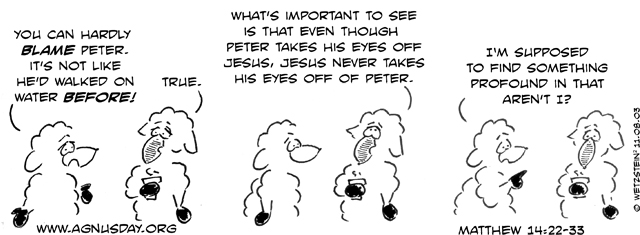
Back in the Boat. There are many commentaries and sermons on the web that proclaim “get out of the boat!” One, somewhat cleverly, referred to the great danger that Christians are just at Sunday worship and become “boat potatoes” never taking faith outside the walls of the church. I did not find any that talked about being “back in the boat.” As mentioned a few days ago, we should be mindful that each Sunday we sit in the “nave” of the church, a word whose origins come from the Latin navis which means “boat” or “ship.” We have already considered a range of reason why Peter would have gotten out of the boat and stepped in to the chaos of the storm. It is that vein that people encourage “boat potatoes” to go over the sides, into the storm, where people need to be rescued. Continue reading
Where does Church fit?
David Lose (…in the Meantime) has been musing about things:
Given how many other groups and movements legitimately lay claim to our allegiance today, can the Church ever expect to exert the level of influence in our lives that it once did?
The Boat: stepping out
Given other stories we know about Peter, there is a bias for us to assume Peter is just being Peter here in this story, impetuously acting before considering the bigger picture. But we should remember that this story is likely grounded in saying something about ekklesia (church). Eugene Boring (328) points out that this is no longer a story about what Jesus alone can do: Continue reading
The Boat: He who comes
Coming on the Water. Alyce McKenzie is the George W. and Nell Ayers Le Van Professor of Preaching and Worship at Perkins School of Theology at SMU. She always has a good “take” on Scriptures. I enjoy reading her Edgy Exegsis column on the Patheos portal. I thought I would share her insights on this reading:
Twenty centuries earlier, another man looks out over another lake from the mountaintop to which he has retreated to pray. He is not a superhero who has retreated to his bat cave. He is not a ghost out to haunt the already terrified. He is a man. Fully God, fully human. He is the Son of God, though those around him don’t yet recognize him. His ship of faith is being battered by the rejection of his hometown folks and the beheading of his cousin John the Baptist by Herod. He knows his time is coming. Crowds of needy people press in on him constantly. Continue reading
The Boat: tossed about
Tossed about: it describes Jesus and the disciples. Jesus had already wanted to be by himself in prayer before the encounter with the great multitude of people who need “rescue” from hunger (Mt 13:12-21). Their need becomes the wind and waves that toss Jesus about as he responds in compassion. The disciples are directed to go ahead by boat – and they will be tossed about on the seas.
22 Then he made the disciples get into the boat and precede him to the other side, while he dismissed the crowds. 23 After doing so, he went up on the mountain by himself to pray. When it was evening he was there alone. This is the only place after the initial period in the wilderness (4:1–11) where Matthew specifically mentions that Jesus chose to be truly alone, sending his disciples away. This pericope (scholar language for “story”) is the first time in the Gospel according to Matthew that Jesus is pictured as praying. Even in Gethsemane he will keep three of the disciples with him (26:37). Matthew does not elsewhere mention Jesus’ habit of praying alone, as in Mark 1:35; Luke 5:16; 6:12; 9:18, though he has of course recorded his instruction to his disciples to pray in this way, 6:5–6. It would be possible therefore to read this unusual note as indicating a particular crisis at this point in Jesus’ ministry. But that would be an argument from silence, and Matthew gives us no indication of the subject of Jesus’ prayer. In the narrative context the solitary prayer in the hills serves rather to explain how Jesus comes to be so far away from his disciples on this occasion when they find themselves in difficulties. (France, 569) Continue reading
The Boat: context
After the collection of parables in Mt 13, the 14th chapter takes up what might well be a natural fall out of his teachings that are increasingly vague even as they point to coming judgment – weeds that will be burned and fish that will be discarded. People begin to wonder if Jesus is pronouncing judgment upon them or their “group.” The inevitable pushback or rejection will become more and more present in the narrative or at least in its subtext. Despite the pushback, Jesus must prepare the disciples. And so after teaching the disciples about the nature of the kingdom and why people do not necessarily believe (Mt 13), the Gospel reaches a pivot point in the telling of Jesus’ rejection at Nazareth, his native place (v.54). As usual the people are astonished, but in the end they took offense at him (v.57). Nonetheless Jesus continues to the preparation of disciples. Continue reading
Nine Words and a Question Mark
It is a simple question: nine words and a question mark. It is a probing, provocative, and pointed question. St. Paul asks it in his letter to the Romans, our second reading. It is just nine simple words: What will separate us from the love of Christ? (Rom 8:35). St Paul is writing at the end of a long passage in his letter that begins in Chapter 5 and reaches its thunderous conclusion in Chapter 8. You have to imagine St. Paul as the orator, having built up his argument, the crowds leaning forward in anticipation. He has already answered the question, Who will deliver me…? (Rom 7:24) with the resounding affirmation of Jesus Christ,, the Lord, as the deliverer. St. Paul has already convinced us that in the grace of God we have been saved and given new life: Or are you unaware that we who were baptized into Christ Jesus were baptized into his death? We were indeed buried with him through baptism into death, so that, just as Christ was raised from the dead by the glory of the Father, we too might live in newness of life. (Rom 6:3-4) We have been given newness of life, led in the Spirit of God to be children of God (Rom 8:14) and if children, then heirs, heirs of God and joint heirs with Christ. (Rom 8:17). All of this pure gift, not earned, no way to purchase for the price has already been paid in full – it is the deal of a lifetime – an eternal lifetime. Continue reading
Practiced Hospitality
Several weeks ago we announced that we would try an experiment – Nametag Sunday. It is a pilot project that has arisen out of an ongoing conversation around what it means to be a committed parish of the faithful. Among all the studies and from surveys of Catholics across this nation – one thing that is clear: a parish must be welcoming. Continue reading