Still working on it…

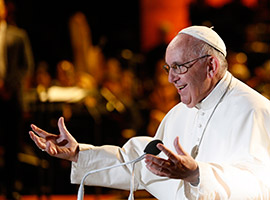
popeSeveral weeks ago I wrote “Not yet…” an article that acknowledged Pope Francis’ new apostolic exhortation, the Joy of Love – and noted that I was glad people were asking me about it, but I needed time to read it, re-read it, and think about it. I can report that I have now read it, have re-read parts of it, and am still thinking about. What I can offer at this point is some thoughts from here and there – and offer them cautiously at that. Continue reading

Keeping the Word: Paraclete

farewell-discoursePerhaps it best not to translate the Greek word paraclete because there are too many possibilities. While the literal meaning of the related verb (parakaleo) means “to call to one’s side,” usually asking the other for help, the noun took on a legal meaning as “helper in court”. Thus we have translations like “counselor,” “advocate,” or “one who speaks for another” as well as the too general translation of “helper”. Continue reading

Keeping the Word

farewell-discourse23 Jesus answered and said to him, “Whoever loves me will keep my word, and my Father will love him, and we will come to him and make our dwelling with him. 24 Whoever does not love me does not keep my words; yet the word you hear is not mine but that of the Father who sent me. 25“I have told you this while I am with you. 26 The Advocate, the holy Spirit that the Father will send in my name—he will teach you everything and remind you of all that (I) told you. 27 Peace I leave with you; my peace I give to you. Not as the world gives do I give it to you. Do not let your hearts be troubled or afraid. 28 You heard me tell you, ‘I am going away and I will come back to you.’ If you loved me, you would rejoice that I am going to the Father; for the Father is greater than I. 29 And now I have told you this before it happens, so that when it happens you may believe. (John 14:23-29)

Verse 23 begins with, “Jesus answered and said to him.” Jesus is answering the question raised in v. 22 by Judas (not Iscariot): “Lord, how is it that you will reveal (emphanizo) yourself to us, and not to the world?” This question comes because Jesus has just said that he would love and reveal himself to those who have and keep his commandments — those who love him (v. 21: Whoever has my commandments and observes them is the one who loves me. And whoever loves me will be loved by my Father, and I will love him and reveal myself to him.”). Continue reading

Keeping the Word: context

farewell-discourseJesus’ departure and return (13:31–14:31)  Once Judas has left the light (13:1), Jesus begins to speak to his own, his dearest friends. Various disciples — Peter, Thomas, Philip, Judas (not Iscariot, possibly Thaddeus) — carry the discussion forward by the questions they pose. This enables us to break down the whole, hopefully to see it more clearly, by dividing it according to the characters who ask the leading questions. Continue reading

Keeping the Word: introduction

farewell-discourse23 Jesus answered and said to him, “Whoever loves me will keep my word, and my Father will love him, and we will come to him and make our dwelling with him. 24 Whoever does not love me does not keep my words; yet the word you hear is not mine but that of the Father who sent me. 25“I have told you this while I am with you. 26 The Advocate, the holy Spirit that the Father will send in my name—he will teach you everything and remind you of all that (I) told you. 27 Peace I leave with you; my peace I give to you. Not as the world gives do I give it to you. Do not let your hearts be troubled or afraid. 28 You heard me tell you, ‘I am going away and I will come back to you.’ If you loved me, you would rejoice that I am going to the Father; for the Father is greater than I. 29 And now I have told you this before it happens, so that when it happens you may believe.
(John 14:23-29)

Introduction. Our passage today is taken from the “Farewell Discourse” of Jesus contained in five chapters of John (13:1-17:56). In other words, we have but a few verses which are an integral part of a much larger passage. Accordingly, the Discourse can be outlined in a number of ways, though three main parts are fairly clear: Continue reading

Because you believe

This weekend I am preaching for the Annual Pastor Appeal – so I thought I would post a homily from several years ago that I gave on this same weekend.


Christ-glorifiedAs I have loved you, so you also should love one another (John 13:34)

In his book Surprised By Joy, CS Lewis describes being at a very proper English tea, standing there with an overly filled cup, when, quite by accident someone bumped into him, causing the jostled cup to spill some of its content out.  Later, when reflecting on that most ordinary of things, he noted isn’t that a lot like life.  If we want to know that with which we have filled our life, we only need to be jostled by life to see what spills out. Continue reading

Hands

hands-pastor-colIt is said that you can tell a lot about a person by their hands. The common wisdom is that a person’s self-image is revealed in the manner in which they shake hands. One of the oft-told stories in my family is when my then college-aged niece brought home a young man to meet the family and her grandmother. We were all greeted by the “dead-fish handshake,” a weak hello, and eyes cast to one side. The family advice was uniform: dump him. My niece thought we were all a bit judgmental. Perhaps, but let’s just say it was an occasion where experience met prudence. The handshake told us almost everything we needed to know. Several weeks later, our niece came to the same assessment. Continue reading

Glorified: love

Christ-glorified

The Commandment to Love. 34 I give you a new commandment: love one another. As I have loved you, so you also should love one another. 35 This is how all will know that you are my disciples, if you have love for one another.” This is the first of two instances (13:34; 15:12) in which Jesus commanded his disciples to love one another, but only on this occasion did he refer to it as a ‘new’ command. What is new about this commandment? It can refer to something that didn’t exist before. But the command to love one another is not recent. It is found in the Torah (Lev 19:18; Dt 6:4). It can refer to something that existed previously, but was not fully known or understood; e.g., a “new” understanding. I think that it is in this sense that this commandment is “new”. Continue reading

Glorified: Jesus departs

Christ-glorified

Jesus’ Departure. Referring again to his imminent departure, Jesus said to his disciples, “My children, I will be with you only a little while longer You will look for me, and as I told the Jews, ‘Where I go you cannot come,’ so now I say it to you” (v.33).

“My children (teknia)…” This term of endearment expresses Jesus’ love for his disciples and is a poignant introduction to his announcement that his departure is imminent. The term a little longer (eti mikron) is imprecise (cf. 7:33), so they could not be sure how soon this separation would take place, but given the announcement of the betrayal they might suspect that it would be very soon. Jesus seems to refer not just to the time of separation between his death and resurrection, but also to the time thereafter. For he says they will look for him, which they did not do after his death, but which they did do after the resurrection. Just as the first disciples sought him out (1:38), so will they continue to seek for him after his departure. Part of the purpose of the farewell discourse is to tell them of the new ways in which they will find him in the future. Continue reading

Glorified: God and Jesus

Christ-glorified

Our short text can be divided into three parts:

  • 31-32 – the glorification of God and Jesus
  • 33 – Jesus’ departure
  • 34-35 – the commandment to love.

The Glorification of God and Jesus. The immediate reference to Judas’ departure, like the coming of the Greeks (12:20-23), signals to Jesus that a new stage of the glorification has been reached. The betrayal has begun, and so “Now is the Son of Man glorified, and God is glorified in him.” This verse and the following verse are particularly difficult to translate. The cross is itself the revelation of divine glory and the way for Jesus to share the divine life with his followers. It is also the way for God to glorify the Son in himself (v. 32), which he will do at once as Jesus returns to his presence (17:5). Just as Jesus’ keynote address focused on the relation between the Father and the Son (5:19-27), so also his farewell discourse begins from that same fundamental point. This relationship is central to this Gospel. Continue reading