
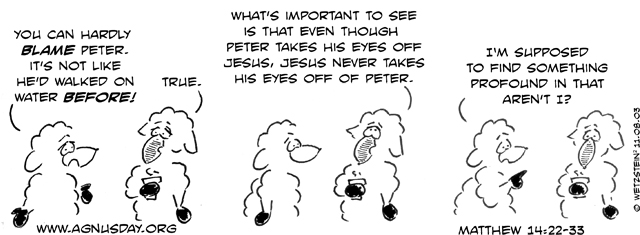
Back in the Boat. There are many commentaries and sermons on the web that proclaim “get out of the boat!” One, somewhat cleverly, referred to the great danger that Christians are just at Sunday worship and become “boat potatoes” never taking faith outside the walls of the church. I did not find any that talked about being “back in the boat.” As mentioned a few days ago, we should be mindful that each Sunday we sit in the “nave” of the church, a word whose origins come from the Latin navis which means “boat” or “ship.” We have already considered a range of reason why Peter would have gotten out of the boat and stepped in to the chaos of the storm. It is that vein that people encourage “boat potatoes” to go over the sides, into the storm, where people need to be rescued. Continue reading
Monthly Archives: August 2017
In the Boat: stepping out
Given other stories we know about Peter, there is a bias for us to assume Peter is just being Peter here in this story, impetuously acting before considering the bigger picture. But we should remember that this story is likely grounded in saying something about ekklesia (church). Eugene Boring (328) points out that this is no longer a story about what Jesus alone can do: Continue reading
In the Boat: He who comes
Coming on the Water. Alyce McKenzie is the George W. and Nell Ayers Le Van Professor of Preaching and Worship at Perkins School of Theology at SMU. She always has a good “take” on Scriptures. I enjoy reading her Edgy Exegsis column on the Patheos portal. I thought I would share her insights on this reading:
Twenty centuries earlier, another man looks out over another lake from the mountaintop to which he has retreated to pray. He is not a superhero who has retreated to his bat cave. He is not a ghost out to haunt the already terrified. He is a man. Fully God, fully human. He is the Son of God, though those around him don’t yet recognize him. His ship of faith is being battered by the rejection of his hometown folks and the beheading of his cousin John the Baptist by Herod. He knows his time is coming. Crowds of needy people press in on him constantly. Continue reading
In the Boat: tossed about
Tossed about: it describes Jesus and the disciples. Jesus had already wanted to be by himself in prayer before the encounter with the great multitude of people who need “rescue” from hunger (Mt 13:12-21). Their need becomes the wind and waves that toss Jesus about as he responds in compassion. The disciples are directed to go ahead by boat – and they will be tossed about on the seas.
22 Then he made the disciples get into the boat and precede him to the other side, while he dismissed the crowds. 23 After doing so, he went up on the mountain by himself to pray. When it was evening he was there alone. Continue reading
In the Boat: context
After the collection of parables in Mt 13, the 14th chapter takes up what might well be a natural fall out of his teachings that are increasingly vague even as they point to coming judgment – weeds that will be burned and fish that will be discarded. People begin to wonder if Jesus is pronouncing judgment upon them or their “group.” The inevitable pushback or rejection will become more and more present in the narrative or at least in its subtext. Despite the pushback, Jesus must prepare the disciples. And so after teaching the disciples about the nature of the kingdom and why people do not necessarily believe (Mt 13), the Gospel reaches a pivot point in the telling of Jesus’ rejection at Nazareth, his native place (v.54). As usual the people are astonished, but in the end they took offense at him (v.57). Nonetheless Jesus continues to the preparation of disciples. Continue reading
Knowing Jesus
“Ignorance of Scripture is ignorance of Christ.” So said Pope Francis on June 15th of last year as part of a papal audience. But it is not original to Pope Francis; he is quoting St. Jerome, the great biblical scholar and translator from the late 4th and early 5th century. What about you? What is your comfort level with Sacred Scripture? Where would you place yourself on the scale? Continue reading
The glory of God: a reflection
Annemarie Reiner (of Adelaide, Australia) posted this reflection on the Transfiguration on her blog “Who Do You Say That I Am.” (August 2006) It is a very nice reflection for this Feast of the Transfiguration.
When we look at our Gospel today we can understand why daily reflection is so important. These three disciples (and the rest of them) didn’t get who Jesus was until well after his death. They didn’t understand what had happened at the transfiguration. They didn’t understand what was happening as they witnessed Jesus’ life. They didn’t understand what was happening at the crucifixion. But they kept pondering their experiences over and over – if they didn’t we simply wouldn’t have the New Testament.
So what do we learn from this? Continue reading
The glory of God: Elijah’s coming
Peter’s Response. As in 16:13-20, Peter again responds, again without a full understanding. Consider Peter’s proposal to make three tents (skēnḗ; also “booth” or “tabernacle”). What did he intend? It has been variously understood as traveler’s hut, the “tent of meeting” where God spoke with Moses outside the camp (Exod 33:7), a more formal tent used in the Festival of Booths (cf. Lev 23:42–43; Zech 14:16ff), and even as the Jerusalem Temple tabernacle. It is this last image that Matthew may have in mind as background – notwithstanding Peter’s intention. It is the Temple tabernacle where the Shekinah, the fiery cloud that symbolized the continuing presence of God among the people, dwelt over the ark of the covenant. The response to Peter’s proposal is three-fold (Boring, 364) Continue reading
The glory of God: destiny
Commentary. Matthew 17:1-13 is an instructional session for all the disciples – note that in v.10, Peter, James and John have been joined the remainder of the group. Just as the preceding scene (16:13-28) juxtapositions the divine transcendence of Peter’s confession of Jesus as Son of God based on a revelation from heaven (16:17) with Jesus’ own teaching about the suffering Son of Man, so also in this scene the confession of the heavenly voice is juxtaposed with Jesus’ self-confession as suffering Son of Man.
The description of the Transfiguration is brief—just the first three verses of Matthew 17. But the incident becomes the context for two significant incidents for the disciples. Continue reading
