
 1 On the third day there was a wedding in Cana in Galilee, and the mother of Jesus was there. 2 Jesus and his disciples were also invited to the wedding. 3 When the wine ran short, the mother of Jesus said to him, “They have no wine.” 4 (And) Jesus said to her, “Woman, how does your concern affect me? My hour has not yet come.” 5 His mother said to the servers, “Do whatever he tells you.” 6 Now there were six stone water jars there for Jewish ceremonial washings, each holding twenty to thirty gallons. 7 Jesus told them, “Fill the jars with water.” So they filled them to the brim. 8 Then he told them, “Draw some out now and take it to the headwaiter.” So they took it. 9 And when the headwaiter tasted the water that had become wine, without knowing where it came from (although the servers who had drawn the water knew), the headwaiter called the bridegroom 10 and said to him, “Everyone serves good wine first, and then when people have drunk freely, an inferior one; but you have kept the good wine until now.” 11 Jesus did this as the beginning of his signs in Cana in Galilee and so revealed his glory, and his disciples began to believe in him. (John 2:1-11) Continue reading
Cana: context
Reply
 There are lots of different new years to celebrate. The Western world celebrated two weeks ago. The Chinese New Year is Tuesday, February 5. It is the year of the pig in case you are interested. Lots of different dates around the world – and all are based on some different calendar, event and spirituality – and all have very different ways to celebrate.
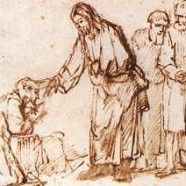 “Lord, if you wish, you can make me clean.” Jesus stretched out his hand, touched him, and said, “I do will it. Be made clean.” (Luke 5:12-13)
 The Theology of History. It is interesting to note that Luke relates no encounter between Jesus and John. In fact, before we are told about Jesus’ baptism, we are informed that John has been put in prison! A traditional way of understanding this order of events is that Luke (the rhetorical historian) divides history into three separate and distinct eras. The first is the time of the prophets, which includes John the Baptist. That era ends with the imprisonment of John. John will no longer be in the picture. After that, the time of Jesus begins with a statement in our text about: (1) the opening of the heaven, (2) the coming down of the Holy Spirit in a visible form (dove); and (3) heavenly speech. This era of Jesus ends with his ascension — related only in Luke & Acts. Jesus will no longer be in the picture. After that, the time of the Holy Spirit (or the Church) begins with a statement in Acts 2:1-4 about (1) something coming “from heaven,” (2) the coming down of the Holy Spirit in a visible form (tongues of fire), and (3) heavenly speech.
 Recently I found myself on a basketball court. I picked up the ball with visions of past glories rebounding in my head (…and those glories are more delusional than actual). As I positioned myself at the free-throw line it occurred to me that the ball had become noticeably heavier and that the basket was somewhat further away. Undaunted, I went through the routine and took the shot. The shot arched nicely through the winter air and in my mind the crowd broke out in a chorus of ….. air ball, air ball! … as the shot returned to earth well short of its intended destiny of “nothing but net.”
  friarmusings