
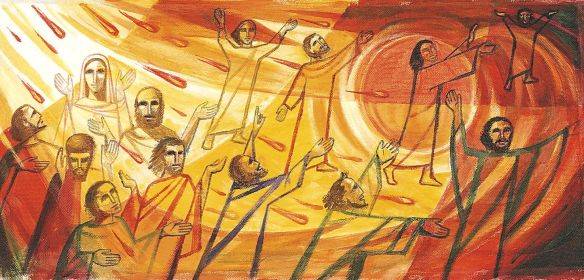
 When I was a child growing up in the 1950s Catholic milieu, we prayed “In the Name of the Father, and the Son, and the Holy Ghost.” We didn’t give it a lot of thought. We were kids. We also did not particularly make the connection between the third person of the Trinity and Casper the Friendly Ghost or any of his not-so-friendly counterparts. But at some point, the phrase “Holy Ghost” gave way to “Holy Spirit.”
The terms “Holy Ghost” and “Holy Spirit” are synonymous: one derives from the Old English gast and the other from the Latin spiritus. Yet in modern English, we most commonly refer to “ghost” as the spirit of a dead person. Understandably, all modern Bibles translate the Greek pnuema as “Spirit”… when appropriate in reference to God.
“when appropriate” because pneuma (πνεῦμα) is an ancient Greek word for “breath” and is the NT choice for translation of the Hebrew ruach (רוח) which means “wind”, “breath” or “spirit.”
It is the ruach of God that hovers over the choas of the world and brings creation and life (Genesis). It is the ruach of God that comes to the prophets. It is the ruach of God that descends upon Jesus at this baptism in the Jordan inaugurating a new creation. It is the ruach of God that comes upon the Apostles and disciples giving birth to the Church. It is the ruach of God that empowers each of us for mission.
On Pentecost Sunday, enjoy this video on the Holy Spirit from our friends at The Bible Project.
The Bible Project is a not-for-profit 501(c)3 organization that relies on the generosity of folks like us. Please consider supporting their on-going work of evangelization.
Discover more from friarmusings
Subscribe to get the latest posts sent to your email.
 friarmusings