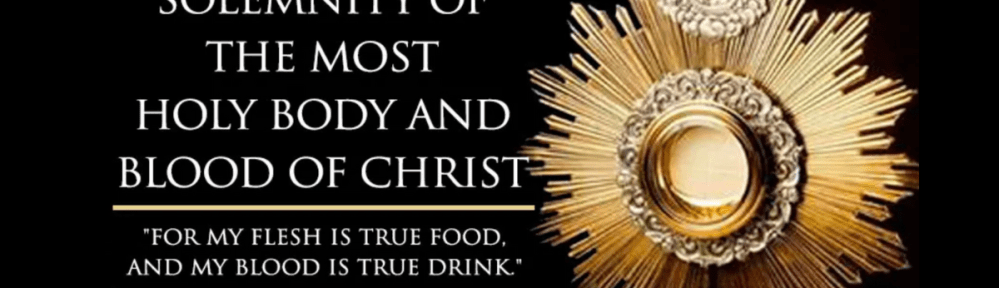
This coming Sunday is the Solemnity of the Body and Blood of Christ. All the gospel writers describe the miracle of the fishes and loaves (Mk 6:33-46, Mt 14:13-23, Lk 9:10-17, and Jn 6:1-15). Through the dialogue that precedes and follows the miracle, Jesus teaches the disciples to trust in him whenever they meet with difficulties in their future apostolic endeavors. He teaches them that they should engage in using whatever resources they have even if they are clearly inadequate. He will supply what is lacking and underscores the meaning of the their continuing mission:
- they are to nourish the people,
- they will need God’s help in nourishing the people, and
- their job is to distribute that which Christ provides.
In the account of the miracles, although Jesus orders the Apostles to feed the people, the main act is performed by Jesus alone. In a solemn, liturgical style, St John describes the scene as “Jesus then took the loaves, and when he had given thanks, he distributed them to those who were seated…” (Jn 6:11). Where the other gospels go on to describe more events, the fourth gospel pauses to theological reflect on the meaning of the miracle whose inner meaning is spelled out at length in Jn 6:25-59. These verses are known as the Bread of Life Discourse.
The best way to understand this discourse is to recognize that it centers on one biblical text, “He gave them bread from heaven to eat” (v. 31), and is therefore a conscious demonstration of the truth of 5:39, 46–47 that the Scriptures illuminate the person of Jesus. The pivotal text is an echo of many Old Testament verses:
- Exod 16:4: “I will now rain down bread from heaven for you”;
- Neh 9:15: “Food from heaven you gave them in their hunger”;
- Ps 78:24: “He rained manna upon them for food and gave them heavenly bread”;
- Ps 105:40: “ … and with bread from heaven he satisfied them.”
All of these verses are referring to the miracle of manna in the desert during the Exodus from Egypt. The first reading on Corpus Christi Sunday is taken from Dt 8 in which Moses reminds the people of what God had done for them: “…fed you with manna, a food unknown to you and your fathers, in order to show you that not by bread alone does one live, but by every word that comes forth from the mouth of the LORD.” (Dt 8:3)
This is a sign/miracle which discloses Jesus as the one who sustains us with his living word and with the gift of his own life in the Eucharistic bread. Not only the sign of the bread but also the reassuring words to the disciples, ‘It is I’ (John 6:20), along with the Christological ‘I am’ statements (vv. 25, 35, 41, 48-51), all draw our attention beyond the words of Jesus and beyond the Eucharist itself to the person of Jesus who communicated his life-giving power through them. For St. John, the point of this scene is that Jesus is the Moses-like prophet who feeds his people with a new bread. This new bread is Jesus’ word of revelation received in faith as well as his Eucharistic bread. But the crowd’s understanding is clouded by their messianic expectations because their hopes are tainted with politics and power. They do not see the spiritual nature of the messianic kingdom; only the outward signs.
The discourse is interrupted four times by dialogue from/within the audience. Lifted from the text and placed in order of occurrence it is easy to see the shifting reaction of the audience as their messianic expectations are not being met.
So they said to him, “What sign can you do, that we may see and believe in you? What can you do? Our ancestors ate manna in the desert, as it is written ‘He gave them bread from heaven to eat.’” (John 6:30-31)
So they said to him, “Sir, give us this bread always.” (John 6:34)
The Jews murmured about him because he said, “I am the bread that came down from heaven,” and they said, “Is this not Jesus, the son of Joseph? Do we not know his father and mother? Then how can he say, ‘I have come down from heaven’?” (John 6:41-42)
The Jews quarreled among themselves, saying, “How can this man give us [his] flesh to eat?” (John 6:52)
In Jn 6:4 we are told that the Passover was at hand. After that St John has little to directly say about the Passover and its relation to the Bread of Life Discourse. Many Catholic scholars believe that St John’s writing assumes that the reader is familiar with the synoptic Gospels. Consequently, St John does not recount the story of Jesus, rather, St John gives the theological perspective. Whereas the synoptic writers recount the Eucharistic institution in their Gospels, St John provides the theological basis for the event. Where the synoptic writers place their accounts in the proper historical setting, the Passover feast; St John provides the explanations in a different setting, following the miracle of the feeding of the 5,000. In this way he shows the prefiguring of Holy Eucharist in the OT via the Exodus account, as well as an immediate prefiguring here at another Passover.
But St John did not simply use the Passover setting as a backdrop. There is some evidence that in St John’s telling of the story he has captured very strong parallels to the Passover feast, just as in the Last Supper. In the Passover liturgy four children ask questions about what is enacted by the celebration. These questions have parallels in questions that the crowd asks of Jesus. The first question of the meal is about the works of God. The second question regards passages in Scripture. The mocking question in vv.41-42 is equated with the third question posed at the meal by the ‘wicked child’. The ‘sincere child’ asks the fourth question supposed to be a practical question paralleled in v.52.
Discover more from friarmusings
Subscribe to get the latest posts sent to your email.

