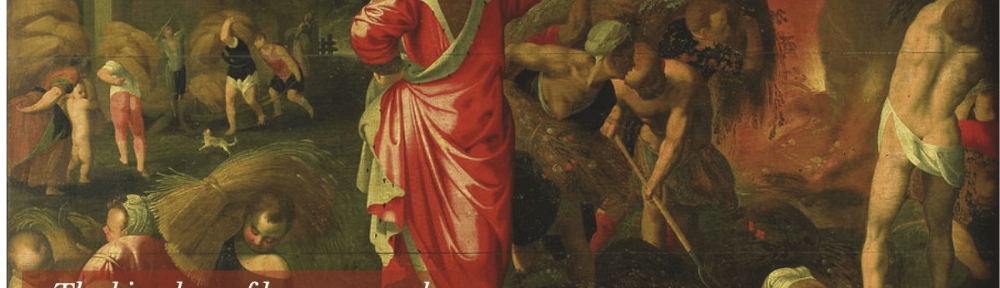
This coming Sunday is the 16th Sunday in Ordinary Time. One should note that this parable of the “Weeds among the Wheat” is explained in Mt 13, outside our gospel, but closely placed:
36 Then, dismissing the crowds, he went into the house. His disciples approached him and said, “Explain to us the parable of the weeds in the field.” 37 He said in reply, “He who sows good seed is the Son of Man, 38 the field is the world, the good seed the children of the kingdom. The weeds are the children of the evil one, 39 and the enemy who sows them is the devil. The harvest is the end of the age, and the harvesters are angels.
40 Just as weeds are collected and burned (up) with fire, so will it be at the end of the age. 41 The Son of Man will send his angels, and they will collect out of his kingdom all who cause others to sin and all evildoers. 42 They will throw them into the fiery furnace, where there will be wailing and grinding of teeth. 43 Then the righteous will shine like the sun in the kingdom of their Father. Whoever has ears ought to hear.
The identification of the allegorical characters is not hidden, but what is the intention of the parable as a whole, especially as it pertains to the decision by the Master to leave the wheat and the darnel untouched until the harvest? I would suggest that the meaning may well be connected to the unique element of this parable: there are two sowings.
In the parable of the “Sower and the Seed” (vv.3-9) There is one sowing with seed, a symbol of the good and potent word of God, which generates believers, and the issue is “What kind of soil are you?” But in the parable of the “Weeds Among the Wheat” there are two sowings, and the question is “Are the good seeds sown by the householder/Jesus? Or are you the toxic seed sown by the enemy/Satan. This is an expression of a Matthean view of two kingdoms: of heaven and of the world.
The parable of the “Weeds Among the Wheat” points out the presence of the kingdom in the world: children of the kingdom must coexist with children of the evil one in this world until the end. As mentioned above, this reinforces the themes of on-going conversion (understanding, action, joy, perseverance in suffering brought about by tribulation or persecution, and ultimately bearing fruit superabundantly “in the world,” that place where anxiety and the lure of riches choke the word and it bears no fruit (v.22).
There are scholars who hold that Matthew’s unique use of the parable speaks primarily to the idea of a community of believers in which true and false disciples coexist – a theme not unknown to Matthew’s gospel. As R.T. France [2007, 532] notes: “See for instance the recruitment of “bad as well as good” guests to the wedding feast…with the result that one of the new invitees had subsequently to be thrown out (22:11–13). The wicked will be picked out “from among the righteous” (13:49). There are false prophets who are wolves dressed up as sheep (7:15–20); there are those who call Jesus “Lord, Lord” with apparent sincerity, but who do not belong to him (7:21–23); there are foolish as well as wise bridesmaids, waiting and sleeping together until the bridegroom arrives (25:1–12); there is a son who sounds more loyal than his brother, but who ultimately fails to deliver (21:28–32). All these passages are peculiar to Matthew, and more could be added.”
As interesting as that might be, here the field is identified as the “world” which indicates that the concern is wider than just what happens inside the Church. Within the “world” believers and unbelievers continue to exist side by side even after the proclamation of the kingdom of heaven and Jesus’ assault on the kingdom of Satan. Then and now some disciples find this a bit unsettling and a little baffling. Where is the kingdom and a new order promised by Jesus? It does not seem to be much of a kingdom when opposition continues unabated? The parable answers that question by a call to patience, directing attention away from the current situation to the coming judgment, when it will be made plain who are the true people of God and who are the “children of the Evil One.” God is not in a hurry, and we must be prepared to wait for his time.
Image credit: Parable of the Weeds among the Wheat, attributed to Isaac Claesz. van Swanenburg, 1590 – 1610, Public Domain
Discover more from friarmusings
Subscribe to get the latest posts sent to your email.
 friarmusings