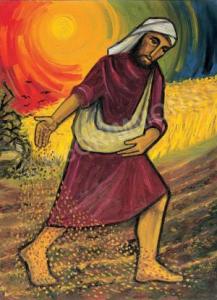
Weeds, Wheat and Choice

Note: by the time you read this I should be on the way back from the Friar’s meeting. This was posted three years ago.


The “enemy came and sowed weeds all through the wheat.”  We really should not be surprised. It’s the way it has always been. The “enemy” – a nice term for Satan, the devil and all the evil minions – are just doing what they have always done – offering us a choice.

In the Garden of Eden, humanity had it pretty good. Everything we could want. God came and walked with us in the cool of the afternoon. We were in communion with God. Imagine that, little ol’ us in communion with the one who is infinitely good, infinitely loving, infinitely just and so much more – and what God seeks is communion with us. God only asked one thing of Adam and Eve: eat of the tree of life, but do not eat of the Tree of the Knowledge of Good and Evil. Along comes the enemy to offer us a choice.

Adam and Eve could have chosen to remain in communion with God or they could grasp at control in order to decide what is good and what is evil; to set aside the moral compass that points to the goodness of God and have our own compass that points any way we choose. The enemy did not make anyone choose. The choice was ours. And so it remains today. The enemy is there hoisting up choices. And we hear it playing out in our thoughts, in what we tell others, or what others tell us. “It’s only a small thing.” “No one will ever know.” “What’s the harm?” “Don’t pretend you’re some holier-than-thou saint.”

I love the passage in the Gospel where Jesus quotes a Psalm: “I will open my mouth in parables, I will announce what has lain hidden from the foundation of the world.” Yup, since the foundation of the world we have been continually faced with the choice between the One who is Goodness and the source of all Good or giving in to the pursuit of some less good, or no good at all.

So when the enemy comes to sow weeds all through the wheat of our lives, the enemy is doing what he does – offering a choice. But in this gospel passage it’s not an easy this-or-that choice. Early on you can’t tell the difference between the baby wheat and the baby weeds. Later on when you can tell the difference the roots are all tangled up together, so if you try to uproot the weed, you’re pulling out wheat also.  In the parable, Jesus is saying, this is the way the world will be: weeds and wheat together – because some will choose to be weeds and sow weeds throughout the kingdom. So, we are not to judge, but let it be and the harvester will take care of it: “collect the weeds and tie them in bundles for burning; but gather the wheat into my barn.

I guess we have no choice in the matter. Doesn’t Matthew 7:1 say, “Stop judging, that you may not be judged”? True, in so far as it is not our role who decides who will be bundled for burning and who ends up in the barn. But we do have a choice. Consider Matthew 18: “If your brother sins [against you], go and tell him his fault between you and him alone.

You are in that situation of choosing when you think or say, “I thought they were my friend.” “How could they do that to me?” You know what the gospel says – go and talk to him or her. Want for them exactly what God wants for you – community. This is when the enemy offers you choices: “It’s no big thing. Let it slide.” “Just ghost them.” “Cancel them!” If you are the one whispering this to another, perhaps you are unwittingly acting as the enemy’s minion … just saying…  In any case, this is how the harmony between you and that person begins to erode and perhaps the harmony between that person and God is also eroding. What are we to do?

The first reading from the Book of Wisdom reminds us, as does the gospel, that in the end God’s justice to God’s self demands a reckoning. God is justice, power and might – as so the scribe reminds us: “For your might is the source of justice; your mastery over all things makes you lenient to all.” Lenient to all who call upon God. Lenient, clement, merciful, kind. This is the character of God so beautifully expressed in Exodus 34:6: “… a merciful and gracious God, slow to anger and rich in kindness and fidelity.”  Fidelity – that loyal love.

But though you are master of might, you judge with clemency, and with much lenience you govern us; for power, whenever you will, attends you. And you taught your people, by these deeds, that those who are just must be kind; and you gave your children good ground for hope that you would permit repentance for their sins. (Wisdom 12:16-19)

Clemency, mercy, grace, loyal love, kindness, hope  – all these things are offered to us when we choose wrongly, rejecting the moral compass of God and choosing our own designs. This is what we are keeping from the friend to whom we won’t engage and reorient them to God’s design. This is what we need to offer our friend in the words and the way we speak: mercy, loyal love, and kindness.

This is what is waiting for us when our own moral compass is misdirected. It awaits us in prayer! “But, Father, I’m not sure I know how to pray when I feel so far from God.” You, me and St. Paul:

The Spirit comes to the aid of our weakness; for we do not know how to pray as we ought, but the Spirit himself intercedes with inexpressible groanings. And the one who searches hearts knows what is the intention of the Spirit, because he intercedes for the holy ones according to God’s will. (Romans 8:26-27)

Pray for yourself, pray to know how to best approach that other person and know the clemency, mercy, grace, kindness and loyal love of God is right there with and for you.


Image credit: Parable of the Weeds among the Wheat, attributed to Isaac Claesz. van Swanenburg, 1590 – 1610, Public Domain
The Mustard Seed and Yeast

This coming Sunday is the 16th Sunday in Ordinary Time. In this post we move away from the parable of the “Weeds among the Wheat.”

31 He proposed another parable to them. “The kingdom of heaven is like a mustard seed that a person took and sowed in a field. 32 It is the smallest of all the seeds, yet when full-grown it is the largest of plants. It becomes a large bush, and the ‘birds of the sky come and dwell in its branches.’” 33 He spoke to them another parable. “The kingdom of heaven is like yeast that a woman took and mixed with three measures of wheat flour until the whole batch was leavened.” 

The mustard seed is an annual herb whose incredibly small seeds produce a plant that is normally 2 to 6 feet in height (possibly as tall as 10 feet) but it would not be mistaken for a tree. I mention “tree” because in the Greek the word dendron is used, which typically means “tree” but can refer to a large bush. So where the NAB ops for “becomes a large bush” other translations opt for “becomes a tree.” There is a case to be made for both. The tree motif reflects the symbol of the imperial tree found in representations of empires including the apocalyptic imagery of the Kingdom of God (see Ps 104:12, Dan 4:9, Ezek 17:23). It is imagery that persisted into the medieval age and appears in St. Bonaventure’s’ Tree of Life which birds of the sky come to dwell.

Some folks comment that Jesus is lampooning the apocalyptic view of the Kingdom. Perhaps, or rather continuing with the idea presented in the wheat/tares parable, the presence of the Kingdom here and now can be overlooked in its smallness and simplicity. One should remember the King of Kings entered Jerusalem on a donkey rather than a warhorse.

In the parable about the “yeast that a woman took and mixed with three measures of wheat flour ” Many commentaries focus on the yeast as a symbol of evil being mixed to the “wheat flour” of the proclamation of the Good News of the Kingdom. The word that is used (zymē) is better translated as “leaven.” The most typical course of making bread was to insert into the new dough a small amount of old, fermented dough reserved from the previous baking; it is this “leaven” (or sourdough) rather than “yeast” proper which the woman is here using. Our translation takes the Greek enkryptō and translates it as “mix” which is a viable translation. Equally viable is “hide” which is used in many modern translations. Retranslated, the passage becomes “leaven that a woman took and hid in three measures of wheat flour.” I would suggest that this translation is more aligned with the meaning of the other parables.

The three measures of flour (about 60 lbs) is an exaggerated amount, but even a small bit of leaven can have a great effect.  The kingdom of Heaven might be insignificant when one considers the leaven, but the end result is mighty and wondrous.

There is much debate over the meaning of these two short parables. Some Christians believe that the imagery of the parables is meant to portray the presence of evil within professing Christendom. This is due primarily to an understanding of the Kingdom of Heaven as a “mystery” encompassing Christendom, understood as organized Christianity. Christendom as a whole contains evil elements mixed with the good, so both parables are usually viewed as picturing that evil. The birds nesting in the mustard tree are unbelievers. It is also pointed out that yeast is often a symbol of evil (Exod 12:15, 19; Matt 16:6, 11–12; 1 Cor 5:6–8; Gal 5:9; but see Lev 7:13–14; 23:17) and asserted that the parable of the yeast portrays the growth of evil within Christendom. This view of the parables is often held in conscious opposition to a view which understands the images of the growth of the Kingdom in the two parables as indicating the ultimate conversion of the world to Christianity before Christ returns.

There is good reason to disagree with the view that emphasizes the presence of evil. First, its understanding of the Kingdom of Heaven as the mystery of evil within Christendom between the two comings of Jesus is doubtful. Rather, the Kingdom in Matthew is the rule of God, inaugurated through the words and works of Jesus and consummated at his return. Second, it is very doubtful that straightforward statements that compare the Kingdom of God to yeast or to mustard seed should be understood as a portrayal of evil. After all, it is the growth of God’s rule, not Satan’s, which is being portrayed. One need not assume that birds or yeast must always be viewed as biblical symbols for evil—consider that the imagery of a lion portrays Satan in one context and Jesus in another (1 Pet 5:8; Rev 5:5). The parables of the mustard seed and the yeast speak of the deceptively subtle yet dramatically significant growth of God’s Kingdom. Despite frequent fruitless responses to the Kingdom message, it does bear much fruit in many cases (13:23). Even John the Baptist may doubt its advance, but it is advancing just the same (11:1–6). The strong man is being bound, and his goods are being plundered (12:29).

While some may view this advance of the Kingdom over-optimistically, others view the present age too pessimistically because they do not acknowledge that the Kingdom was inaugurated and began its advance during the earthly ministry of Jesus. It may presently seem as insignificant as a mustard seed, but it will eventually be the largest tree in the garden. Its growth may be as imperceptible as the influence of yeast in a loaf of bread, but in the end it will be pervasive throughout the earth. The use of humble symbols like mustard seeds and yeast is appropriate for God’s humble servant who does not cry out in the streets (12:19) and who rides into Jerusalem on a donkey, not a stallion (21:1–5). The majority of scholars hold that these parables portray a contrast between the present reality and the ultimate destiny of the Kingdom. That which is now humble will be glorious. The realization that God is already at work and that there is a unity of the ultimate with the present should give all believers hope.


Image credit: Parable of the Weeds among the Wheat, attributed to Isaac Claesz. van Swanenburg, 1590 – 1610, Public Domain

Our Impatience with the Weed

This coming Sunday is the 16th Sunday in Ordinary Time. The landowner (God) is quite patient and accepts that there will be “weeds” among the harvest – it is the lot of the human enterprises. Some people do not/will not/cannot hear the Word sown in their lives. The laborers in the parable are quick to want to eradicate the poison. I think history has shown that we reach beyond our calling – not to simply point out error – but to extinguish the source and root of that error. In the first centuries of the Church, when some of the epic battles over theological orthodoxy and heresy were waged, executions were not part of the Church’s response. There might be condemnation, banishment and loss of position, but people were not put to death. Yet a millennia later the island nation of England has its book of Protestant and Catholic martyrs as witness to our human reaction to “weeds” among us, despite the Gospel message.

Patricia Datchuck Sánchez nicely summarizes this point:

In marked contrast to the forbearance and patience of God, there is a tendency among his creatures to distinguish, discriminate and, all too often, to disparage and even to dispose of one another. Differences which are perceived as a measure of weakness or a diminishment of personal worth have unfortunately proven to be sufficient impetus for provoking some of the darkest periods in the history of humankind.

In an effort to separate “good” from “bad”, or the law-abiding from the insurgents, Claudius forced a separation and commanded all Jews to leave Rome (ca. 49-50 C.E.). Centuries later, Jews would be similarly expelled from Spain (1492). Later yet, and in an act of unique horror, Adolf Hitler attempted to definitively separate and annihilate every Jewish person in order to construct what he perceived to be a superior race. When he was finally stopped in 1945, only 3,000,000 out of a population of 9,000,000 Jews in Europe remained alive. Millions of non-Jews were also killed during the third Reich, their only crime being the fact that they were judged as different and therefore lesser than their persecutors.

During the Middle Ages (ca. 1150 C.E.), formal investigative tribunals were established with an eye to safeguarding the integrity and authenticity of the faith. But when Pope Innocent III declared heresy a capital time in 1199 C.E. and when the Fourth Lateran Council (1215 C.E.) provided secular punishment for heretics, all manner of cruelty and injustice ensued. Inquisitors were ruthless in their prosecution of those whose ideas ranged anywhere from the truly heretical to the merely diverse. Those alleged to be heretics had no rights; they were forced to prove their own innocence without benefit of counsel.

Similar attempts at separating those judged to be orthodox from those who were not resulted in the infamous witch trials which swept Europe from the thirteenth to the early eighteenth century and crossed the Atlantic to take hold in the Americas in the seventeenth century. Religious intolerance perpetrated the torture and deaths of actual practitioners of black magic, necromancy, etc. as well as others who were accused simply because they happened to have red hair, or who, because of nervousness may have stumbled through the Lord’s Prayer.

Segregation and separation of peoples because of their different ideas, or social mores, has been a blight on the visage of humanity for centuries.


Image credit: Parable of the Weeds among the Wheat, attributed to Isaac Claesz. van Swanenburg, 1590 – 1610, Public Domain

Two Sowings

This coming Sunday is the 16th Sunday in Ordinary Time.  One should note that this parable of the “Weeds among the Wheat” is explained in Mt 13, outside our gospel, but closely placed:

36 Then, dismissing the crowds, he went into the house. His disciples approached him and said, “Explain to us the parable of the weeds in the field.” 37 He said in reply, “He who sows good seed is the Son of Man, 38 the field is the world, the good seed the children of the kingdom. The weeds are the children of the evil one, 39 and the enemy who sows them is the devil. The harvest is the end of the age, and the harvesters are angels.

40 Just as weeds are collected and burned (up) with fire, so will it be at the end of the age. 41 The Son of Man will send his angels, and they will collect out of his kingdom all who cause others to sin and all evildoers. 42 They will throw them into the fiery furnace, where there will be wailing and grinding of teeth. 43 Then the righteous will shine like the sun in the kingdom of their Father. Whoever has ears ought to hear. 

The identification of the allegorical characters is not hidden, but what is the intention of the parable as a whole, especially as it pertains to the decision by the Master to leave the wheat and the darnel untouched until the harvest? I would suggest that the meaning may well be connected to the unique element of this parable: there are two sowings.

In the parable of the “Sower and the Seed” (vv.3-9) There is one sowing with seed, a symbol of the good and potent word of God, which generates believers, and the issue is “What kind of soil are you?”  But in the parable of the “Weeds Among the Wheat” there are two sowings, and the question is “Are the good seeds sown by the householder/Jesus? Or are you the toxic seed sown by the enemy/Satan.  This is an expression of a Matthean view of two kingdoms: of heaven and of the world.

The parable of the “Weeds Among the Wheat” points out the presence of the kingdom in the world: children of the kingdom must coexist with children of the evil one in this world until the end. As mentioned above, this reinforces the themes of on-going conversion (understanding, action, joy, perseverance in suffering brought about by tribulation or persecution, and ultimately bearing fruit superabundantly “in the world,” that place where anxiety and the lure of riches choke the word and it bears no fruit (v.22).

There are scholars who hold that Matthew’s unique use of the parable speaks primarily to the idea of a community of believers in which true and false disciples coexist – a theme not unknown to Matthew’s gospel. As R.T. France [2007, 532]  notes: “See for instance the recruitment of “bad as well as good” guests to the wedding feast…with the result that one of the new invitees had subsequently to be thrown out (22:11–13). The wicked will be picked out “from among the righteous” (13:49). There are false prophets who are wolves dressed up as sheep (7:15–20); there are those who call Jesus “Lord, Lord” with apparent sincerity, but who do not belong to him (7:21–23); there are foolish as well as wise bridesmaids, waiting and sleeping together until the bridegroom arrives (25:1–12); there is a son who sounds more loyal than his brother, but who ultimately fails to deliver (21:28–32). All these passages are peculiar to Matthew, and more could be added.”

As interesting as that might be, here the field is identified as the “world” which indicates that the concern is wider than just what happens inside the Church. Within the “world” believers and unbelievers continue to exist side by side even after the proclamation of the kingdom of heaven and Jesus’ assault on the kingdom of Satan. Then and now some disciples find this a bit unsettling and a little baffling. Where is the kingdom and a new order promised by Jesus? It does not seem to be much of a kingdom when opposition continues unabated? The parable answers that question by a call to patience, directing attention away from the current situation to the coming judgment, when it will be made plain who are the true people of God and who are the “children of the Evil One.” God is not in a hurry, and we must be prepared to wait for his time.


Image credit: Parable of the Weeds among the Wheat, attributed to Isaac Claesz. van Swanenburg, 1590 – 1610, Public Domain 

Your choice

The “enemy came and sowed weeds all through the wheat.”  We really should not be surprised. It’s the way it has always been. The “enemy” – a nice term for Satan, the devil and all the evil minions – are just doing what they have always done – offering us a choice.

In the Garden of Eden, humanity had it pretty good. Everything we could want. God came and walked with us in the cool of the afternoon. We were in communion with God. Imagine that, little ol’ us in communion with the one who is infinitely good, infinitely loving, infinitely just and so much more – and what God seeks is communion with us. God only asked one thing of Adam and Eve: eat of the tree of life, but do not eat of the Tree of the Knowledge of Good and Evil. Along comes the enemy to offer us a choice. Continue reading

The Mustard Seed and Yeast

This coming Sunday is the 16th Sunday in Ordinary Time. In this post we move away from the parable of the “Weeds among the Wheat.”

31 He proposed another parable to them. “The kingdom of heaven is like a mustard seed that a person took and sowed in a field. 32 It is the smallest of all the seeds, yet when full-grown it is the largest of plants. It becomes a large bush, and the ‘birds of the sky come and dwell in its branches.’” 33 He spoke to them another parable. “The kingdom of heaven is like yeast that a woman took and mixed with three measures of wheat flour until the whole batch was leavened.”  Continue reading

Our Impatience with the Weed

This coming Sunday is the 16th Sunday in Ordinary Time. The landowner (God) is quite patient and accepts that there will be “weeds” among the harvest – it is the lot of the human enterprises. Some people do not/will not/cannot hear the Word sown in their lives. The laborers in the parable are quick to want to eradicate the poison. I think history has shown that we reach beyond our calling – not to simply point out error – but to extinguish the source and root of that error. In the first centuries of the Church, when some of the epic battles over theological orthodoxy and heresy were waged, executions were not part of the Church’s response. There might be condemnation, banishment and loss of position, but people were not put to death. Yet a millennia later the island nation of England has its book of Protestant and Catholic martyrs as witness to our human reaction to “weeds” among us, despite the Gospel message. Continue reading

Two Sowings

This coming Sunday is the 16th Sunday in Ordinary Time.  One should note that this parable of the “Weeds among the Wheat” is explained in Mt 13, outside our gospel, but closely placed:

36 Then, dismissing the crowds, he went into the house. His disciples approached him and said, “Explain to us the parable of the weeds in the field.” 37 He said in reply, “He who sows good seed is the Son of Man, 38 the field is the world, the good seed the children of the kingdom. The weeds are the children of the evil one, 39 and the enemy who sows them is the devil. The harvest is the end of the age, and the harvesters are angels. Continue reading

Are we missing something?

wheatToday’s gospel, the explanation of the parable of the weeds in the field, almost begs the question…. where is the parable? The parable was Saturday’s gospel. When asked to explain the parable, Jesus’ answer is to the point and stark: “He who sows good seed is the Son of Man, the field is the world, the good seed the children of the Kingdom. The weeds are the children of the Evil One, and the enemy who sows them is the Devil. The harvest is the end of the age, and the harvesters are angels. Just as weeds are collected and burned up with fire, so will it be at the end of the age” ….at the end of the age. Continue reading

Always a chance for conversion

Next Sunday is the celebration of the 16th Sunday in Ordinary Time. You can read a complete commentary on the Gospel here.

24 He proposed another parable to them. “The kingdom of heaven may be likened to a man who sowed good seed in his field. 25 While everyone was asleep his enemy came and sowed weeds all through the wheat, and then went off. 26 When the crop grew and bore fruit, the weeds appeared as well. 27 The slaves of the householder came to him and said, ‘Master, did you not sow good seed in your field? Where have the weeds come from?’ 28 He answered, ‘An enemy has done this.’ His slaves said to him, ‘Do you want us to go and pull them up?’ 29 He replied, ‘No, if you pull up the weeds you might uproot the wheat along with them. Continue reading