
Please REFRESH the screen/page to ensure all posts display
- China, Taiwan, and the U.S. Strategy in the Indo-Pacificby Friar MusingsRecently folks have been asking me about the U.S. Navy and what do I think about the current state of the fleet in the context of China, Taiwan, the Straits of Hormuz, and a host of related topics. And this is just a portion of fleet operational areas. There are current operations not only in the Indo-China theatre, but also in the Mediterranean, Caribbean, North Atlantic, and the western Pacific. It is a world-wide fleet as regards operations. It is also a fleet that is stretched thin and likely over extended. The USS Gerald R. Ford Carrier Strike Group just … Continue reading →
- China and Taiwan – A Short Historyby Friar MusingsThe relationship between mainland China and the island known today as Taiwan has evolved over many centuries and is shaped by migration, imperial rule, colonialism, civil war, competing national identities, and modern geopolitics. The history is complex because both the mainland government of the People’s Republic of China (PRC) and the government of Taiwan, the Republic of China (ROC), developed different interpretations of sovereignty and legitimacy. Early Taiwan Before Large-Scale Chinese Settlement. For thousands of years, Taiwan was inhabited by Austronesian Indigenous peoples, culturally and linguistically related to peoples in the Philippines and Pacific islands. Imperial Chinese dynasties knew of … Continue reading →
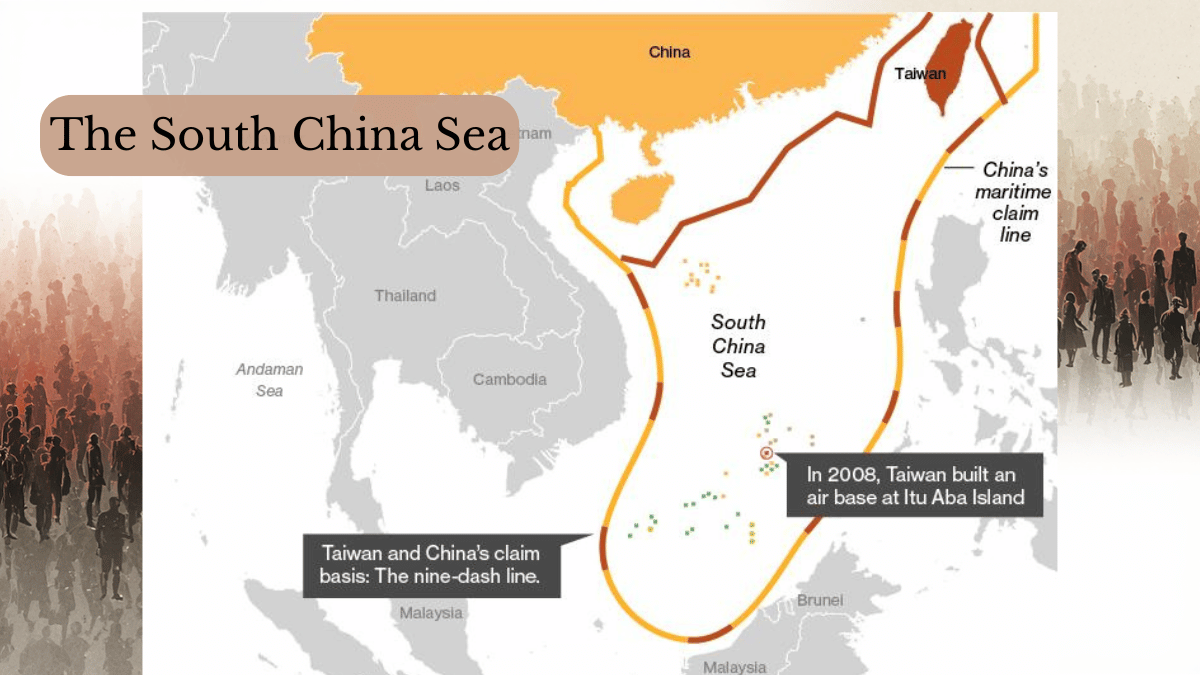
- The Nine-Dash Lineby Friar MusingsThe Nine-Dash Line The “Nine-Dash Line” is a map boundary used by the People’s Republic of China to claim large portions of the South China Sea. It is not directly a sovereignty claim over Taiwan, but it is closely connected to the broader China–Taiwan issue because both the government in People’s Republic of China (Beijing/PRC) and the government in Taiwan (the Republic of China, or ROC) historically inherited versions of the same maritime claims from pre-1949 China. But they are not the only countries with claims in the South China Sea. Claimants include Vietnam, Malaysia, Indonesia, Singapore, Brunei and the … Continue reading →
- China’s Economic Lifeline – the South China Seaby Friar MusingsChina’s interests in the South China Sea are profoundly commercial and economic, not merely military or nationalist. The sea functions as one of the central arteries of China’s economy and global position. Beijing views control, influence, or at least secure access to the region as vital to national survival and long-term development. The South China Sea as a Strategic Economic Corridor. Roughly one-third of global maritime trade passes through the South China Sea (SCS), including enormous volumes of container shipping, energy imports, bulk commodities, and manufactured exports. For China specifically, the sea links China’s industrial east coast, Southeast Asian markets, … Continue reading →
- The State of the Chinese Navy (PLAN)by Friar MusingsOverview This is a somewhat longish post with details that may be of interest to a smaller group. Perhaps an “executive summary” would be helpful: Chinese shipyards generally build both civilian-use and military-use vessels – and often civilian vessels meet military specifications, e.g., ferries – allowing their easy incorporation into fleet use. China’s first interest is the South China Sea (SCS) and this is reflected in their “order of battle” in that combat ships are modern but the vessels needed for logistic support for a “blue water” navy are not part of the order. With their mainland based airfields, combatants, … Continue reading →
- Amphibious Invasionsby Friar MusingsOverview Opposed amphibious landings are difficult to say the least. Later this week we will remember the Normandy landings of June 6, 1944 which were, and remains, the largest amphibious invasion in history. The Allied Forces under the central command of General Dwight D. Eisenhower deployed nearly 7,000 naval vessels, over 11,000 aircraft, and enormous logistical support systems. The naval force included battleships, cruisers, destroyers, troop transports, and specialized landing craft. Over the course of the day more than 165,000 troops landed at five different beaches. Resistance ranged from intense at Omaha Beach to minimal at Utah Beach. This was … Continue reading →
- The State of United States Shipbuildingby Friar MusingsOverview In the year 2024 China built more ships in their own yards – in one year – than the United States built, in total, since the end of World War II. At the end of that war the U.S. had approximately 11,000 logistic and auxiliary vessels – far, far more than we needed for peacetime. Post-war the surplus was sold or given to European allies to “jump start” their economies and shipyards. The same was done for Asian nations – including Japan. Today, China’s shipbuilding capacity is approximately 200 times that of the United States. That reflects the massive … Continue reading →
- Militarization of the South China Seaby Friar MusingsAs the posts in this series to this point have indicated, China views the South China Sea (SCS) as well within its territorial waters and not international waters (The 9-Dash Line,). The degree to which they enforce that claim depends on who and what is transiting the waters. During the week of May 24, 2026 the PLAN aggressively denied a Dutch warship entrance into the SCS while commercial traffic proceeded uninterrupted. The Chinese ability to enforce the claim is substantial and has been steadily enhanced in the passing years as this post will show. China’s ability to enforce its claims … Continue reading →
- Flash Pointsby Friar MusingsIf the People’s Republic of China did not directly invade Taiwan, there are flash points that could still bring China and the United States to the brink of armed conflict. Such events would probably emerge from a combination of: maritime confrontations, escalation from gray-zone coercion, accidents or miscalculation, alliance obligations, and disputes over freedom of navigation and regional dominance. Most analysts believe a future crisis is more likely to begin through escalation of a limited confrontation than through a deliberate declaration of war. South China Sea Confrontation: Philippines These are the most likely near-term flash points. As described in previous … Continue reading →
- Denizens of the Deepby Friar MusingsVirginia Class Submarine The role of naval vessels, aircraft, missiles, drones, and ground forces are likely more familiar to the average citizen than the role, use, and operation of submarines. While I enjoyed the Hunt for Red October, I wondered if the screen writers wanted the submarines to perform an Immelmann Loop or some other amazing maneuver from the world of aerobatics. If jet aircraft are the Lamborghinis, submarines are the Dodge Ramblers of the order of battle. Your options are left, right, up, down, forward, and occasionally reverse. And doing all this blindfolded. Sound, sound detection, and silence are … Continue reading →
- The Great Underwater Wall of Chinaby Friar MusingsChina is noted for the system of walls and fortifications known as the Great Wall that stretches 13,000 miles across its historical northern borders as protection against various nomadic groups invading from the Eurasian Steppe. Modern day China may one day be equally known for the underwater version it has constructed and continues to expand on the seabed of on its eastern border, the South and East China Seas. And ostensibly for the same reason: to stop “nomadic” submarines invading from the Pacific Ocean. The underwater “great wall” consists of advanced acoustic and non-acoustic sensor technologies that monitor underwater activities … Continue reading →
- Taiwan: what is at stakeby Friar MusingsFor decades, U.S. policy has been characterized by “strategic ambiguity.” Washington intentionally avoids answering two questions: Would the United States definitely defend Taiwan militarily? Would Taiwan be supported if it declared formal independence? The purpose is to discourage both a Chinese attack on Taiwan and a unilateral declaration of independence by Taiwan. By leaving its response uncertain, the United States seeks to deter actions by either side that could trigger a conflict. Successive administrations, both Republican and Democratic, have generally pursued four goals: preserve peace and stability in the Taiwan Strait, deter the use of force by China, support Taiwan’s … Continue reading →

