
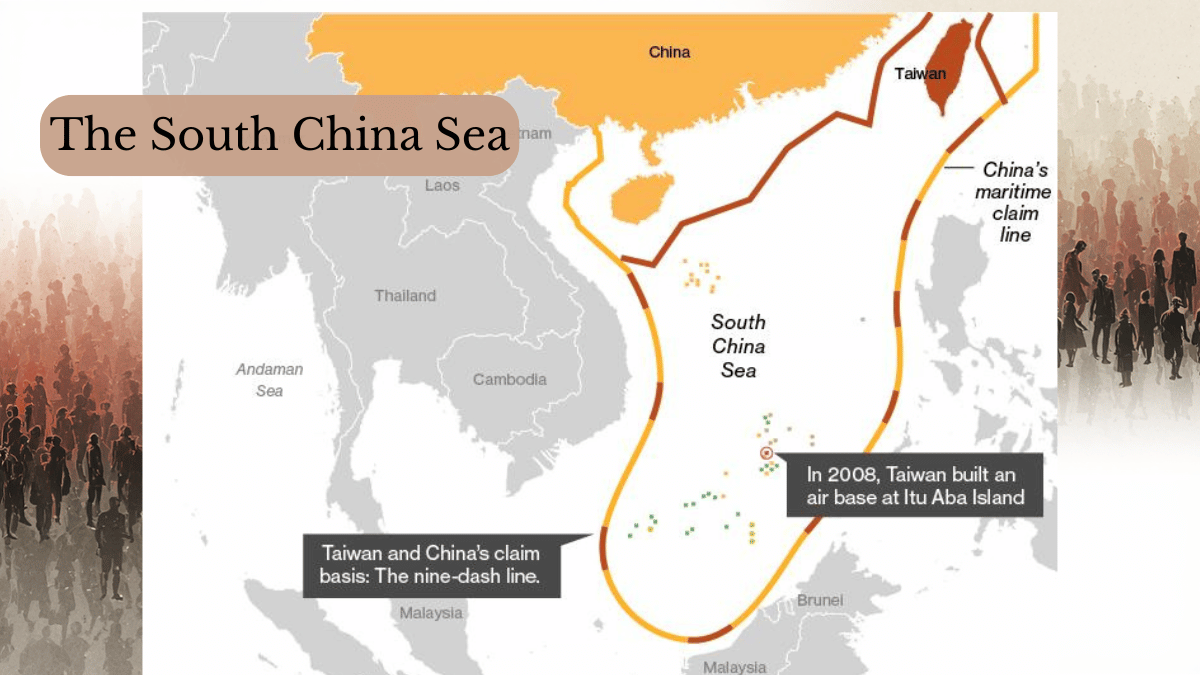
The Nine-Dash Line
The “Nine-Dash Line” is a map boundary used by the People’s Republic of China to claim large portions of the South China Sea. It is not directly a sovereignty claim over Taiwan, but it is closely connected to the broader China–Taiwan issue because both the government in People’s Republic of China (Beijing/PRC) and the government in Taiwan (the Republic of China, or ROC) historically inherited versions of the same maritime claims from pre-1949 China. But they are not the only countries with claims in the South China Sea. Claimants include Vietnam, Malaysia, Indonesia, Singapore, Brunei and the Philippines.
The line originated with the Republic of China government in 1947 as an “Eleven-Dash Line.” After the Chinese Civil War, the communist government in Beijing adopted and modified it into the current Nine-Dash Line. Taiwan’s ROC government still officially maintains a similar claim, though Taipei today emphasizes stability and practical administration more than expansive maritime nationalism. It is interesting to note that Beijing sometimes argues that Taiwan’s continued adherence to similar maritime claims supports the idea that both sides belong to “one China.”
The Nine-Dash Line matters because the South China Sea contains major international shipping lanes, commercial fishing grounds, potential oil and gas reserves and militarily is a key strategic location. PRC/China has used the claim to justify building shoals into artificial islands, establishing military facilities there and on naturally existing islands, as well as conducting aggressive coast guard and naval patrols. Reports and videos of aggressive maritime engagements routinely appear online, in the news, and in maritime industry journals.
The Nine-Dash Line, in a way, is tangential to the China-Taiwan dispute. The Nine-Dash Line is primarily a South China Sea territorial claim, not a direct claim about Taiwan itself. However, it is important as Taiwan controls Taiping Island (Itu Aba), the largest naturally occurring island in the Spratly chain – and some 1,000 miles south-southwest of Taiwan. This gives Taiwan a direct physical role in South China Sea disputes. Taiwan also sits near the northern gateway to the South China Sea from the East China Sea and along critical naval routes connecting the Pacific Ocean to Chinese coastal waters.
But the nations most impacted by aggressive PRC maritime patrols and attempts at enforcement are the Philippines, Malaysia, Vietnam and Indonesia. The South China Sea is important to these nations for the same reasons it is economically important to China.
Claims and Assertions
The origin of the “Nine-Dash Line” is rooted in a mixture of historical memory, nationalism, geography, imperial legacy, and modern state-building. It was not created out of nowhere as a purely arbitrary assertion, but neither was it historically defined in the precise modern legal sense that China sometimes presents today.
Chinese dynastic records from the Song, Yuan, Ming, and Qing periods contain references to islands, shoals, navigation routes, and fishing grounds in what is now called the South China Sea. For centuries, Chinese fishermen, merchants, and sailors traveled through the South China Sea. Chinese fishermen from Hainan and Guangdong regularly traveled seasonally into the Paracel and Spratly regions. Chinese sources also describe maritime trade routes through the area. Imperial Chinese records, navigation charts, and local gazetteers mention these areas intermittently. China argues that these activities demonstrate discovery and naming of islands, longstanding fishing usage, patrols and survey expeditions, and administrative awareness of the region. There is also archaeological evidence of extensive Chinese commercial activity seen in shipwrecks, porcelain cargoes, copper coins, and evidence of the old Maritime Silk Road crossing the South China Sea.
But the South China Sea was never an exclusively Chinese maritime zone historically. Vietnamese, Malay, Filipino, and other Southeast Asian fishermen and traders also operated throughout the region for centuries and can make the same historical and archaeological claims. Even some Chinese legal scholars acknowledge the sea historically functioned as a shared maritime space used by many peoples.
What’s more, pre-modern Asian states generally did not define maritime sovereignty the way modern international law does. It was understood that “control” was fluid and shifting as seen in tribute systems, fishing access, trade routes, or occasional patrols rather than fixed maritime borders. So there was a historical Chinese presence and awareness in the region, but not continuous modern-style administrative control over the entire sea. The same can be said about several other nations.
This is important because under modern international law, merely having fishermen or traders present does not automatically create sovereignty over enormous maritime areas.
The Modern Era
The 1947 assertion by the Republic of China government under the Kuomintang (still before the takeover by the Communist Chinese) reflected several motivations. It was reclaiming territory after Japanese occupation, asserting China’s status as a restored great power, resisting perceived Western and Japanese encroachment, and strengthening national unity after decades of invasion and civil war. When the communists won the Chinese Civil War in 1949, the government in Beijing took up the mantle of maritime claims.
For many Chinese people both in mainland China and Taiwan, the South China Sea claims became emotionally tied to the broader narrative of overcoming the “Century of Humiliation.” That narrative includes the Opium Wars, the Unequal Treaties that resulted from those wars, the resulting colonial concessions, the Japanese invasion, and the loss of sense from the foreign domination that was in place from the 19th to mid-20th centuries. In this mindset, recovering lost territories became symbolic of restoring national dignity and sovereignty. Many Chinese see the South China Sea claims not as expansionism, but as reversing historical injustice. But the counter-claimants in the region are not nations or peoples involved in any historical injustices against China. The controversy is that historical usage, shifting periods of colonial dominance, and other factors are not automatically factors in modern legal sovereignty under international law.
In 2016, an international tribunal in The Hague ruled in a case brought by the Philippines that China’s sweeping Nine-Dash Line claims had no legal basis under the UN Convention on the Law of the Sea (UNCLOS). Beijing rejected the ruling. Taiwan also rejected parts of the decision because it affected claims tied to Taiping Island.
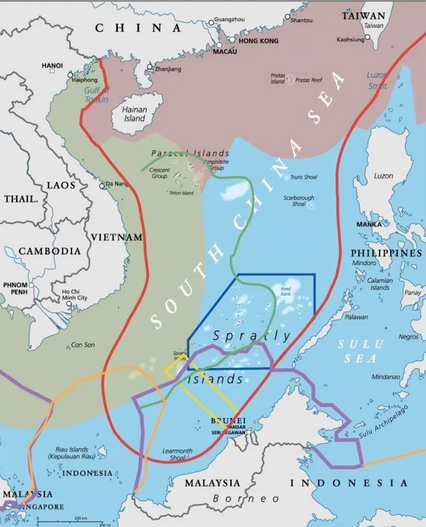
South China Claims and Economic Zone Disputes

Discover more from friarmusings
Subscribe to get the latest posts sent to your email.

