
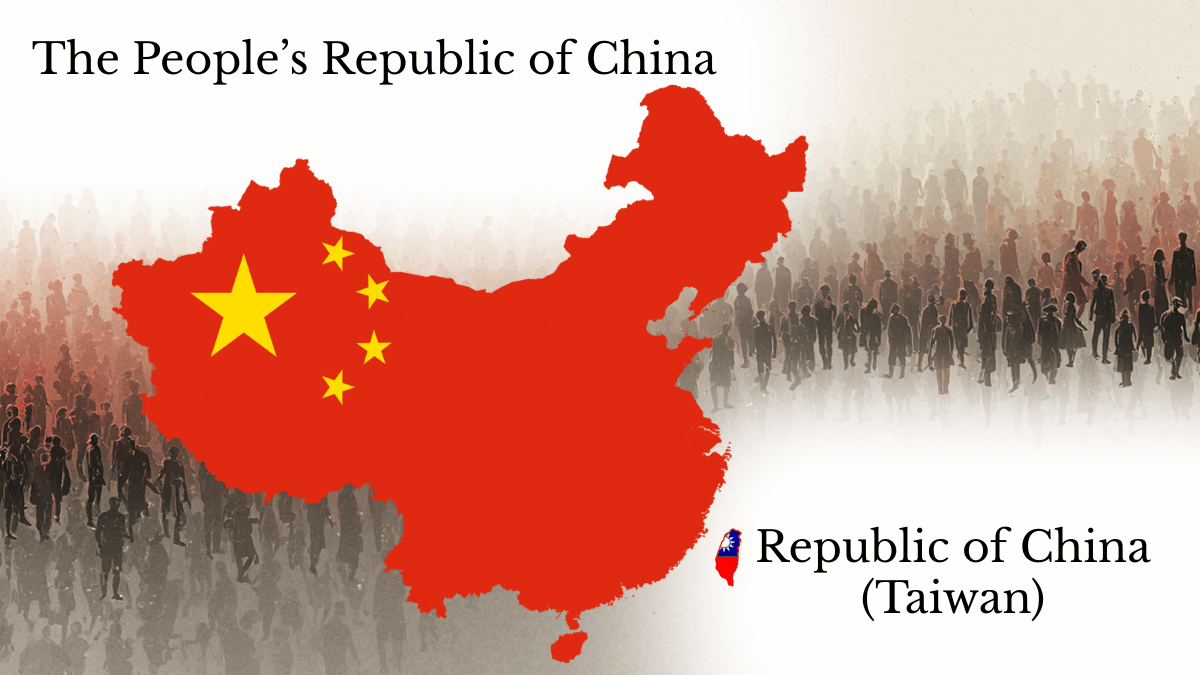
The relationship between mainland China and the island known today as Taiwan has evolved over many centuries and is shaped by migration, imperial rule, colonialism, civil war, competing national identities, and modern geopolitics. The history is complex because both the mainland government of the People’s Republic of China (PRC) and the government of Taiwan, the Republic of China (ROC), developed different interpretations of sovereignty and legitimacy.
Early Taiwan Before Large-Scale Chinese Settlement. For thousands of years, Taiwan was inhabited by Austronesian Indigenous peoples, culturally and linguistically related to peoples in the Philippines and Pacific islands. Imperial Chinese dynasties knew of the island, but for much of history it remained outside direct Chinese administration. Beginning in the late Ming period (16th–17th centuries), increasing numbers of settlers from Fujian and Guangdong provinces migrated to Taiwan, especially fishermen and farmers.
European Colonial Presence (1600s). In the early 17th century, European powers entered Taiwan. The Netherlands established a colony in southern Taiwan in 1624. Then Spain briefly occupied northern Taiwan from 1626–1642. There is much that can be said about this period but there is perhaps one lasting effect: the Dutch encouraged Han Chinese immigration to develop agriculture and trade. The indigenous people identity was, for all practical purposes, at risk of being absorbed into a Chinese identity.
Taiwan apart from China. In the 17th century the Ming Dynasty of China fell to the Qing Dynasty. In 1662, a Ming loyalist on Taiwan, Zheng Chenggong (Koxinga), expelled the Dutch and established a regime on Taiwan. It was an outpost of the now fallen Ming Dynasty. Koxinga hoped Taiwan could serve as a base to retake mainland China from the Qing. Even from this early date there was a strong sense of “other” from the mainland Chinese. This and the following years are a fluid time in the history of China, Japan and Korea.
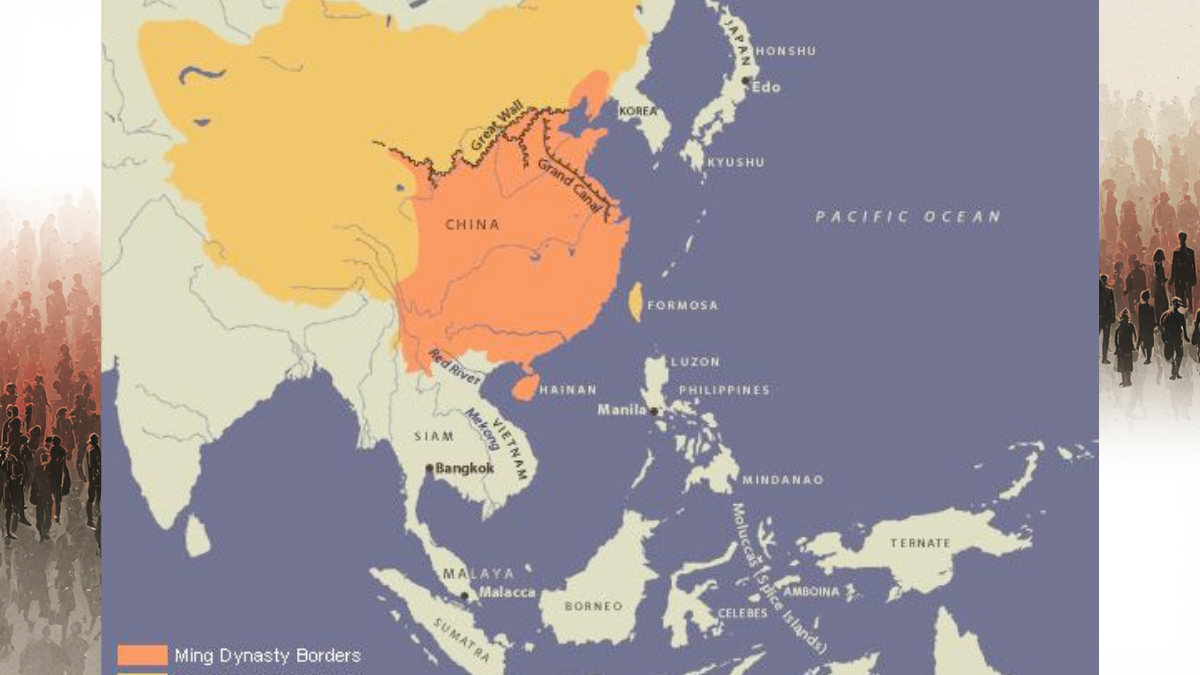
Qing Dynasty Comes to Taiwan. In 1683, the Qing conquered Taiwan and incorporated it into the empire. Initially the Qing treated Taiwan as a frontier territory and limited migration, but over time millions of Han Chinese settlers arrived. During this period indigenous peoples were gradually displaced from western plains into mountainous regions, ethnic tensions sometimes emerged between settlers from different regions of China, and Taiwan became increasingly linked economically and culturally with the mainland Fujian province. In 1885 Taiwan became a full province of the Qing Empire and firmly part of mainland China. The Chinese Qing government was China’s last imperial dynasty.
But by this time the Qing Empire had fallen on hard times at the hands of the European colonial powers, especially Britain. The great lure of China had not only been for its exotic exports but the possibilities of exports to China with their population in the millions. In the mid-19th century Britain had a massive trade deficit with China, as they imported huge amounts of tea, silk, and porcelain but China wanted few British products in return. An import/product was needed that would balance the trade relationship. Unfortunately the British East India company began the importation of opium from India. It became the commodity that reversed the cash flow, paying for Chinese goods but causing widespread addiction in China.
Seeing the social and economic devastation, the Qings banned opium in 1839. They confiscated and destroyed over 20,000 chests of British opium in Guangzhou (Canton), the merchants demanded compensation, viewing it as an attack on property. Their demand was backed by the British government who further demanded “free trade” and an end to China’s restrictive Canton system which limited each foreign nation’s traders to one port and imposed strict rules for transactions. The conflict was fundamentally about sovereignty – China asserting its right to control its own internal affairs versus Britain’s assertion of international trade rights and extraterritoriality for its citizens. The First Opium War between Great Britain and China was fought from 1839 to 1842. The British crushed the Chinese and forced trade agreements that highly favored the British. Other colonial powers demanded equal benefits leading to what are called, “The Unequal Treaties.” A second Opium War was fought in 1857-1858.
The once great China was now a devastated nation subjected to colonial demands. Something that was not lost on Japan as it came out of its isolationist period and entered the Meiji Era of Japanese governance. You read about this movement within Japan that would ultimately greatly impact China.
Japanese Rule (1895–1945). The First Sino-Japanese War resulted from the collision of modern Japan’s strategy to be recognized as a great world power, China’s central government declining ability to extract tributes from regions and tribute countries, and increased instability in Korea as Japan and Russia strove to exert influence over this traditional Chinese tribute state. I leave the details of this period and the conflict to others. Japan won and extracted major concessions from China (Treaty of Shimonoseki) one of which was that China transferred full sovereignty of Taiwan (then called Formosa), the Pescadores (Penghu Islands) and the Liaodong Peninsula including Port Arthur, a warm water port. There were many other concessions. For the next 50 years Taiwan was a Japanese colony. Japan built railways, ports, and modern infrastructure; expanded education and public health; suppressed resistance movements; and encouraged Japanese cultural assimilation. The Taiwanese experienced both modernization and colonial subjugation during this 50-year era.
Return to Chinese Rule After World War II. After World War II, Japan surrendered Taiwan to the Republic of China (ROC) government led by Chiang Kai-shek and the Kuomintang (KMT). However, tensions quickly emerged between local Taiwanese and mainland Chinese administrators. Corruption and economic disruption fueled unrest. In 1947 the February 28 Incident (often called the “2-28 Incident”) erupted after anti-government protests. The KMT violently suppressed the uprising, killing thousands. This became a foundational trauma in modern Taiwanese political memory.
Chinese Civil War and the Division of China (1949). The modern cross-strait conflict largely dates from the end of the mainland Chinese Civil War. In 1949 Mao Zedong and the Chinese Communist Party established the People’s Republic of China (PRC; Communist China) on the mainland. Chiang Kai-shek and the ROC government retreated to Taiwan with roughly 1–2 million soldiers, officials, and refugees. From that point onward the PRC governed mainland China and the ROC governed Taiwan and several nearby islands. Both governments initially claimed to be the sole legitimate government of all China.
The Cold War and Modern Era. During the Cold War the United States supported Taiwan militarily and politically, while the PRC viewed Taiwan as a breakaway province that must eventually be reunified. Major crises occurred in the Taiwan Strait in the 1950s and again in 1995–1996 when missile tests and military exercises heightened tensions.
Taiwan under KMT rule was authoritarian for decades under martial law (1949–1987), a period known as the “White Terror.” Beginning in the late 1980s, Taiwan democratized: martial law ended, opposition parties were legalized, and free elections developed leading to modern Taiwan with its vibrant democratic and economic system.
Changing Identity
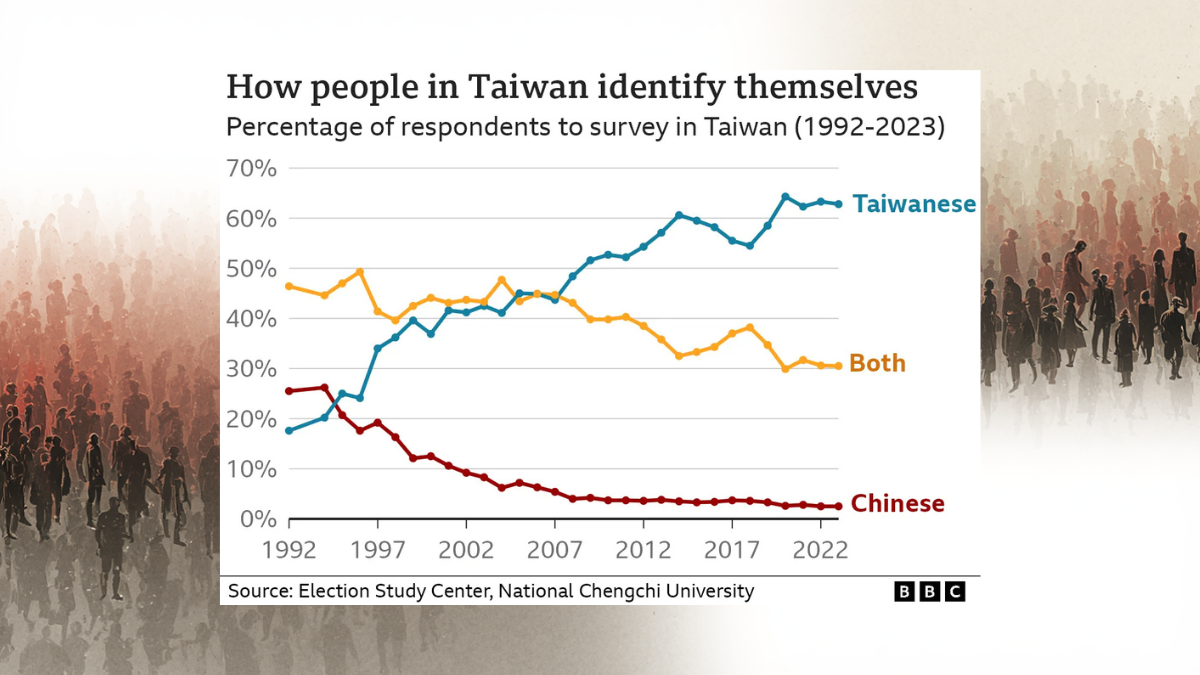
A significant development has been the growth of a distinct Taiwanese identity. Many residents now identify primarily as “Taiwanese” rather than “Chinese,” especially younger generations. At the same time, political opinion in Taiwan varies. Some support eventual reunification with China, some favor maintaining the current ambiguous status, and others support formal independence. Most polling shows strong support for maintaining the current de facto independence without provoking war.
The Current Situation
Today the PRC claims Taiwan as part of China under the “One China” principle while Taiwan operates as a self-governing democracy with its own military, currency, constitution, and elections. Most countries, including the United States, do not formally recognize Taiwan as an independent state, but many maintain unofficial relations with it. The Vatican does recognize Taiwan (ROC) as an independent nation. The PRC has stated it seeks peaceful reunification but has not ruled out force. Taiwan rejects PRC rule under the Communist Party. This issue remains one of the most sensitive geopolitical flashpoints in the world.
Taiwan and the United States
Here in 2026 the relationship between the United States and Taiwan is intentionally close but formally unofficial. Since Washington shifted diplomatic recognition of China from Taiwan/ROC to the People’s Republic of China in 1979, the U.S. has recognized Beijing as the sole legal government of China under its “One China” policy, while simultaneously maintaining extensive political, economic, and military ties with Taiwan.
Politically, the United States supports Taiwan’s democratic system, its participation in international trade and selected international organizations, and the peaceful resolution of disputes. Washington does not officially recognize Taiwan as an independent state, but it strongly opposes any attempt to change Taiwan’s status by force or coercion. Militarily, the United States is Taiwan’s principal security partner and largest arms supplier. The U.S. is committed to helping Taiwan maintain a sufficient self-defense capability by providing defensive weapons, training, and military support.
All-in-all, U.S. policy is “strategic ambiguity,” meaning Washington deliberately avoids stating explicitly whether American forces would directly defend Taiwan in the event of a Chinese attack. While supplying Taiwan with arms the U.S. also avoids provoking open conflict with China.

