
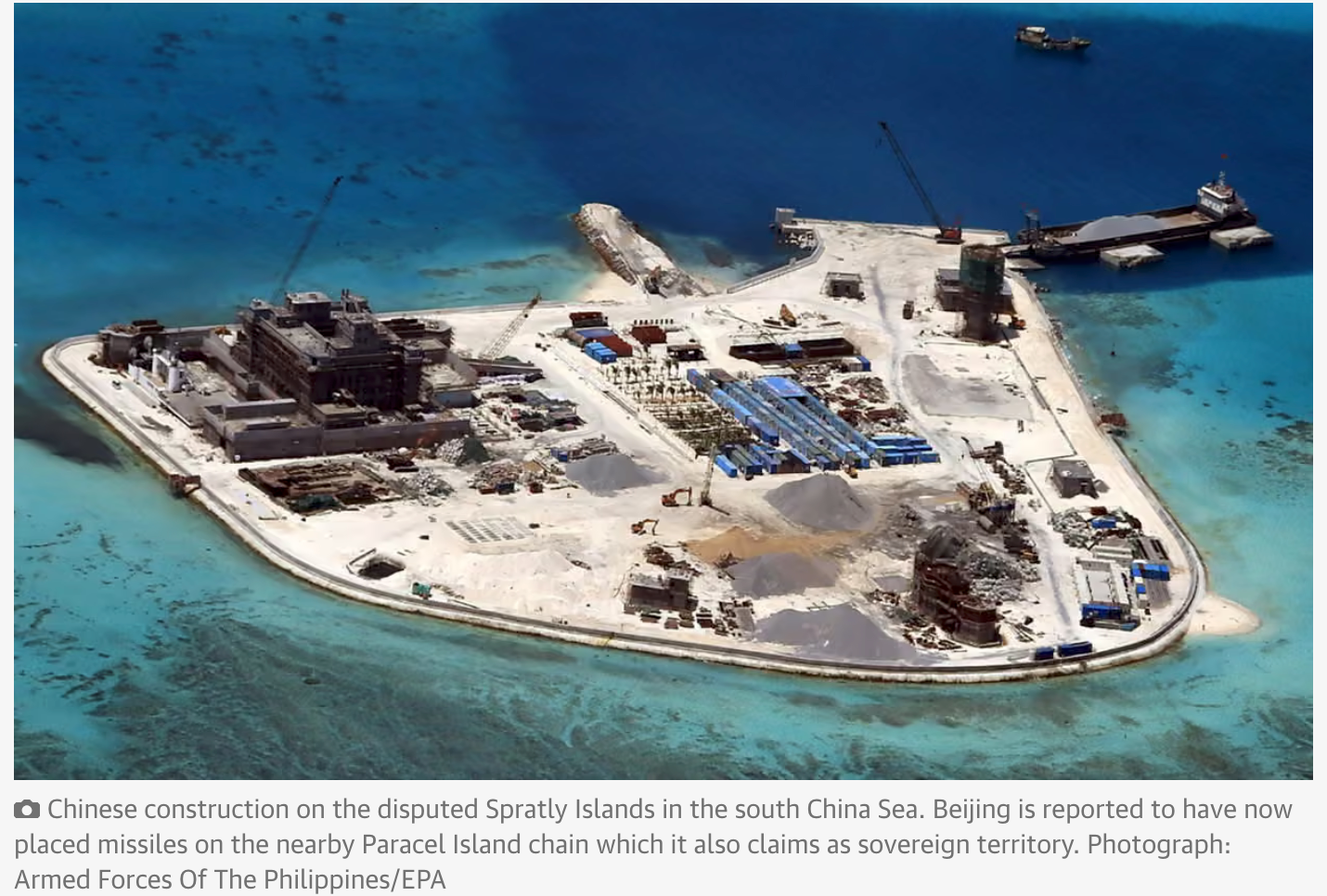
As the posts in this series to this point have indicated, China views the South China Sea (SCS) as well within its territorial waters and not international waters (The 9-Dash Line,). The degree to which they enforce that claim depends on who and what is transiting the waters. During the week of May 24, 2026 the PLAN aggressively denied a Dutch warship entrance into the SCS while commercial traffic proceeded uninterrupted. The Chinese ability to enforce the claim is substantial and has been steadily enhanced in the passing years as this post will show. China’s ability to enforce its claims consists of:
- A fleet of naval combatants ranging from aircraft carriers to frigates with a combined lethality of strike aircraft, vertical launch missiles, and naval rifles (5-inch and higher). As well their submarine force is quite capable.
- Chinese air force assets from the mainland with sufficient range to cover the entire region.
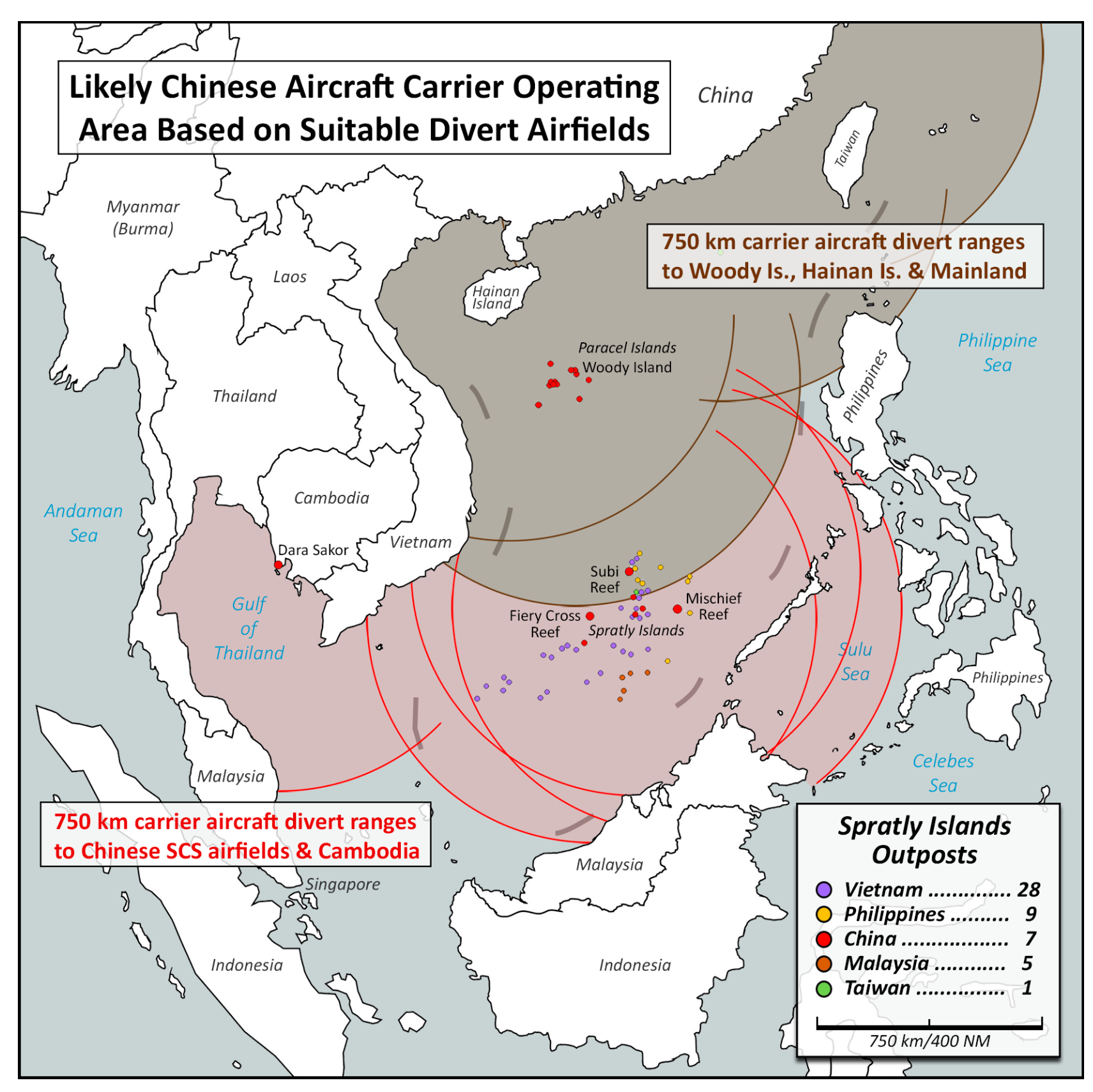
- Buildup of islands and shoals into military installations all of which are believed to have vertical launch missiles and some able to support air operations (“unsinkable” aircraft carriers)
- An extensive fleet of Coast Guard and maritime enforcement vessels, most armed.
- All of the above bring to bear radar and other surveillance capability that results in an air and surface space that is hyper-monitored
- Evidence that China has developed the Command, Control and Communications (C3) capability to integrate all into a well coordinated response.
Some Details. With the above being the executive summary, here are some of the details. A previous post, The 9-Dash Line, outlined the claims and counter-claims on islands and shoals in the CSC which are being methodically militarized.
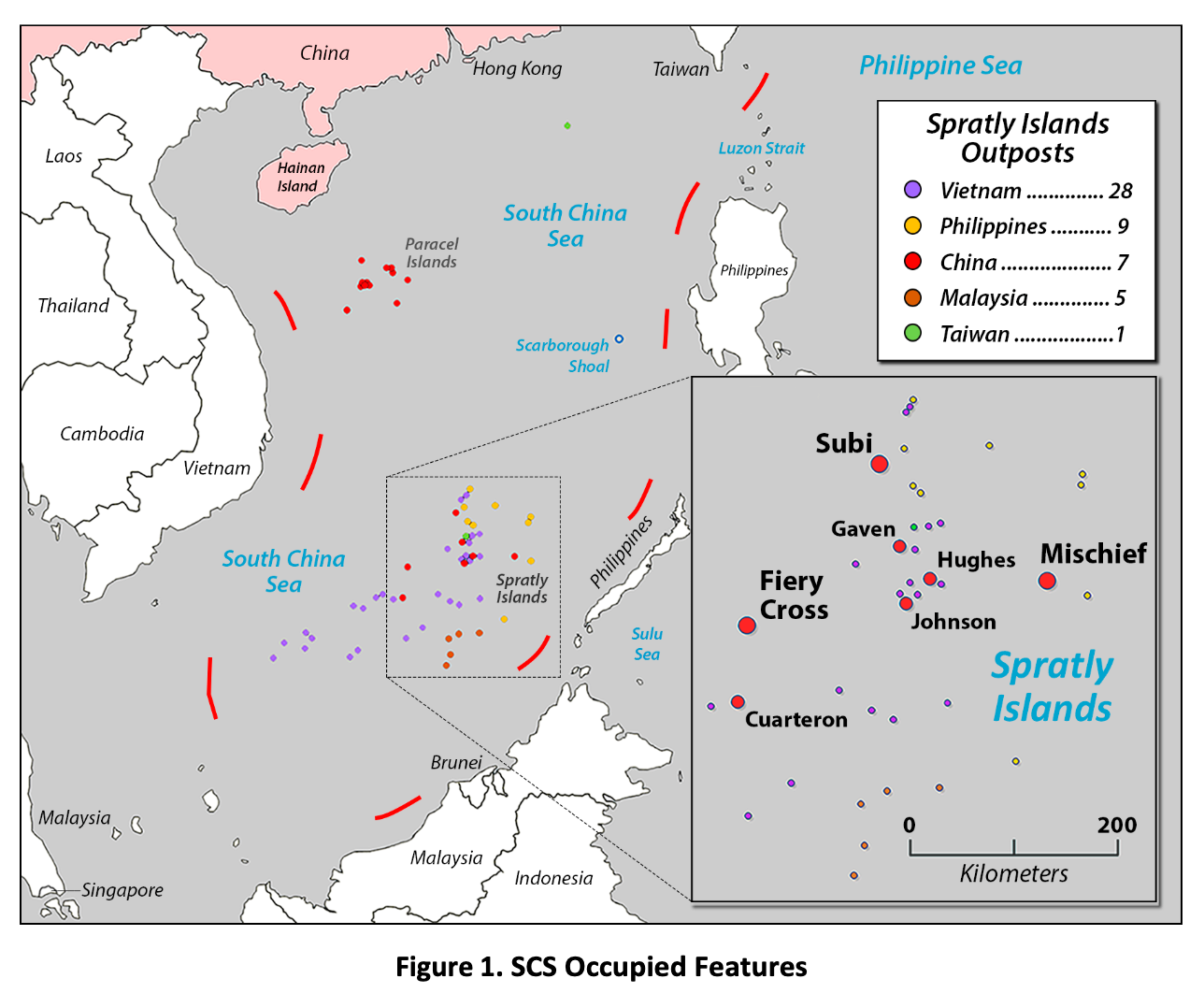
As mentioned in previous posts, China is not the only nation adding military capability to the SCS arena as seen in the above map.
- Spratly Islands: China has built up seven “islands”, with the most heavily developed being Subi Reef, Mischief Reef, and Fiery Cross Reef. These three feature significant airfields, missile shelters, and radar arrays – including YJ-62 and YJ-12B anti-ship cruise missiles
- Paracel Islands: China controls about 20 outposts here, including Woody Island, which serves as a regional administrative and military hub. Since 2016, China has sent advanced HQ-9 surface-to-air missiles to the Paracel Islands. Woody Island frequently hosts H-6K nuclear-capable bombers, which are capable of launching missiles with range extending to Australia.
- Scarborough Shoal: While no permanent structures have been built yet, China maintains a constant coast guard presence here to control the feature, according to the Center for Strategic and International Studies. Others are getting in on the trend of dredging and building island bases, especially Vietnam.
- Military emplacements at Mischief Reef include advanced radar systems, missile storage facilities, and hangars for fighter planes. (Supplied: CSIS Asia Maritime Transparency Initiative/Maxar)

These installations, particularly on the “Big Three” reefs in the Spratlys (Fiery Cross, Subi, Mischief), allow China to project power deeper into Southeast Asia threatening maritime and air traffic. These deployments are part of an anti-access/area denial (A2/AD) strategy to contest US military presence in the region. The following image shows the ability of China to “project power” over the SCS area.
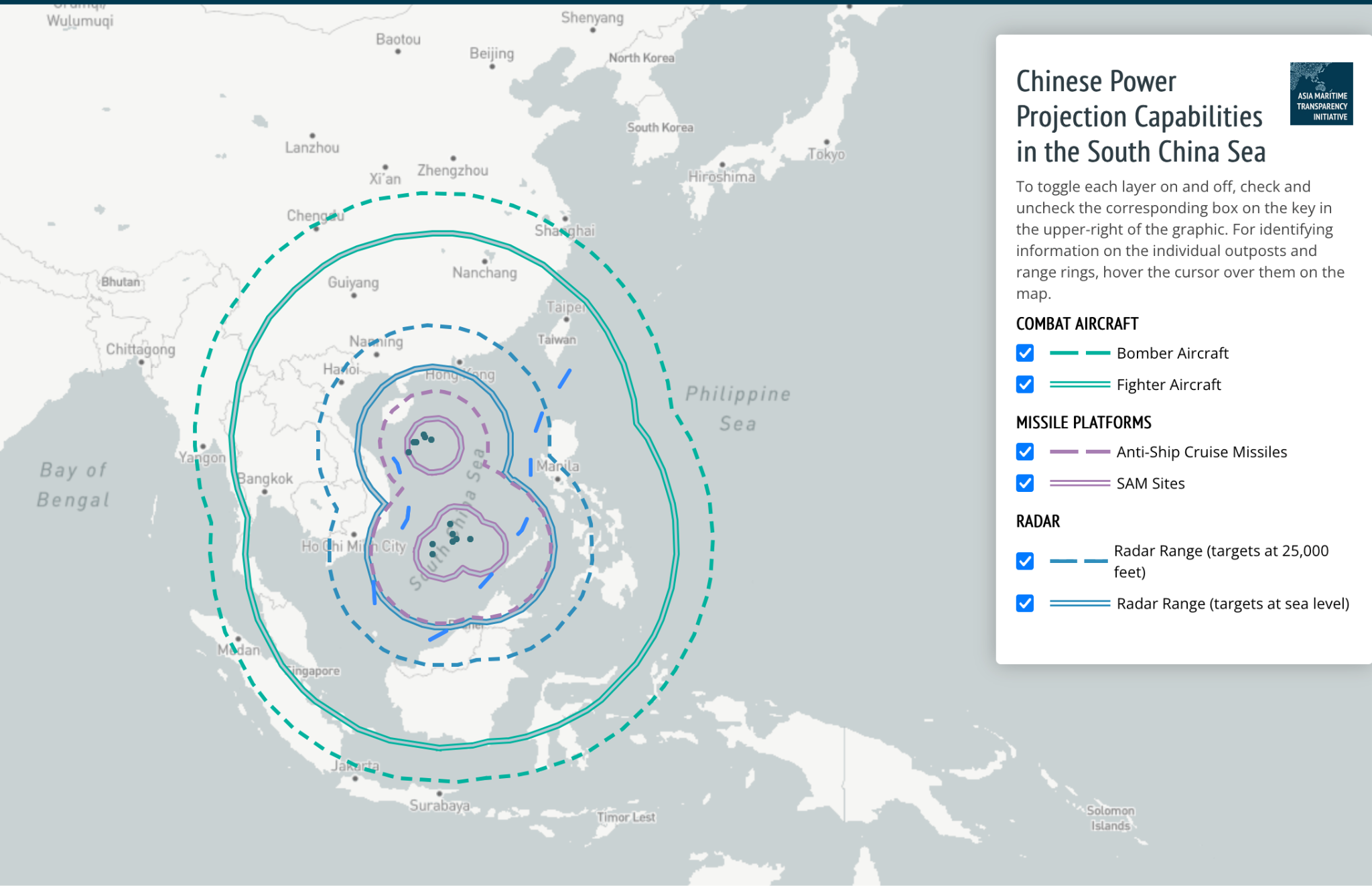
Even in the absence of a large-scale deployment of PLA weapons, the island-reefs have already been weaponized with significant information capabilities—command, control, communications, computers, intelligence, surveillance, and reconnaissance (C4ISR). When and if there is a large-scale deployment of weapons to the Chinese outposts, necessary conditions will have been established in the information domain. The island-reefs are equipped to provide the PLA with superior battlespace awareness and a decided information advantage in any future military conflict in the SCS.
Offensive and defensive strike capabilities on the island-reefs may best be described as “modular.” Infrastructure on the PLA outposts was built to accommodate close-in-weapons systems (CIWS), surface-to-air missiles (SAMs), surface-to-surface missiles (SSMs), large aircraft, fighter-sized aircraft, and helicopters. A vast majority of PLA weapons systems are road-mobile or relocatable. The major island-reefs—Fiery Cross, Subi, and Mischief Reefs—are large enough to accommodate virtually any mobile weapons system or aircraft in the PLA inventory. Delivered by ship or aircraft, future deployments of offensive or defensive lethal capabilities to the SCS island-reefs could occur with little or no warning.
China is currently engaged in a concerted effort to increase the PLAN’s capabilities in the undersea environment and perform acoustic reconnaissance from fixed arrays, ASW aircraft, and surface ships. However, even if the PLA Navy (PLAN) can detect an enemy submarine at long range, underwater weapons, such as torpedoes or depth charges, have very short ranges. Generally, once detected through acoustic or non-acoustic means, a submarine must still be localized by another submarine, a ship, or an ASW aircraft before that platform can prosecute the target with short-range underwater weapons.
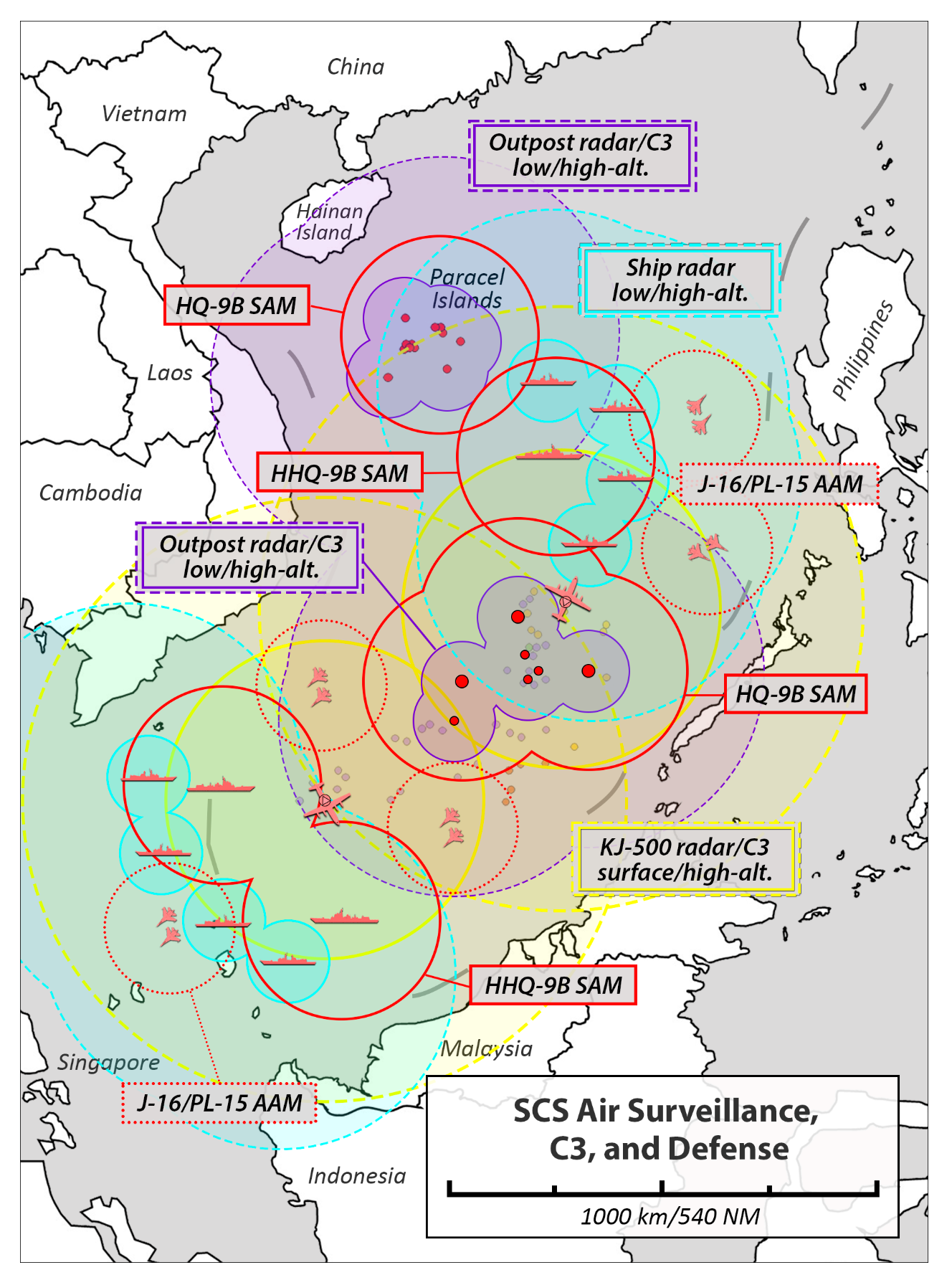
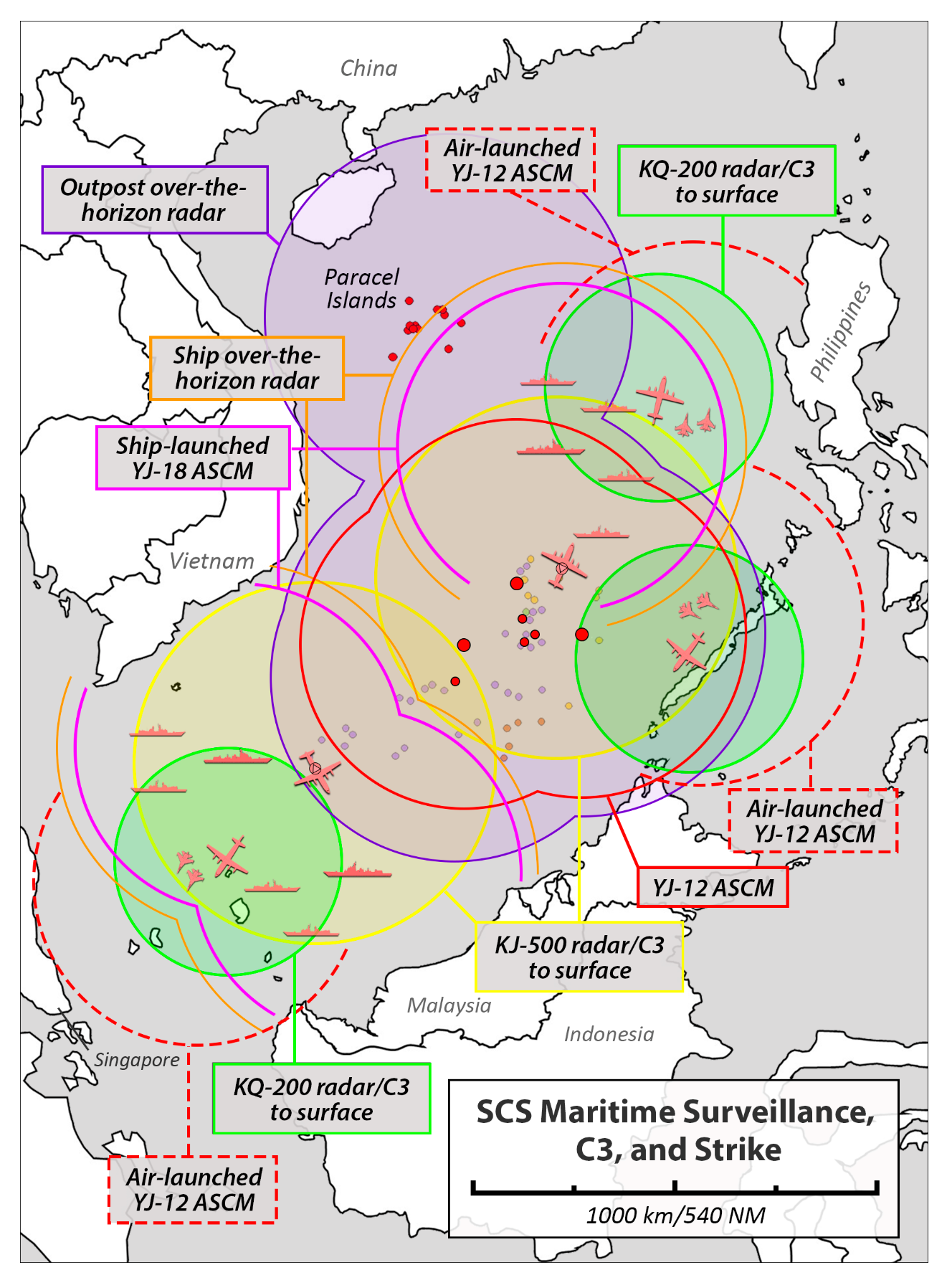
If a picture is worth a thousand words, the following images will give you an idea of the “threat environment” in the SCS:
- Combat air coverage capability,
- Depth of surveillance capability, and
- Maritime strike capability.
The South China Sea is an “inland sea” over which China can exercise extensive anti-access/area denial (A2/AD) strategy to contest any foreign military presence in the region.
Discover more from friarmusings
Subscribe to get the latest posts sent to your email.


Thank you for your posts.