
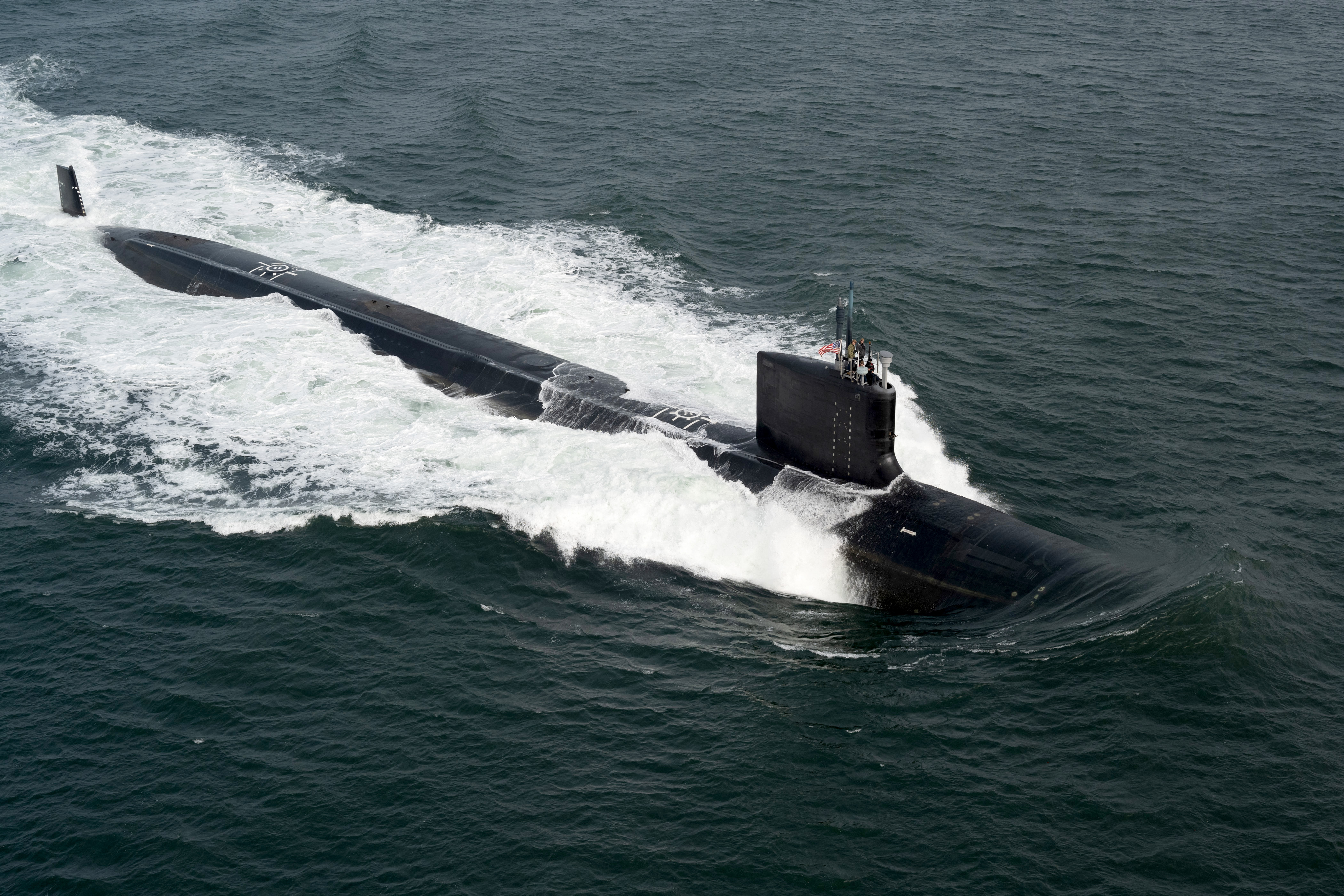
Virginia Class Submarine
The role of naval vessels, aircraft, missiles, drones, and ground forces are likely more familiar to the average citizen than the role, use, and operation of submarines. While I enjoyed the Hunt for Red October, I wondered if the screen writers wanted the submarines to perform an Immelmann Loop or some other amazing maneuver from the world of aerobatics. If jet aircraft are the Lamborghinis, submarines are the Dodge Ramblers of the order of battle. Your options are left, right, up, down, forward, and occasionally reverse. And doing all this blindfolded. Sound, sound detection, and silence are critical success factors.
The U.S. submarine fleet is all nuclear powered which gives each submarine the ability to operate for extended periods of time during which fuel/fuel oil is not the limiting factor for operations. There are 14 Ohio Class ballistic missile boats (submarines are referred to as boats, not ships); 4 Ohio class boats were converted to Tomahawk cruise missiles. Each boat is capable of carrying up to 154 Tomahawk cruise missiles. The fast-attack (SSN) fleet consists of 28 older Los Angeles class boats, 25 newer Virginia class boats, and 3 from the Seawolf class. The Virginia and Seawolf boats are similar in capabilities. If you are interested in submarines and their operations in the 21st century, take a moment to watch this video on the Virginia Class submarine.
Virginia Class Submarines. The PRC’s China Maritime Studies Institute released their assessment of the Virginia Class submarine and its capabilities and threats. The title of the assessment was: The Elusive “Deep-Sea Beast”: Analysis of the Performance of the Main Equipment of the U.S. Navy Virginia-Class Nuclear Attack Submarine. The Virgnia Class has their attention because these boats are designed for classic submarine offensive operations, but also anti-submarine missions, special forces operations, intelligence gathering, surveillance and reconnaissance missions, and more.
The boat has advanced active and passive sonar systems, internal and external design features which are next generation noise suppression including the propulsion system which no longer utilizes the traditional massive propeller. All of these advanced systems are supported by advanced real-time processing solutions integrated into their specific mission. There are more than 400 sensors targeting internal ship noise and vibration that compromise the overall noise profile emanating from the boat – the profile that could be detected by other submerged units. The suite of active and passive sonar is greatly enhanced with acoustic signal processing to identify underwater sounds from biologics to marine life to other underwater vehicles – manned or unmanned.
What does all of that mean? The Virginia class boats are capable of operations in the South China Sea if needed.
Sea Mines
Because of the current situation in the Straits of Hormuz, the general public is aware that sea mines remain a potent threat in denial of access operations. China might be expected to mine lanes of expected naval operation, waters around contested shoals and islands, and similar operations. China has no shortage of vessels from which to seed the waters. The U.S.’s most stealth means of laying mines is the submarine force. The US retains the capability to lay mines from surface vessels and aircraft. During WW II, the extensive mining of Japanese straits, ports, and waterways was accomplished by low flying B-29 bombers. It should be noted surface and air mine laying operations assume domination of the attending air space.
Denial of access operations would be a way for China to keep foreign vessels out. But at the same time, it is a way for other nations to keep China “in” and deny the flow of merchant shipping which is the life blood of the Chinese economy. Such an action is probably a last step before the outbreak of hostilities. When the U.S. and allies embargoed oil shipments to Japan, it was the first domino to fall leading to Pearl Harbor.
A modern sea mine is a self-contained explosive device designed to destroy ships, submarines and other types of vessels. Mines deny enemy ships and submarines access to specific ocean areas or channelize the enemy into operating in certain particular areas. As such, mines provide low-cost battlespace shaping and force protection capabilities for the U.S. Navy. And you do not have to bump into one in order to detonate the mine. Mines can operate on proximity triggers (magnetic, acoustic, pressure and vibrational) that are supported by microprocessors, e.g. to listen for the distinct and specific sound of a vessel’s propulsion, and machinery through the water.
U.S. submarines are capable of laying specialized autonomous naval mines. The Mark 67 SLMM is a covert, submarine-launched mobile mine designed for shallow waters, while the Mark 60 CAPTOR encapsulates a torpedo. The Mark 60 waits on the ocean floor and uses its processing circuits to detect enemy submarines. Rather than exploding, the mine launches the torpedo. There are other mines in the inventory, but they operate similarly.
Unmanned Underwater Vehicles (UUVs)
But the truly next-level capability is with unmanned underwater vehicles (UUVs). The extent of which these are currently deployed and their planned future – e.g., the DARPA Manta Ray Project – are the subject of next level undersea warfare. The UUVs will extend the base submarine’s sonar and weapons suite to areas either inaccessible (depth, danger, or incident avoidance, etc.) or prudently avoided. From the base submarine, there is a complete integration of sensor and communication systems, target motion analysis, tactical situational awareness, command and control decision tools, and launch control of all submarine payloads, including torpedoes, missiles, unmanned vehicles, and countermeasures.
I suspect it is the future of SCS operations.

