Married in Heaven?

In today’s gospel, the Sadducees are testing Jesus by presenting a reductio ad absurdum argument based on levirate marriage. A woman is successively married to seven brothers. They ask: “At the resurrection when they arise whose wife will she be” – which is interesting since the Sadducees don’t believe in the Resurrection. Jesus responds with “When they rise from the dead, they neither marry nor are given in marriage, but they are like the angels in heaven.

Most Christians recognize that it was not really a question and since levirate marriage is not practiced in modern life, that problem is no problem at all… but there is modern fallout with a question often framed as: “If there is no marriage in heaven, does that mean I am not married, won’t love my spouse, may not even know my spouse… what about my family?”

The Sadducees’ question assumes that the resurrection is simply a continuation of earthly life under the same social arrangements. Our modern concern is whether any aspect of these important earthly social arrangements persists into the life to come. But notice Jesus does not say that people cease to know one another or to love one another. He does not say that earthly relationships become meaningless or that spouses become strangers. However, He does seem to say that marriage as an institution in the way that we know it does not continue in the resurrection.

In Scripture, marriage has several purposes: mutual love and companionship, the procreation and raising of children, as a sign of God’s covenant with humanity, and as a sacramental image of Christ and the Church. Theologians offer that marriage is like a sacrament pointing beyond itself. Just as we do not need a road sign after arriving at the destination, the sacramental sign gives way to the reality toward which it points. Mutual love is perfected, life is eternal, death is no more, and the covenant is fulfilled, In the resurrection, the purposes of marriage have reached their fulfillment.

The key point is that in eternal life relationships are transformed by perfect union with God. John Chrysostom argued that relationships are purified and elevated in the resurrection. The love spouses shared is not lost but perfected. One could easily extend Chrysostom’s argument to include family ties. Augustine of Hippo taught that personal identity remains and what passes away is not love but the juridical bond of marriage. Thomas Aquinas taught that the sacrament of marriage belongs to this life. Its function ceases in heaven because its purpose has been fulfilled. Yet the love formed through marriage remains.

So will I see my spouse in heaven? From a Catholic perspective, the answer is emphatically yes, assuming both are united with God. The deeper question is: What kind of relationship will that be? The Church’s tradition consistently says that you will not love your spouse less; you will love your spouse more perfectly than ever before. All the selfishness, misunderstandings, possessiveness, fears, wounds, and limitations that affected earthly love will be gone. The love remains.

Heaven does not erase human love; it brings it to its fullest perfection.


Image credit: iStock 2214229139 | seb-ra | downloaded 6-1-2026 | standard iStock license
Militarization of the South China Sea

As the posts in this series to this point have indicated, China views the South China Sea (SCS) as well within its territorial waters and not international waters (The 9-Dash Line,). The degree to which they enforce that claim depends on who and what is transiting the waters. During the week of May 24, 2026 the PLAN aggressively denied a Dutch warship entrance into the SCS while commercial traffic proceeded uninterrupted. The Chinese ability to enforce the claim is substantial and has been steadily enhanced in the passing years as this post will show. China’s ability to enforce its claims consists of:

  • A fleet of naval combatants ranging from aircraft carriers to frigates with a combined lethality of strike aircraft, vertical launch missiles, and naval rifles (5-inch and higher). As well their submarine force is quite capable.
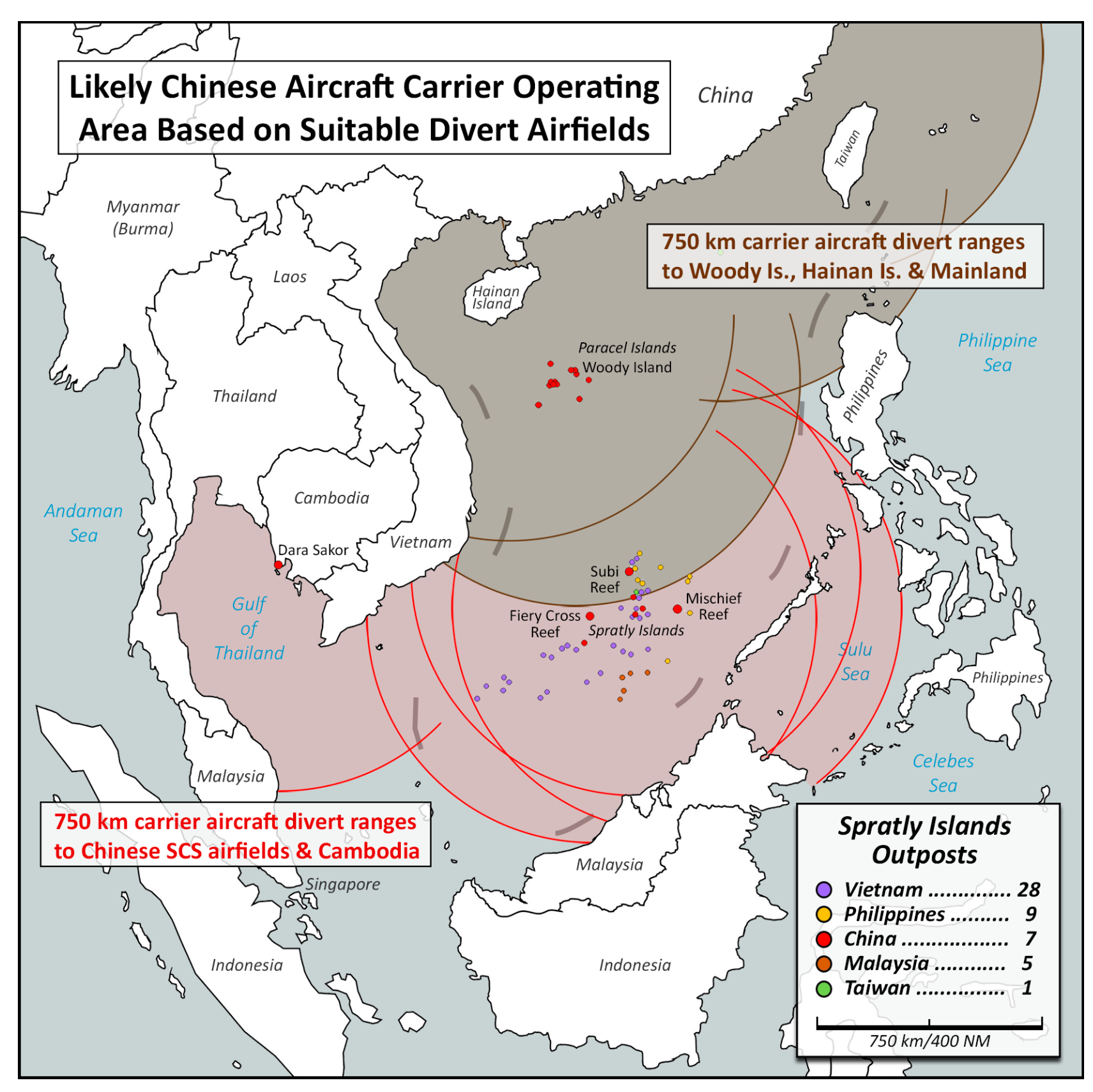
  • Chinese air force assets from the mainland with sufficient range to cover the entire region. 
  • Buildup of islands and shoals into military installations all of which are believed to have vertical launch missiles and some able to support air operations (“unsinkable” aircraft carriers)
  • An extensive fleet of Coast Guard and maritime enforcement vessels, most armed.
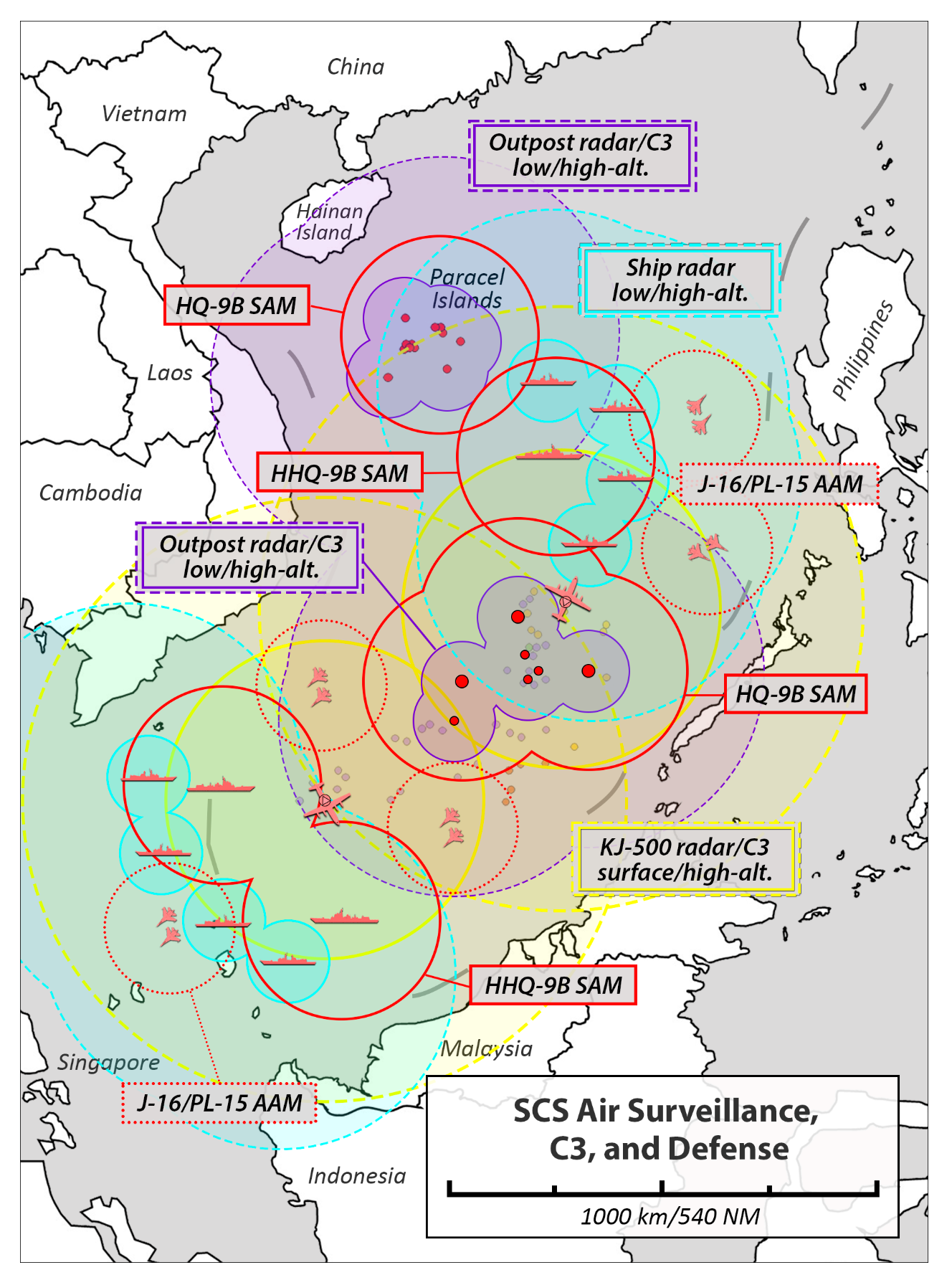
  • All of the above bring to bear radar and other surveillance capability that results in an air and surface space that is hyper-monitored
  • Evidence that China has developed the Command, Control and Communications (C3) capability to integrate all into a well coordinated response.

Some Details. With the above being the executive summary, here are some of the details. A previous post, The 9-Dash Line, outlined the claims and counter-claims on islands and shoals in the CSC which are being methodically militarized.

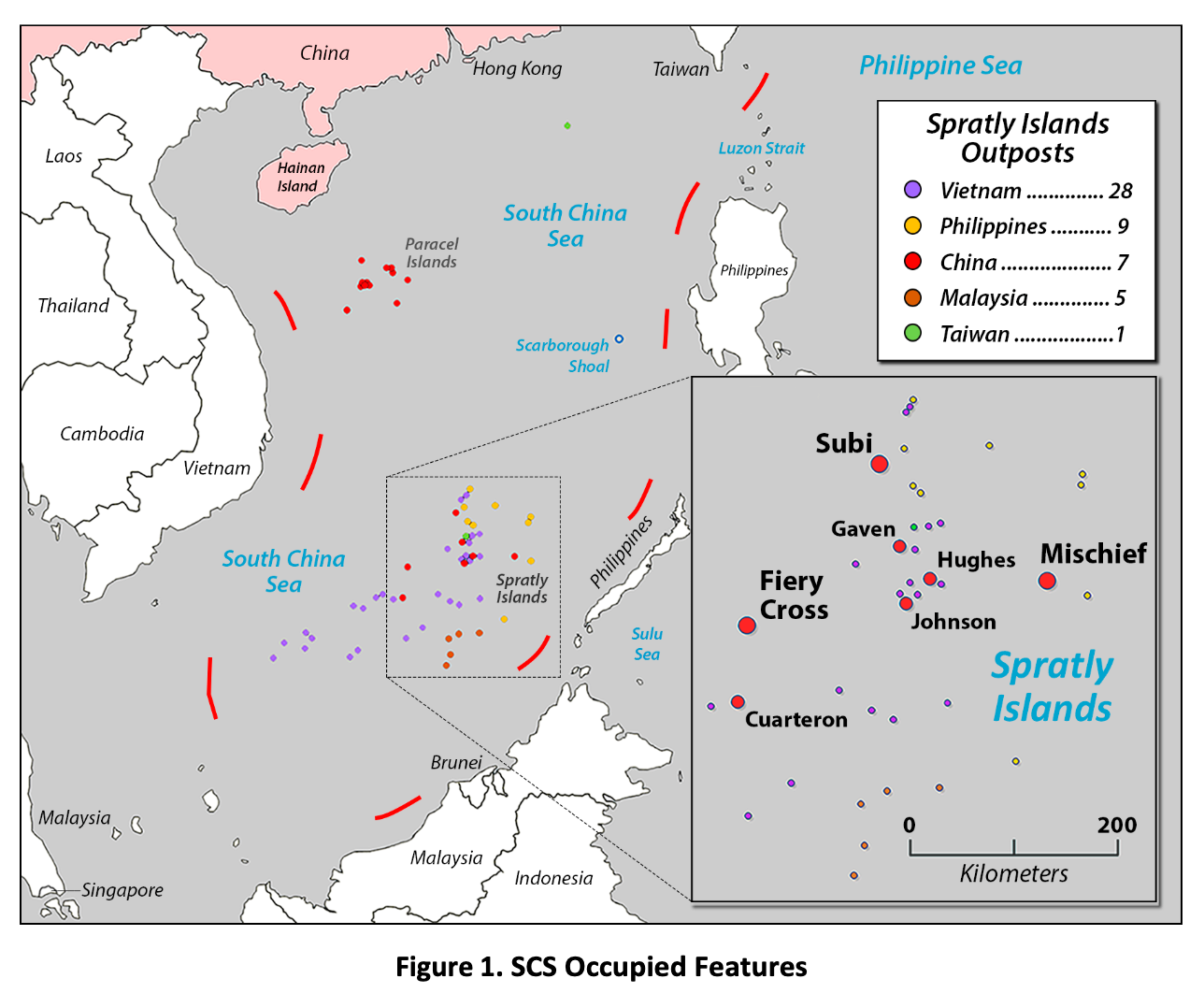
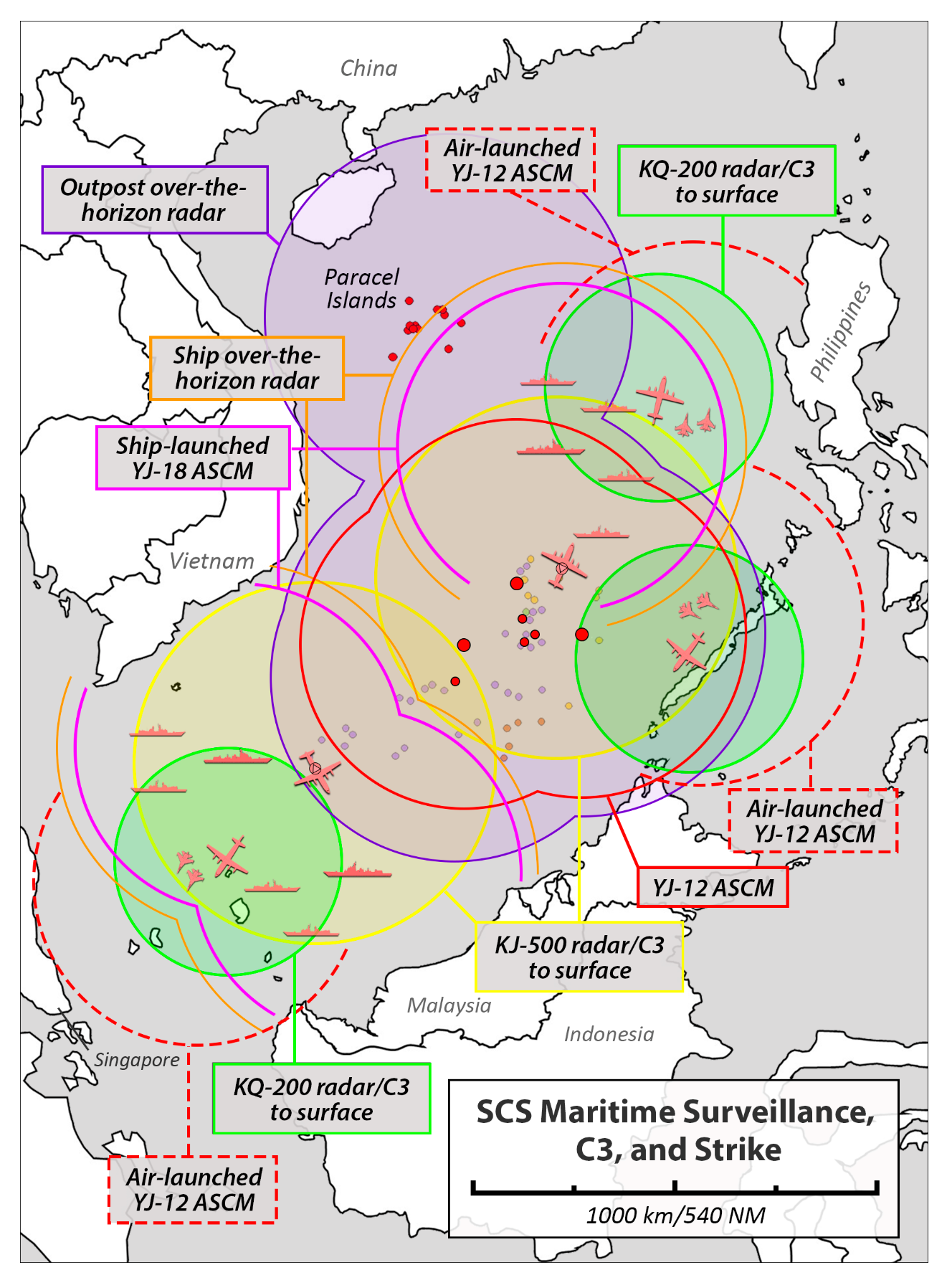
As mentioned in previous posts, China is not the only nation adding military capability to the SCS arena as seen in the above map. 

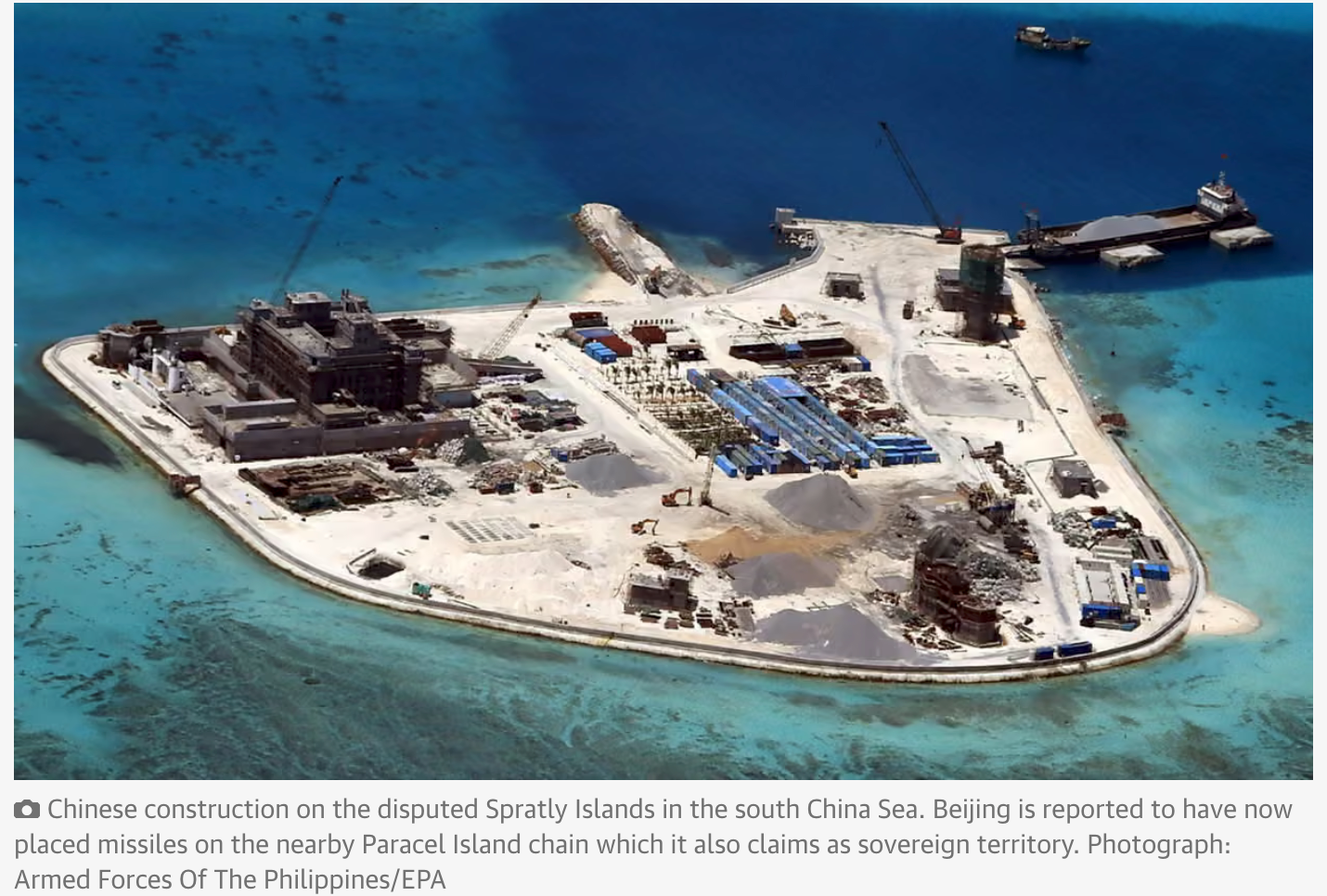
  • Spratly Islands: China has built up seven “islands”, with the most heavily developed being Subi Reef, Mischief Reef, and Fiery Cross Reef. These three feature significant airfields, missile shelters, and radar arrays – including YJ-62 and YJ-12B anti-ship cruise missiles
  • Paracel Islands: China controls about 20 outposts here, including Woody Island, which serves as a regional administrative and military hub. Since 2016, China has sent advanced HQ-9 surface-to-air missiles to the Paracel Islands. Woody Island frequently hosts H-6K nuclear-capable bombers, which are capable of launching missiles with range extending to Australia.
  • Scarborough Shoal: While no permanent structures have been built yet, China maintains a constant coast guard presence here to control the feature, according to the Center for Strategic and International Studies. Others are getting in on the trend of dredging and building island bases, especially Vietnam.
  • Military emplacements at Mischief Reef include advanced radar systems, missile storage facilities, and hangars for fighter planes. (Supplied: CSIS Asia Maritime Transparency Initiative/Maxar)

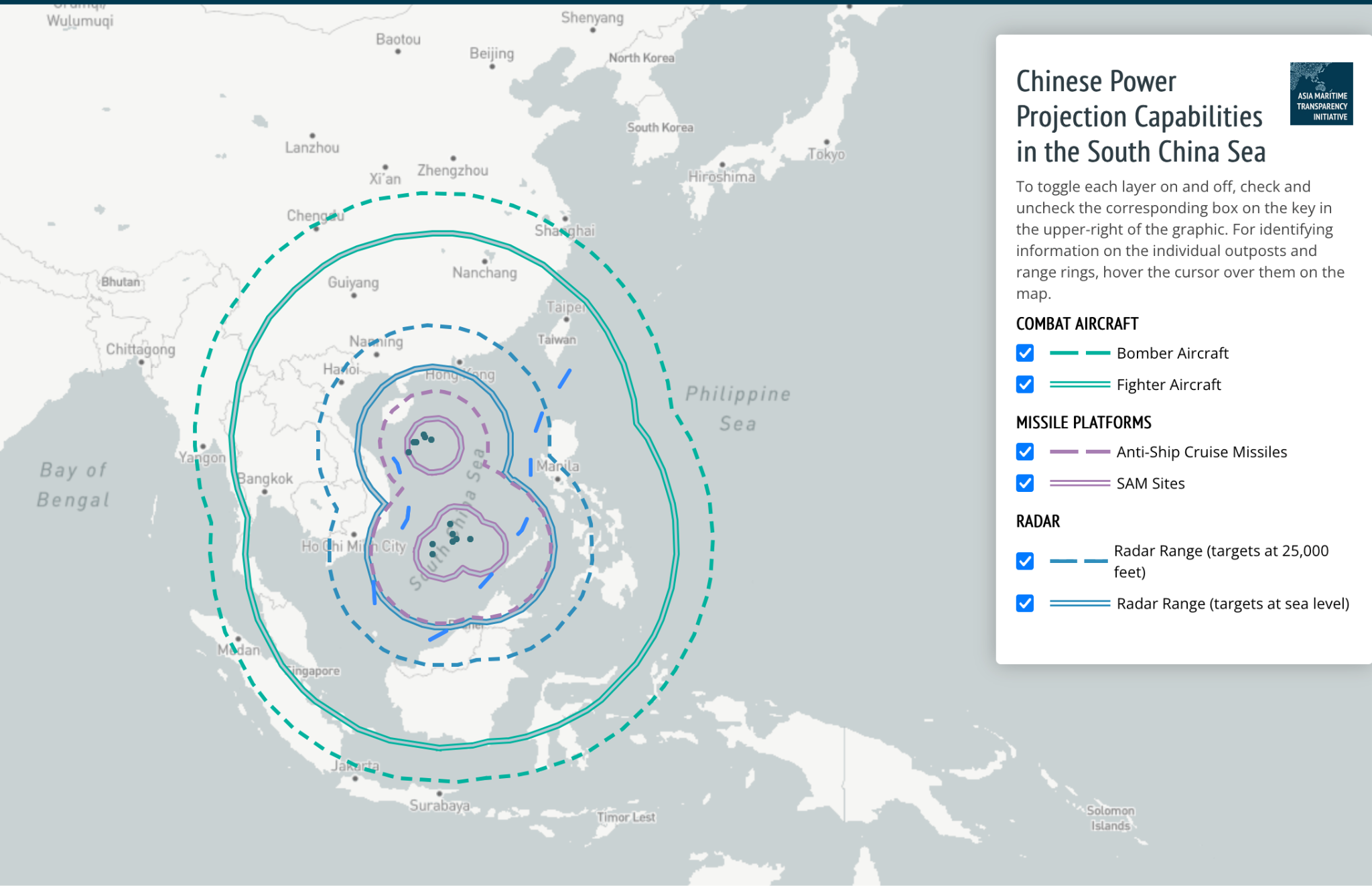
These installations, particularly on the “Big Three” reefs in the Spratlys (Fiery Cross, Subi, Mischief), allow China to project power deeper into Southeast Asia threatening maritime and air traffic. These deployments are part of an anti-access/area denial (A2/AD) strategy to contest US military presence in the region. The following image shows the ability of China to “project power” over the SCS area.

Even in the absence of a large-scale deployment of PLA weapons, the island-reefs have already been weaponized with significant information capabilities—command, control, communications, computers, intelligence, surveillance, and reconnaissance (C4ISR). When and if there is a large-scale deployment of weapons to the Chinese outposts, necessary conditions will have been established in the information domain. The island-reefs are equipped to provide the PLA with superior battlespace awareness and a decided information advantage in any future military conflict in the SCS. 

Offensive and defensive strike capabilities on the island-reefs may best be described as “modular.” Infrastructure on the PLA outposts was built to accommodate close-in-weapons systems (CIWS), surface-to-air missiles (SAMs), surface-to-surface missiles (SSMs), large aircraft, fighter-sized aircraft, and helicopters. A vast majority of PLA weapons systems are road-mobile or relocatable. The major island-reefs—Fiery Cross, Subi, and Mischief Reefs—are large enough to accommodate virtually any mobile weapons system or aircraft in the PLA inventory. Delivered by ship or aircraft, future deployments of offensive or defensive lethal capabilities to the SCS island-reefs could occur with little or no warning.

China is currently engaged in a concerted effort to increase the PLAN’s capabilities in the undersea environment and perform acoustic reconnaissance from fixed arrays, ASW aircraft, and surface ships. However, even if the PLA Navy (PLAN) can detect an enemy submarine at long range, underwater weapons, such as torpedoes or depth charges, have very short ranges. Generally, once detected through acoustic or non-acoustic means, a submarine must still be localized by another submarine, a ship, or an ASW aircraft before that platform can prosecute the target with short-range underwater weapons.

If a picture is worth a thousand words, the following images will give you an idea of the “threat environment” in the SCS:

  • Combat air coverage capability,
  • Depth of surveillance capability, and
  • Maritime strike capability.

The South China Sea is an “inland sea” over which China can exercise extensive anti-access/area denial (A2/AD) strategy to contest any foreign military presence in the region. 

St. Charles Lwanga and the Ugandan Martyrs

Today the Church Universal celebrates the feast of St. Charles Lwanga and the Ugandan martyrs. Likely you do not know much about him and the 21 people that were martyred along with him. Today’s celebration of St. Charles Lwanga and Ugandan martyrs is a major feast and holiday in East Africa. And a reminder to us that this truly is a church universal – katholica.

Lwanga was born in 1860 in Uganda. It was a time of Christian Missionary activity in a country that was still ruled by a tribal kings. Lwanga was born in the Kingdom of Buganda, the central and southern part of modern Uganda, and served as chief of the royal pages and later major-domo in the court of King Mwanga II of Buganda.

Christians were tolerated by the King Mutesa I, but his successor, Mwanga, launched a campaign against them. Mwanga was 18 years old at the time of his ascension to the throne. He believed that the Christian worldview undermined his authority. While the records are not clear, a major reason for his view was that the Christian court pages would not willing engage Mwanga in ritual sex. Mwanga first massacred the Anglican missionary bishop James Hannington and his colleagues in October 1885. Joseph Mukasa, an important member of the royal household and a Catholic, reproached the king for the massacre, and, on November 15 of that year. Mukasa was beheaded.

On May 25, 1886, the king called a court assembly in which he interrogated all present to see if any would renounce Christianity. Led by Lwanga, the royal pages declared their fidelity to their Catholic faith, upon which the king condemned them to death. Charles Lwanga was burned at the stake on June 3, 1886. He and the other 21 Catholic martyrs were canonized by Pope Paul VI in October 1964.

Coming to Jesus for Life

This coming Sunday is the Solemnity of the Body and Blood of Christ. In the previous posts in this series we have not yet commented on the verses that comprise the gospel. As noted earlier our verses (Jn 6:51-58) are part of the much larger Bread of Life Discourse (Jn 6:22-69). And so it is good to explore meaning in the verses that precede our gospel passage.

Jesus said to them, “I am the bread of life; whoever comes to me will never hunger, and whoever believes in me will never thirst. But I told you that although you have seen [me], you do not believe. Everything that the Father gives me will come to me, and I will not reject anyone who comes to me, because I came down from heaven not to do my own will but the will of the one who sent me. And this is the will of the one who sent me, that I should not lose anything of what he gave me, but that I should raise it [on] the last day. For this is the will of my Father, that everyone who sees the Son and believes in him may have eternal life, and I shall raise him [on] the last day.” (John 6:35-40)

In Jn 6:35-40 Jesus spells out the need of faith in himself, a faith that is an active movement of coming to him.  The Jewish midrash literature identifies manna/bread as signifying the divine word or instruction – the memra.  The Word was the means of the covenant, the means of salvation, the revelation of God, the agent of creation, and the same as God. Jesus clearly says that he is the Word made flesh and tells them of the rewards for those that believe. Much of the OT background for this discourse is found in the descriptions of the messianic banquet. In Jewish thought the joys of the messianic days are often pictured under the imagery of an intimate banquet with Yahweh or his Messiah. Is 55:1-3 echoes the command in Jn 6:27 not to work for perishable food and makes it clear that Yahweh’s invitation to eat is part of his promises to renew the covenant with David, and therefore a messianic banquet. The words of Is 55:3 –  ‘Come to me heedfully, listen, that you may have life’ –  are restated by Jesus, announcing that the banquet is at hand for those servants of Yahweh who believe in the one who Yahweh has sent.

In the following line Jesus says “But I told you that although you have seen [me], you do not believe”.  The connection of these two passages recounts Amos 8:11-13 -‘Yes, days are coming, says the Lord God, when I will send famine upon the land: Not a famine of bread, or thirst for water, but for hearing the word of the Lord.  They shall wander in…in search of the Word of the Lord, but they shall not find it.’  Israel has been given the opportunity to partake of the bread of life but has rejected it.  In the closing lines of Jesus’ statement he clearly states that it is Jesus who mediates this divine life to believers and through whom we enter into a life giving communion with God, now and in eternity.

Like the people in the desert who refuse to believe Moses, In Jn 6:41-50, the crowd reject (‘murmured about him’) the bread from heaven.  Afterall, the crowd knows his father and mother – how can he claim to come down from heaven?  But Jesus does not let their lack of faith pass without comment. “Coming to” Jesus in faith is not only the will of the Father but it is also his work, for the Father draws believers to faith in Jesus.  Consequently, to believe in Jesus is to be open to God.  Moreover the prophets (Is 54:10-13 and Jer 31:33) had spoken of a new covenant when God would teach his people through a new law which would be more than an external message (‘I will place my law within them and write it upon their hearts’).  In listening attentively to Jesus, one hears the Father for he is the source of the teachings of the Messiah.  God then draws the believers to faith in Jesus in two ways: (a) through the message of Jesus and (b) as an interior teacher where he makes the message of Jesus an interior law of the heart.

Jesus restates his message in vv. 47-50 – he is the bread of life, without which there is no life.