This coming Sunday is the 16th Sunday in Ordinary Time. In this post we move away from the parable of the “Weeds among the Wheat.”
31 He proposed another parable to them. “The kingdom of heaven is like a mustard seed that a person took and sowed in a field. 32 It is the smallest of all the seeds, yet when full-grown it is the largest of plants. It becomes a large bush, and the ‘birds of the sky come and dwell in its branches.’” 33 He spoke to them another parable. “The kingdom of heaven is like yeast that a woman took and mixed with three measures of wheat flour until the whole batch was leavened.”
The mustard seed is an annual herb whose incredibly small seeds produce a plant that is normally 2 to 6 feet in height (possibly as tall as 10 feet) but it would not be mistaken for a tree. I mention “tree” because in the Greek the word dendron is used, which typically means “tree” but can refer to a large bush. So where the NAB ops for “becomes a large bush” other translations opt for “becomes a tree.” There is a case to be made for both. The tree motif reflects the symbol of the imperial tree found in representations of empires including the apocalyptic imagery of the Kingdom of God (see Ps 104:12, Dan 4:9, Ezek 17:23). It is imagery that persisted into the medieval age and appears in St. Bonaventure’s’ Tree of Life which birds of the sky come to dwell.
Some folks comment that Jesus is lampooning the apocalyptic view of the Kingdom. Perhaps, or rather continuing with the idea presented in the wheat/tares parable, the presence of the Kingdom here and now can be overlooked in its smallness and simplicity. One should remember the King of Kings entered Jerusalem on a donkey rather than a warhorse.
In the parable about the “yeast that a woman took and mixed with three measures of wheat flour ” Many commentaries focus on the yeast as a symbol of evil being mixed to the “wheat flour” of the proclamation of the Good News of the Kingdom. The word that is used (zymē) is better translated as “leaven.” The most typical course of making bread was to insert into the new dough a small amount of old, fermented dough reserved from the previous baking; it is this “leaven” (or sourdough) rather than “yeast” proper which the woman is here using. Our translation takes the Greek enkryptō and translates it as “mix” which is a viable translation. Equally viable is “hide” which is used in many modern translations. Retranslated, the passage becomes “leaven that a woman took and hid in three measures of wheat flour.” I would suggest that this translation is more aligned with the meaning of the other parables.
The three measures of flour (about 60 lbs) is an exaggerated amount, but even a small bit of leaven can have a great effect. The kingdom of Heaven might be insignificant when one considers the leaven, but the end result is mighty and wondrous.
There is much debate over the meaning of these two short parables. Some Christians believe that the imagery of the parables is meant to portray the presence of evil within professing Christendom. This is due primarily to an understanding of the Kingdom of Heaven as a “mystery” encompassing Christendom, understood as organized Christianity. Christendom as a whole contains evil elements mixed with the good, so both parables are usually viewed as picturing that evil. The birds nesting in the mustard tree are unbelievers. It is also pointed out that yeast is often a symbol of evil (Exod 12:15, 19; Matt 16:6, 11–12; 1 Cor 5:6–8; Gal 5:9; but see Lev 7:13–14; 23:17) and asserted that the parable of the yeast portrays the growth of evil within Christendom. This view of the parables is often held in conscious opposition to a view which understands the images of the growth of the Kingdom in the two parables as indicating the ultimate conversion of the world to Christianity before Christ returns.
There is good reason to disagree with the view that emphasizes the presence of evil. First, its understanding of the Kingdom of Heaven as the mystery of evil within Christendom between the two comings of Jesus is doubtful. Rather, the Kingdom in Matthew is the rule of God, inaugurated through the words and works of Jesus and consummated at his return. Second, it is very doubtful that straightforward statements that compare the Kingdom of God to yeast or to mustard seed should be understood as a portrayal of evil. After all, it is the growth of God’s rule, not Satan’s, which is being portrayed. One need not assume that birds or yeast must always be viewed as biblical symbols for evil—consider that the imagery of a lion portrays Satan in one context and Jesus in another (1 Pet 5:8; Rev 5:5). The parables of the mustard seed and the yeast speak of the deceptively subtle yet dramatically significant growth of God’s Kingdom. Despite frequent fruitless responses to the Kingdom message, it does bear much fruit in many cases (13:23). Even John the Baptist may doubt its advance, but it is advancing just the same (11:1–6). The strong man is being bound, and his goods are being plundered (12:29).
While some may view this advance of the Kingdom over-optimistically, others view the present age too pessimistically because they do not acknowledge that the Kingdom was inaugurated and began its advance during the earthly ministry of Jesus. It may presently seem as insignificant as a mustard seed, but it will eventually be the largest tree in the garden. Its growth may be as imperceptible as the influence of yeast in a loaf of bread, but in the end it will be pervasive throughout the earth. The use of humble symbols like mustard seeds and yeast is appropriate for God’s humble servant who does not cry out in the streets (12:19) and who rides into Jerusalem on a donkey, not a stallion (21:1–5). The majority of scholars hold that these parables portray a contrast between the present reality and the ultimate destiny of the Kingdom. That which is now humble will be glorious. The realization that God is already at work and that there is a unity of the ultimate with the present should give all believers hope.
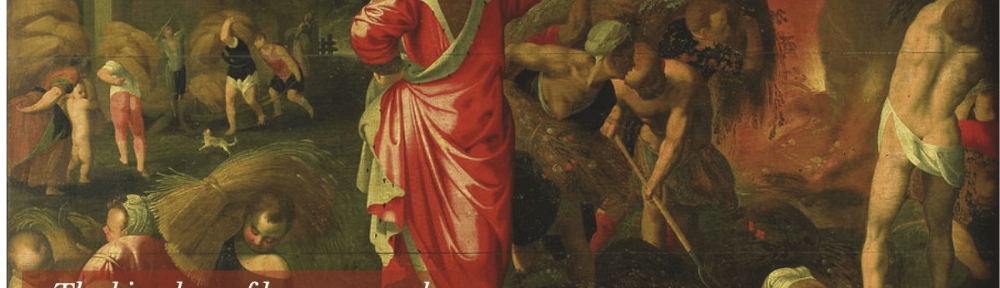
Image credit: Parable of the Weeds among the Wheat, attributed to Isaac Claesz. van Swanenburg, 1590 – 1610, Public Domain
Discover more from friarmusings
Subscribe to get the latest posts sent to your email.
 friarmusings