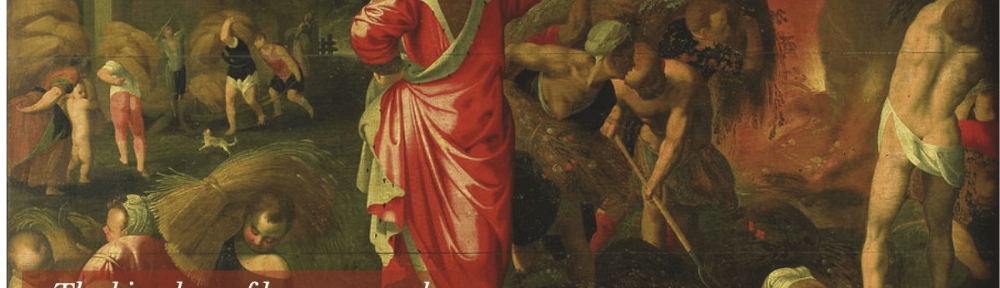
The “enemy came and sowed weeds all through the wheat.” We really should not be surprised. It’s the way it has always been. The “enemy” – a nice term for Satan, the devil and all the evil minions – are just doing what they have always done – offering us a choice.
In the Garden of Eden, humanity had it pretty good. Everything we could want. God came and walked with us in the cool of the afternoon. We were in communion with God. Imagine that, little ol’ us in communion with the one who is infinitely good, infinitely loving, infinitely just and so much more – and what God seeks is communion with us. God only asked one thing of Adam and Eve: eat of the tree of life, but do not eat of the Tree of the Knowledge of Good and Evil. Along comes the enemy to offer us a choice.
Adam and Eve could have chosen to remain in communion with God or they could grasp at control in order to decide what is good and what is evil; to set aside the moral compass that points to the goodness of God and have our own compass that points any way we choose. The enemy did not make anyone choose. The choice was ours. And so it remains today. The enemy is there hoisting up choices. And we hear it playing out in our thoughts, in what we tell others, or what others tell us. “It’s only a small thing.” “No one will ever know.” “What’s the harm?” “Don’t pretend you’re some holier-than-thou saint.”
I love the passage in the Gospel where Jesus quotes a Psalm: “I will open my mouth in parables, I will announce what has lain hidden from the foundation of the world.” Yup, since the foundation of the world we have been continually faced with the choice between the One who is Goodness and the source of all Good or giving in to the pursuit of some less good, or no good at all.
So when the enemy comes to sow weeds all through the wheat of our lives, the enemy is doing what he does – offering a choice. But in this gospel passage it’s not an easy this-or-that choice. Early on you can’t tell the difference between the baby wheat and the baby weeds. Later on when you can tell the difference the roots are all tangled up together, so if you try to uproot the weed, you’re pulling out wheat also. In the parable, Jesus is saying, this is the way the world will be: weeds and wheat together – because some will choose to be weeds and sow weeds throughout the kingdom. So, we are not to judge, but let it be and the harvester will take care of it: “collect the weeds and tie them in bundles for burning; but gather the wheat into my barn.”
I guess we have no choice in the matter. Doesn’t Matthew 7:1 say, “Stop judging, that you may not be judged”? True, in so far as it is not our role who decides who will be bundled for burning and who ends up in the barn. But we do have a choice. Consider Matthew 18: “If your brother sins [against you], go and tell him his fault between you and him alone.”
You are in that situation of choosing when you think or say, “I thought they were my friend.” “How could they do that to me?” You know what the gospel says – go and talk to him or her. Want for them exactly what God wants for you – community. This is when the enemy offers you choices: “It’s no big thing. Let it slide.” “Just ghost them.” “Cancel them!” If you are the one whispering this to another, perhaps you are unwittingly acting as the enemy’s minion … just saying… In any case, this is how the harmony between you and that person begins to erode and perhaps the harmony between that person and God is also eroding. What are we to do?
The first reading from the Book of Wisdom reminds us, as does the gospel, that in the end God’s justice to God’s self demands a reckoning. God is justice, power and might – as so the scribe reminds us: “For your might is the source of justice; your mastery over all things makes you lenient to all.” Lenient to all who call upon God. Lenient, clement, merciful, kind. This is the character of God so beautifully expressed in Exodus 34:6: “… a merciful and gracious God, slow to anger and rich in kindness and fidelity.” Fidelity – that loyal love.
But though you are master of might, you judge with clemency, and with much lenience you govern us; for power, whenever you will, attends you. And you taught your people, by these deeds, that those who are just must be kind; and you gave your children good ground for hope that you would permit repentance for their sins. (Wisdom 12:16-19)
Clemency, mercy, grace, loyal love, kindness, hope – all these things are offered to us when we choose wrongly, rejecting the moral compass of God and choosing our own designs. This is what we are keeping from the friend to whom we won’t engage and reorient them to God’s design. This is what we need to offer our friend in the words and the way we speak: mercy, loyal love, and kindness.
This is what is waiting for us when our own moral compass is misdirected. It awaits us in prayer! “But, Father, I’m not sure I know how to pray when I feel so far from God.” You, me and St. Paul:
The Spirit comes to the aid of our weakness; for we do not know how to pray as we ought, but the Spirit himself intercedes with inexpressible groanings. And the one who searches hearts knows what is the intention of the Spirit, because he intercedes for the holy ones according to God’s will. (Romans 8:26-27)
Pray for yourself, pray to know how to best approach that other person and know the clemency, mercy, grace, kindness and loyal love of God is right there with and for you.
Image credit: Parable of the Weeds among the Wheat, attributed to Isaac Claesz. van Swanenburg, 1590 – 1610, Public Domain
Discover more from friarmusings
Subscribe to get the latest posts sent to your email.
 friarmusings
Sometimes fate gives us no choices and is hard to control the surrounding. Faith helps.