This coming Sunday is the 17th Sunday in Ordinary Time. “Again, the kingdom of heaven is like a merchant searching for fine pearls. When he finds a pearl of great price, he goes and sells all that he has and buys it. Matthew apparently intends the parable of the treasure to be interpreted together with the parable of the pearl, which immediately follows. The two parables do have common features: (I) In each case only a brief vignette of a crucial situation is given, without enough details to evaluate them as realistic stories. The interpreter should, therefore, be wary of filling in the gaps from pious imagination, but concentrate on what the parable does, in fact, portray.
(2) The primary common feature is surely central to the meaning of each: The protagonist goes and sells everything for the sake of the one thing. This is the action of both the plowman and the merchant. This movement of the story as a whole is to be compared with the kingdom of God, for the kingdom is “like” neither the “treasure” of v. 44 nor the “pearl” of v. 45, but in each case somehow like the story as a whole. In each case, the protagonist acts with the single-minded response of the “pure in heart.” From the story in Mark 10:17-31, Matthew and his community had long known of the kingdom’s demand of “all,” and of one who had failed (cf. esp. Mark 10:21, where selling everything and giving it to the poor is connected with true “treasure”).
R.T. France [France, 2007, 541] notes that the two parables are also different: (1) The plowman is doing his regular work, not looking for or expecting anything special, when he comes upon the treasure quite by accident. The merchant is actively seeking, knows what he is looking for, and still finds something beyond all his expectations. The kingdom can become real in either way (cf. 9:2, 22). (2) The great joy of the plowman is emphasized, but is altogether absent from the merchant. This does not mean that the merchant’s selling everything in order to obtain the pearl was joyless, but it does mean that (subjective) joy is not the main point of either parable. (3) What the merchant did, although it may not have measured up to everyone’s understanding of common sense, was unquestionably legal. The same cannot be said of the plowman, whose action may have been questionable, both legally and morally (we are not given enough details to know for sure). The disposition of buried treasure found on someone else’s property was widely discussed in Roman legal discourse. Some of Matthew’s readers may have expected a law-abiding plowman to have reported his find to the owner of the field rather than cashing in on it himself. Sensitive contemporary readers may wonder about the ethics of cheating the owner of the field out of his treasure, even if it was perfectly legal. The story does not legitimize the man’s actions. Jesus was certainly able to use questionable actions of characters in his parables to picture the urgency of acting to gain the kingdom while the opportunity is there (cf. Matt 12:29’s use of breaking-and-entering imagery, and more subtly, Luke 16:1-13).
In the story of the pearl, there is no moral or legal question at all, but still a surprising and provocative action. In the first-century Mediterranean world, the pearl was often a symbol of the highest good (as diamonds sometimes are in modern Western culture). Thus salvation is pictured in the Gnostic “Hymn of the Pearl” as the finding and safe return of a pearl lost in an alien land. Some scholars see both the parable of the treasure and the parable of the pearl as advent/reversal/action, expressed in the parallel sets of verbs in vv. 44 and 45-46: finds/sells/buys.” The advent of the kingdom, sought for or not, brings about a reversal of values, leading to the crucial action that obtains the new. This action, puzzling and out of step with those who live by the old values, is central in each of these parables. [France, 2007, 541]
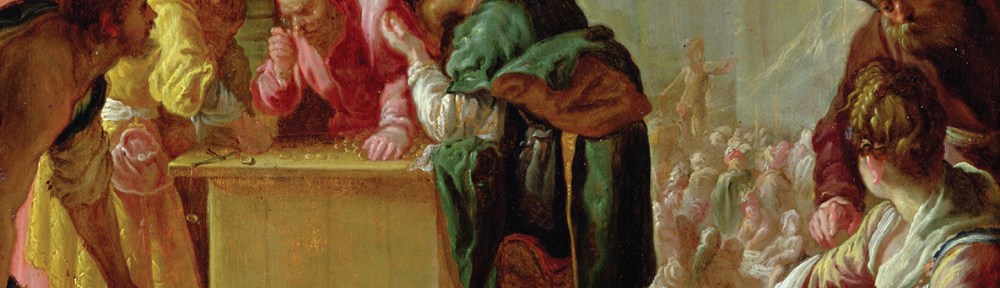
Image credit: The Pearl of Great Price, by Domenico Fetti, 17th century |Kunsthistorisches Museum Wien, Bilddatenbank | Public Domain
Discover more from friarmusings
Subscribe to get the latest posts sent to your email.
 friarmusings