In today’s first reading rebellious Israel finally crosses the point of no return… so to speak. If you have been following the first readings for daily Mass, you have seen the long brewing balance of Israel’ rebellion being met with God’s faithfulness. While still at the foot of Mt. Sinai they rebelled and wanted to know why God/Moses had brought them out into the dessert to die of hunger – plus there was the incident of the golden calf. God provided manna and quail.A year later as they prepared to leave Sinai, they are grumbling again – now tired to manna and quail. Moses reaches his breaking point and begins to rebel against what God asks of him – its all too much. Moses is tired of trying to manage and lead the hard-heart, recalcitrant people. God is faithful and provides Moses with 72 elders to help manage and lead the people.
In today’s reading their journey from Sinai has taken them to the edge of the promised land. Moses sends out 12 spies to gain intel on the land and the people. Caleb and Joshua’s witness was shouted down by the people who relied on the reports of the other spies: the land was inhabited by giants who could not be defeated.
“The LORD said to Moses and Aaron: ‘How long will this wicked assembly grumble against me? I have heard the grumblings of the children of Israel against me.'”
Our reading leaves out / skips over the grumbling – it is pretty severe:
All the Israelites grumbled against Moses and Aaron, the whole community saying to them, “If only we had died in the land of Egypt,” or “If only we would die here in the wilderness! Why is the LORD bringing us into this land only to have us fall by the sword? Our wives and little ones will be taken as spoil. Would it not be better for us to return to Egypt?” So they said to one another, “Let us appoint a leader and go back to Egypt.”(Num 14:2-4)
Sound familiar? In another set of verses skipped over, God tells Moses that he is going to start over raising a new people from the line of Moses. Again Moses intercedes on behalf of the people. Moses summarizes his request by asking that God forgive the iniquity of this people according to the greatness of the covenant love, just as Yahweh has forgiven them many times from Egypt until now (v. 19). Moses is pleading with Yahweh to preserve the covenant relationship that was made when Yahweh brought the people from Egypt. He thus appeals to Yahweh’s covenant faithfulness and at the same time recognizes Yahweh’s utter freedom to maintain or break off relationship with the people. The forgiveness that Moses asks is the preservation of relationship between Yahweh and the people, and the decision not to disinherit the present community by creating a new nation from Moses or from anyone else. Because Israel’s only existence is relationship with Yahweh, there is room for punishment that does not include dissolution of the covenant.
God answers Moses’ prayer by announcing forgiveness (v. 20), that is, the continuation of the fundamental covenant relationship that is the basis of Israel’s existence. But there is punishment also. In the strong language of an oath (v. 21) God asserts that those who rebelled will be denied entry into the land on account of their infidelity: “not one shall see the land which I promised on oath to their fathers”
The story displays the balance: God’s covenant promises, but God’s justice. The punishment keeps the people in Covenant, but justice is served as God fulfills their wish: they will not enter the land promised them. The whole generation that came from Egypt rejected the land, and so they are rejected from entering the land.
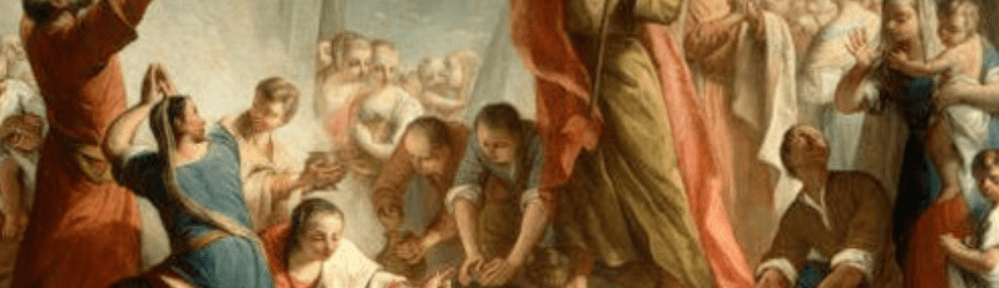
Image credit: The Manna Harvest / Giuseppe Angeli c. 1768, San Eustachio Church, Venice, Italy | Public Domain
Discover more from friarmusings
Subscribe to get the latest posts sent to your email.
 friarmusings