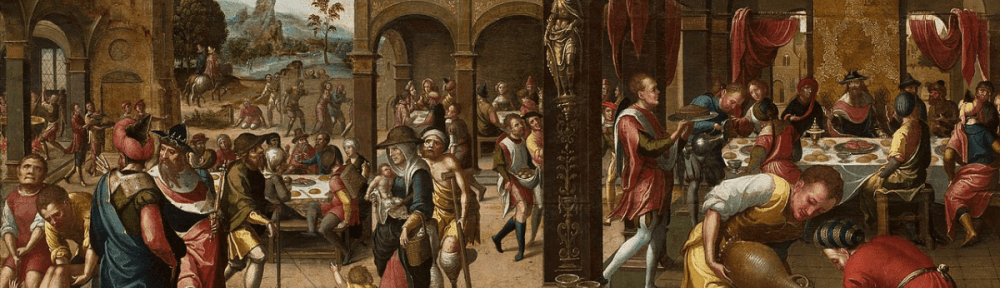
This coming Sunday is the 28th Sunday of Ordinary Time. Among the various sources of Christian tradition, this parable of the wedding banquet has been preserved in three distinct versions. The simplest rendering of the parable can be found in the non-canonical Gospel of Thomas. In this version, the parable consists of a series of refusals to a dinner. Each of the guests who begged off did so for reasons of business or commerce. Consequently the host sent servants into the streets to bring back whomever they could find. Luke’s version of the parable (Luke 14:16-24), also preserves the reversal motif and bears evidence of the evangelist’s conviction that the poor, outcasts, those otherwise marginalized from society will find a welcome in the kingdom.
However, when Matthew’s rendering of this parable is compared to these other sources, there are several obvious differences. The main portion (vv. 1-10) of the parable is offered as an allegorical presentation of salvation history. The host has become a king (God) who was preparing a wedding banquet (symbol of kingdom) for his son (Jesus). The two groups of servants were probably representative of the Hebrew prophets and the Christian apostles, whereas the invited guests who repeatedly refused the king’s invitation and brutalized the servants were intended to portray Israel. People from the byroads represented the gentiles to whom the gospel was also to be extended.
In verse seven, the parable takes a strange twist; the city of the guests is destroyed. Starting a war while the meal is prepared and on the table strains even the wide range of flexibility allowed to parables. Add to that the mention of the burning of the murderers’ city – especially in the light of the Lucan tradition of the story and we begin to suspect something added from Matthew’s community – or something Luke thought to omit Most scholars believe that the Matthean community and evangelist were referencing the destruction of Jerusalem which occurred in 70 C.E. at the hands of Titus and the Roman army. Matthew projected this event back into this parable of Jesus. By so doing he was simply updating the history of salvation as it had unfolded by the time his gospel reached its final form in the mid-80s C.E.
Matthew makes this story the climax of the progression of this three-parable set: The first of the triad, the parable of the two sons (21:28–32), focuses on the (more than a) prophet John; the second, the parable of the lord’s vineyard given to others (21:33–46), pictures the whole prophetic line climaxing in Jesus, the Son who is killed. This third parable is understood from Matthew’s own post-Easter perspective, facing the parousia and final judgment. This final parable thus follows the perspective in picturing the history of salvation from the original calling of Israel to the last judgment, and places Jesus and the church in the succession of Israel’s prophets, persecuted and rejected by Israel.
The parable has the same audience as the preceding one except that now he specifically includes the Pharisees. Matthew’s insertion of “again” (palin, or “once more”) connects the parable to the preceding one as well, as do all the points we noted above. This means that the Matthean meaning cannot be derived from the parable alone, but only from the narrative structure of which it is now an integral part.
Image Credit: Parable of the Great Banquet by Brunswick Monogrammist (circa 1525) National Museum, Warsaw | Public Domain
Discover more from friarmusings
Subscribe to get the latest posts sent to your email.

